
WEEX Labs: Gold & Silver Hit New Highs, Is Bitcoin's Safe-Haven Narrative Losing Its Luster?

From early 2025 through today, gold and silver prices have soared relentlessly, shattering one historical high after another, while Bitcoin has slipped into a volatile downtrend. Its much-touted "digital gold" label now seems to be gathering dust on this flight to safety.
But this story is far from over—2026 may yet deliver a dramatic twist.
Note: You can trade gold (XAUT/USDT), silver (XAG/USDT), and Bitcoin (BTC/USDT) on WEEX.
Gold & Silver Surge: Sovereign Assets Enter a "Gilded Age"
Per the latest data, gold surged 65% in 2025, effortlessly breaching the $4,000 threshold. In 2026 alone, it has climbed further to $4,800—its strongest performance in nearly four decades. Silver’s catch-up rally has been even more staggering: a 141.4% annual gain, marking its biggest leap since 1979.
Traditional inflation-hedge narratives fall short here. The real catalyst? A paradigm shift. As we saw in February 2022 when $300 billion of Russia’s FX reserves were frozen during the Ukraine invasion, central banks worldwide received a brutal wake-up call: Assets that are someone else’s liabilities—like U.S. Treasuries or bank deposits—can be zeroed out overnight in extremis.
While such "black swan" events were once outliers, today’s toxic cocktail of U.S. fiscal instability, whiplash tariff wars, fiat devaluation fears, and eroding Fed independence has turned tail risks into mainstream concerns. Sovereigns and institutions are now front-running this reality, hoarding gold as their armor of choice.
The numbers speak volumes: Global central banks bought over 600 metric tons of gold in 2025 (per World Gold Council), lifting gold’s share of official reserves to 25–27%. With 2026 purchases projected at 840 tons, the PBOC has led the charge—adding gold nonstop since 2022 to amass 74.15 million ounces (~2,300 metric tons) by December 2025.
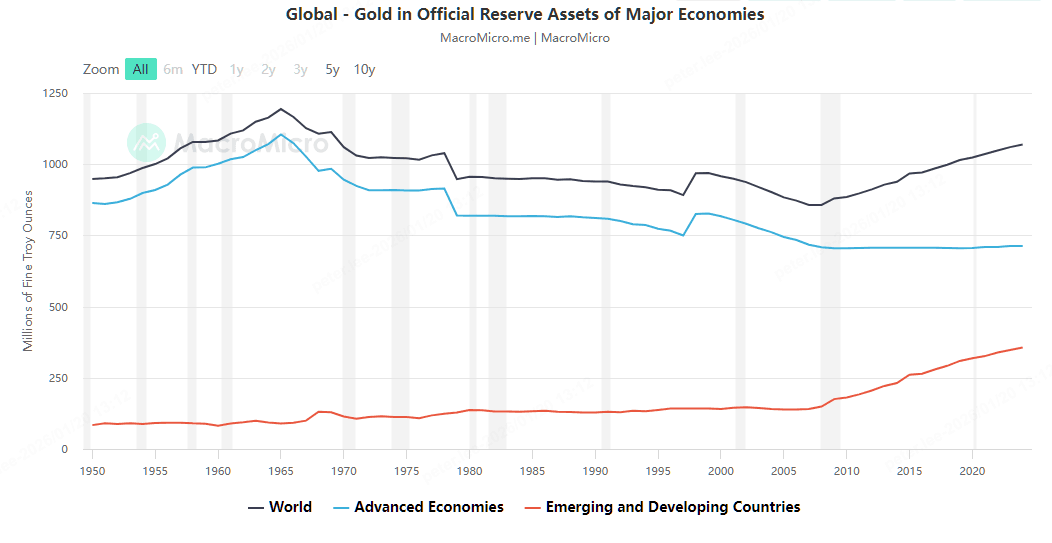
Emerging economies surge in gold purchases
Silver follows a similar—but more industrial—logic. As macro analyst Luke Gromen explained when shifting to silver late last year: Its supply is rock-stiff. Even if prices double, new mines take 5–7 years to come online—while solar and EV demand soars.
Is Bitcoin’s "Digital Gold" Narrative on Ice?
Meanwhile, Bitcoin peaked at $126,000 last October before rolling into a technical bear market. As of this writing, it remains trapped in a grinding downtrend—a stark contrast to precious metals’ fireworks.
As shown above, the Bitcoin/Gold ratio has plummeted from its 2024 peak of 40 to below 20 today—with no bottom in sight.
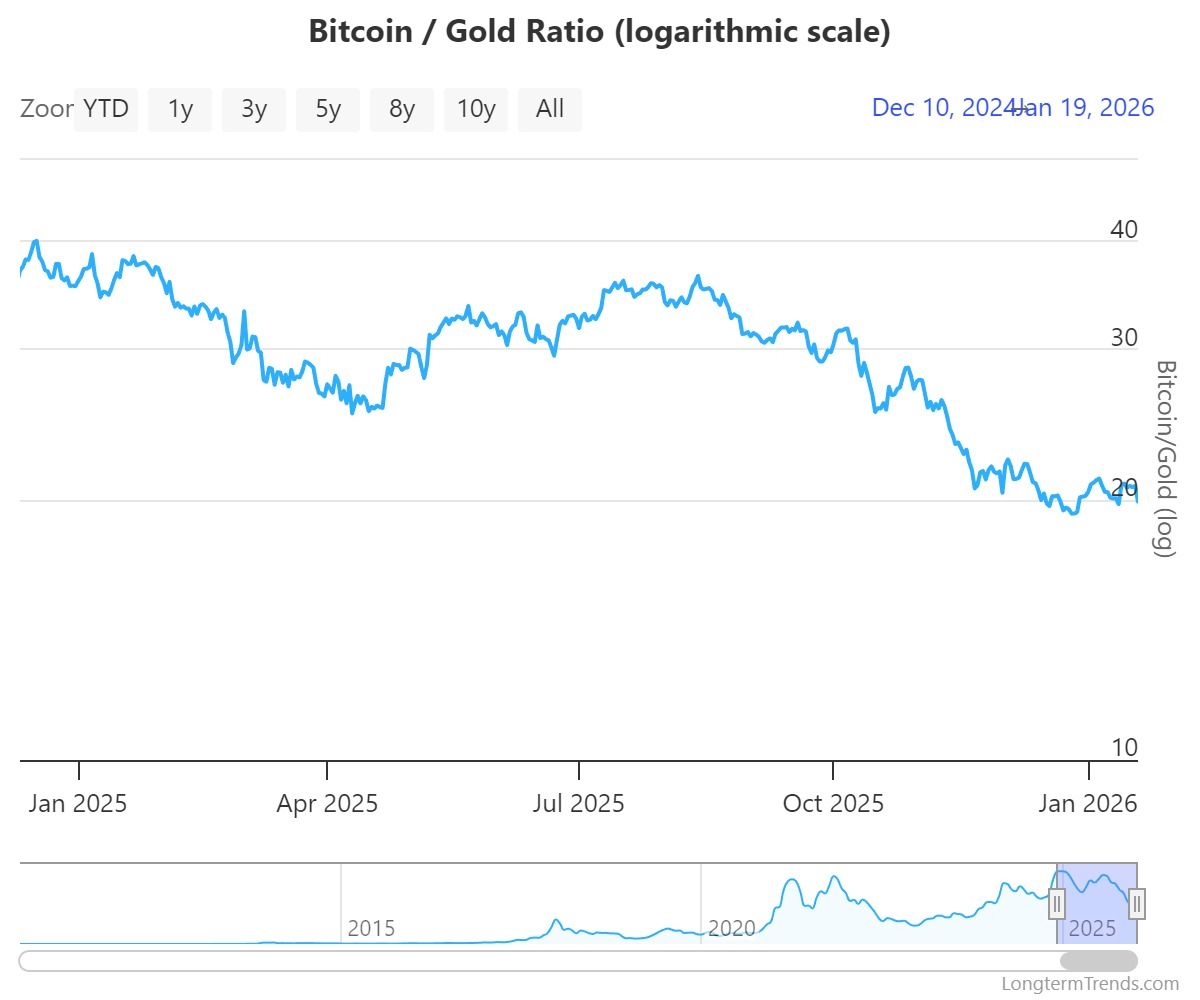 BTC GOLD Rate hits new lows">
BTC/GOLD hits new lows https://www.longtermtrends.com/bitcoin-vs-gold/
This divergence has given gold bull Peter Schiff ample ammunition. Tweeting recently, he quipped: "Bitcoin’s failure to match gold’s gains undermines its narrative as digital gold, resulting in a spectacular crash."
Why didn’t Bitcoin ride the same macro wave?
In my view, the core distinction is structural vs. cyclical. Gold and silver are riding an enduring geopolitical realignment; Bitcoin’s swings remain tied to its halving cycle (now widely debated) and liquidity tides.
Deeper context matters: As deglobalization and great-power rivalry intensify, trust in dollar assets is fraying. Central banks aren’t just fighting inflation—they’re re-engineering reserves for a sanctions-prone world. Naturally, sovereigns flock to gold—a $14 trillion market with millennia of trust. Bitcoin, by contrast, lives and dies by leveraged crypto-native capital: retail speculators, hedge funds, and prop shops. Crucially, per IMF data, central banks hold less than 0.1% of global Bitcoin reserves. Until sovereigns step in, "digital gold" remains a promise—not a reality.
Can Bitcoin stage a gold-like breakout?
Bitcoin's safe-haven narrative hasn't budged—limited supply, inflation hedge, decentralization, easy portability, and hack-resistant. While broader sovereign adoption remains elusive for now, its edge in portability, divisibility, and transparency is unmatched. At the same time, the relentless rally in gold and silver prices has cracked open the ceiling for Bitcoin's long-term potential.
Zooming in on Bitcoin itself, from late 2022 through October last year, it rode a three-year bull run, underscoring how its value is steadily being unlocked. Slipping into a consolidation phase now isn't out of left field—after a three-year surge, Bitcoin often cools off for 12-18 months (think 2018 or 2021), and this pattern aligns perfectly with its historical ups and downs.
Heading into 2026, gold and silver's momentum might hold strong, but Bitcoin isn't backed into a corner. With the Fed's measured rate cuts and progress on U.S. crypto market structure laws, Bitcoin—and the broader crypto ecosystem—will toughen up even more. Its real shot at glory isn't about aping gold, but forging deep ties with traditional finance via RWA (Real World Assets), PayFi, stablecoins, and the like, reshaping its story as a premier store of value.
On a brighter technical note, history shows that gold often pulls ahead of Bitcoin at liquidity inflection points—digital asset research firm Delphi Digital pegs it at about 3 months, while BitWise's research lead André Dragosch puts it at 4-7 months. Either way, once gold wraps up repricing safe-haven demand, currency debasement and fiscal strains will linger on, setting the stage for Bitcoin's big breakout. When gold and silver's "safe-haven premium" starts spilling over, Bitcoin's higher volatility typically amps up the reaction—history doesn't lie.
As illustrated in the chart below, taking a straight-line view of Bitcoin's correlation with gold suggests its rally might be better late than never. That said, this is just one lens on the market.
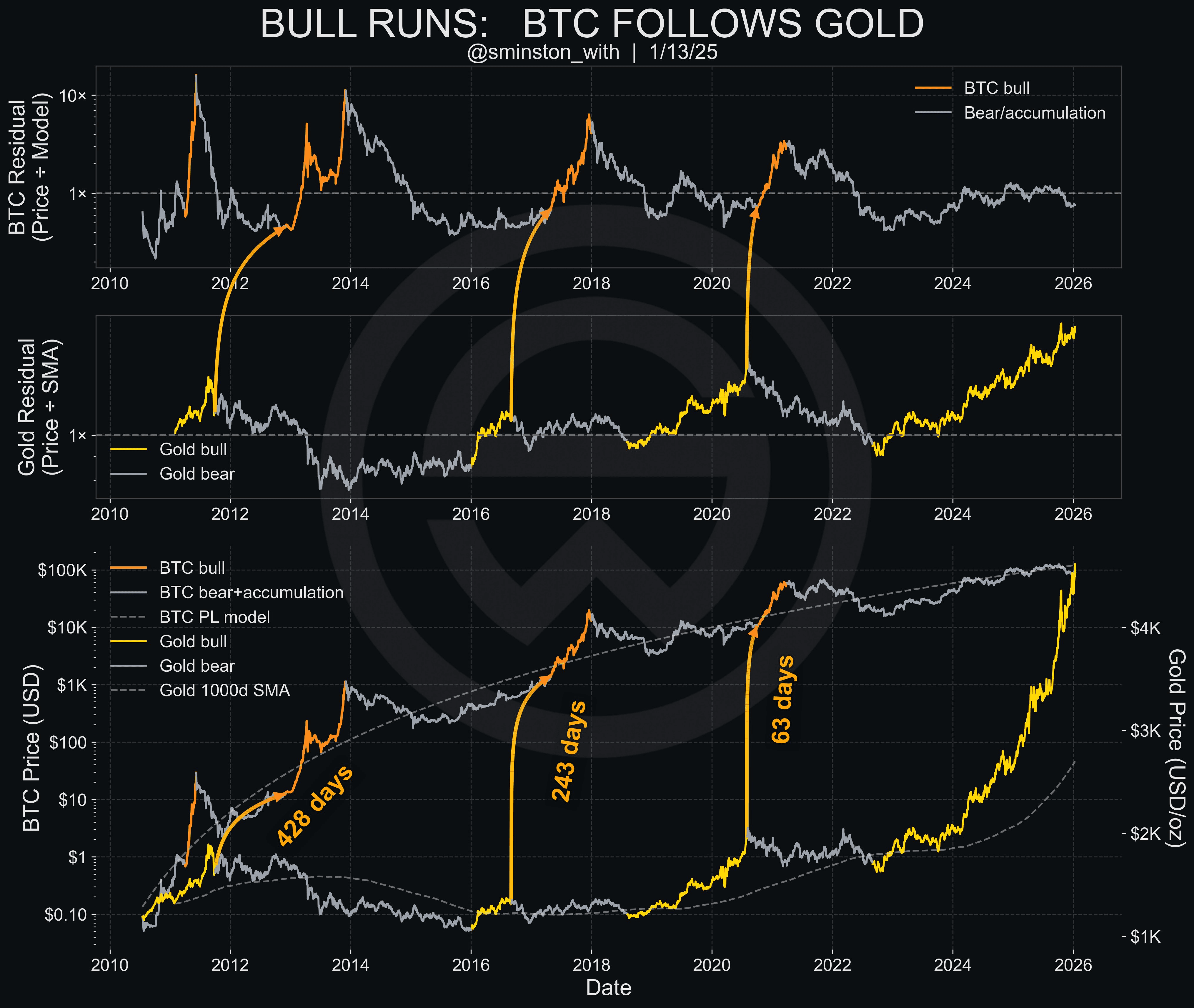
Bitcoin's rallies always follow gold's https://x.com/sminston_with/status/2011148322934063137
All in all, while gold and silver's record highs lay bare the cracks in Bitcoin's safe-haven pitch, they also tee up a chance for a fresh narrative. In 2026's backdrop of rebounding liquidity expectations, Bitcoin's current "gathering steam" could forge a powder-keg bottom, redefining its "digital gold" crown under a new era of seamless system integration.
You may also like

Crunch Time for the CLARITY Act: What’s in Store for Crypto?
Tokenized Stocks 101: When the World's 7+3 Most Valuable Companies Become Crypto's Underlying Assets
Amid the boom in stablecoin investments, which stablecoins are worth keeping an eye on?
How the Three Most Valuable IPOs of 2026 Will Ignite a New RWA Narrative?
51% Attacks Explained: How Blockchains Get Rewritten
With the World Cup hype building, which tokens are worth keeping an eye on?
With OpenClaw taking the world by storm, what can the Agentic economy bring to Web3?
Conflict Escalates, Oil Prices Moon: How Will Crypto React?
Is Ethereum Still King in 2026? How Ethereum and Layer2 Are Reshaping the Crypto Ecosystem
US-Iran Tensions Boil Over: How War Rewires the Crypto Market
BTC Approaches $60K: Crypto Isn't Dead, It's Just Filtering the Noise
What Just Happened Referring to Decoding Crypto's Latest Plunge
WEEX Labs: Is the Much-Hyped “Supercycle” Finally Upon Us?
WEEX Labs: Is the Chinese Meme Coin Craze Really Now?
How to Buy Cryptocurrency on WEEX Exchange 2026: Full Guide
Prediction Market Apps 2026: How Prediction Markets Work? Are They Safe and Legal?
Is Polymarket Legal in India in 2026? Key Legal Updates on Prediction Markets
14 Best Prediction Market Apps in 2026: The Ultimate Guide to Crypto-Native and Regulated Platforms
Crunch Time for the CLARITY Act: What’s in Store for Crypto?
Tokenized Stocks 101: When the World's 7+3 Most Valuable Companies Become Crypto's Underlying Assets
Amid the boom in stablecoin investments, which stablecoins are worth keeping an eye on?
How the Three Most Valuable IPOs of 2026 Will Ignite a New RWA Narrative?
51% Attacks Explained: How Blockchains Get Rewritten
With the World Cup hype building, which tokens are worth keeping an eye on?
Contents
Popular coins


