
WEEX Crypto Gift: The Perfect Gift for Every Crypto Lover in 2025

By: WEEX|2025-11-04 00:00:00
0
Share
copy

WEEX is excited to introduce the Crypto Gift feature, bringing the fun of “grabbing red packets” to the crypto world. Now, you can easily send assets to friends as gifts in just seconds—whether for New Year wishes, celebrations, or spontaneous raffles. With Crypto Gift, simply select between Standard or Random options, set the amount, portions, and claim rules, then share via link or QR code. The best part? No fees, no hassle—just instant transfers. Let Crypto Gift be your bridge to surprise, joy, and shared fortune with those who matter most.

This guide covers what Crypto Gift is, its key highlights, how to use it, and common FAQs.

What is Crypto Gift?

Crypto Gift allows users to create and send multi-claim “crypto red packets” using USDT or WXT. The sender can configure the Crypto Gift type, total amount, number of portions, basic parameters, personalized settings, and advanced settings, then share via link or QR code. When a red packet is claimed, the corresponding amount is instantly credited to the recipient’s account. Any unclaimed amount after expiry is automatically returned to the sender’s account.WEEX Crypto Gift: The Perfect Gift for Every Crypto Lover in 2025
Highlights of Crypto Gift

1.Two allocation modes for different experiences

  • Standard Crypto Gift: The total amount is evenly divided by the number of portions—simple and fair.
  • Random Crypto Gift: The system allocates the amount of each portion randomly, more intriguing and engaging.

2.USDT and WXT are now supported.

3.Advanced settings include claim conditions, such as only new users can claim, or only users who registered via a specific invite link can claim.

4.Easy sharing, wide reach: One-tap copy to share links on social or communities; also supports claiming via QR codes.

5.Instant settlement, smooth experience: Once claimed, funds are automatically credited to the recipient’s account with no waiting.

How to send and claim a Crypto Gift

Web

1.Sending tutorial

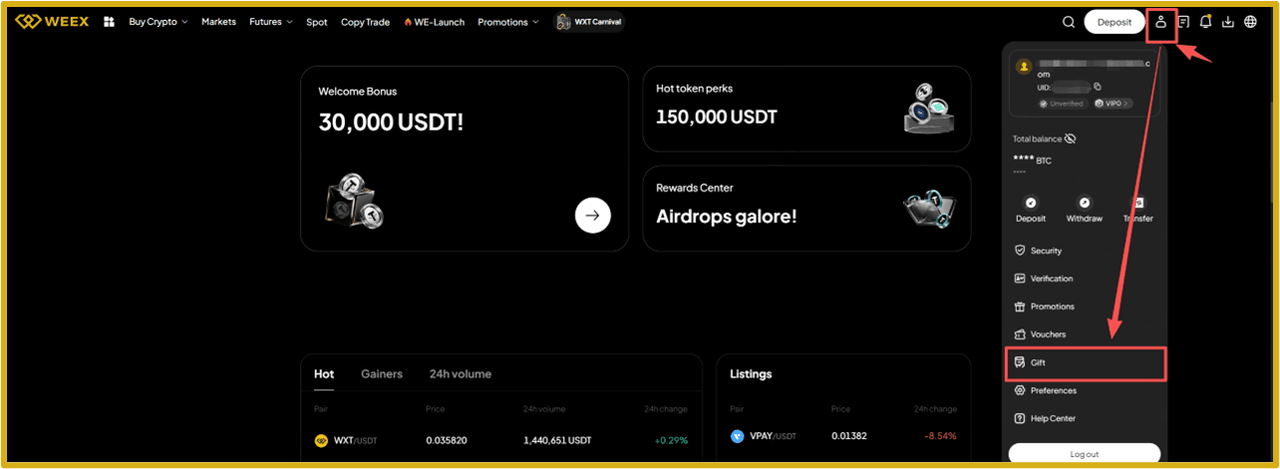
I. While logged in, click “Gift” in the profile menu. You can also go directly via: https://www.weex.com/en/redpacket
WEEX Crypto Gift(2).PNG

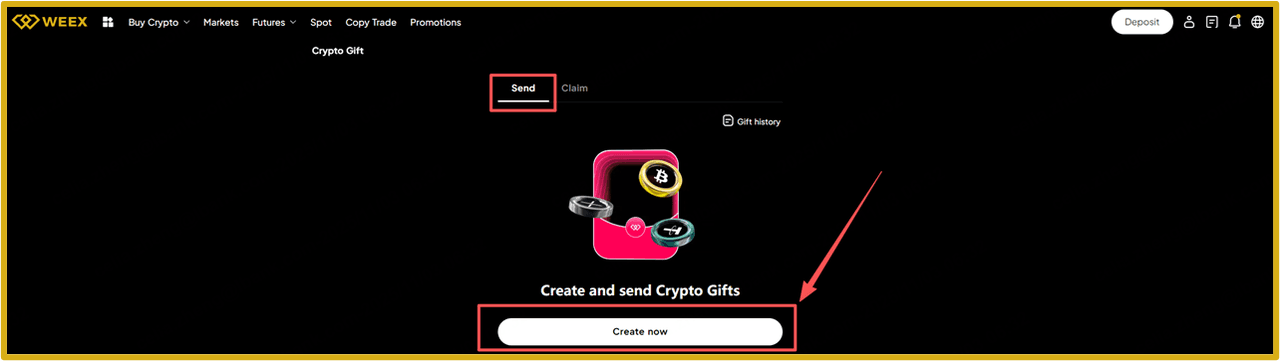
II.Select the “Send” tab and click “Create now” to open the Crypto Gift creation page.
WEEX Crypto Gift(3).PNG

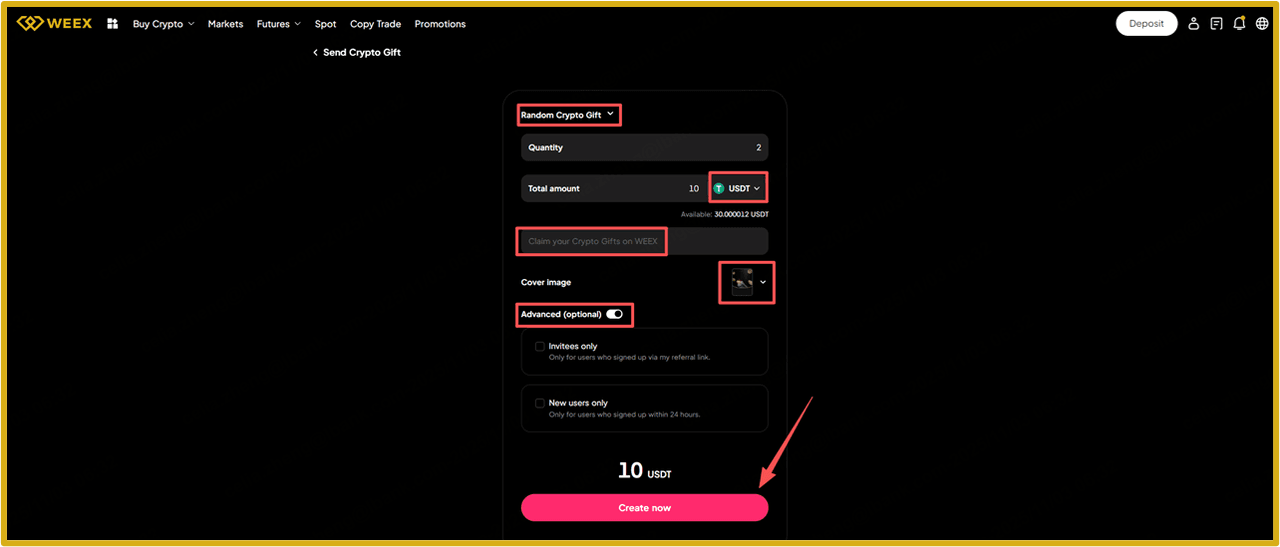
III. Then you can set the Crypto Gift type, basic parameters, personalization settings, and advanced settings. Click "Create Now" at the bottom to finish creation.
WEEX Crypto Gift(4).PNG

IV. Now your Crypto Gift is created successfully. Share it with friends via a QR code or link.
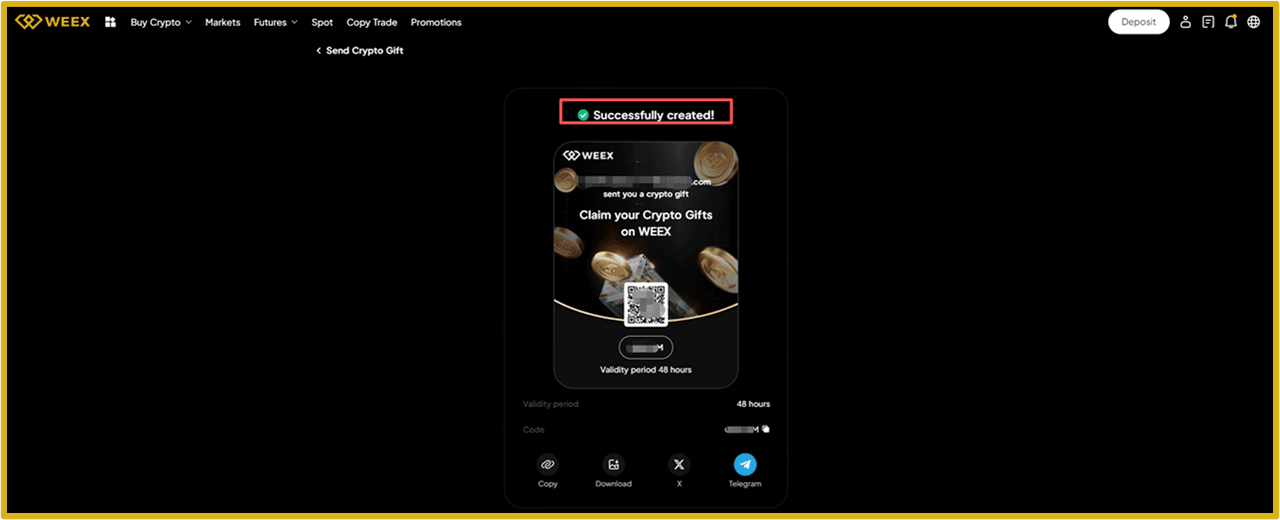
WEEX Crypto Gift(5).PNG

2.Claiming tutorial

I. On the Crypto Gift page, enter the Crypto Gift Code and tap “Claim”.
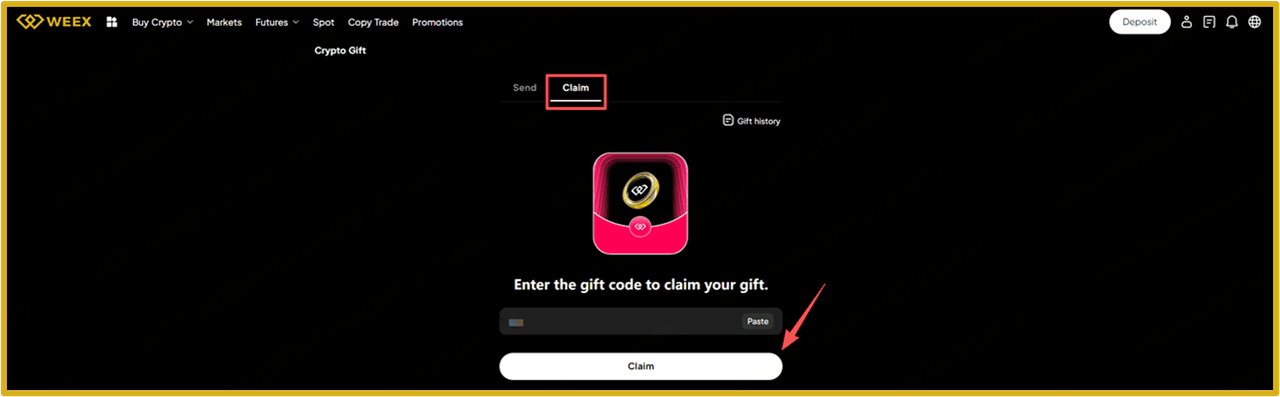
WEEX Crypto Gift(6).png

II.As shown below, once claimed successfully, funds are automatically credited to your account.
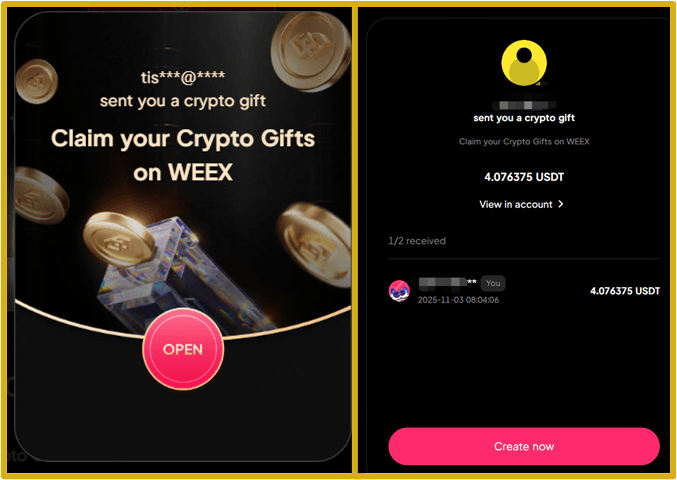
WEEX Crypto Gift(7).png

App

1.Sending tutorial

I. While logged in, go to Homepage and tap the top-right icon to enter the profile menu.

II. In the profile menu, tap “Gift” to open the Crypto Gift page.

III. Select the “Send” tab and click “Create now” to open the Crypto Gift creation page. Tap the top-right icon to view your Crypto Gift history.

IV. Then you can set the Crypto Gift type, basic parameters, personalization settings, and advanced settings. Click "Create Now" at the bottom to finish creation.

V. Now your Crypto Gift has been created successfully. Share via a QR code or link with your friends.
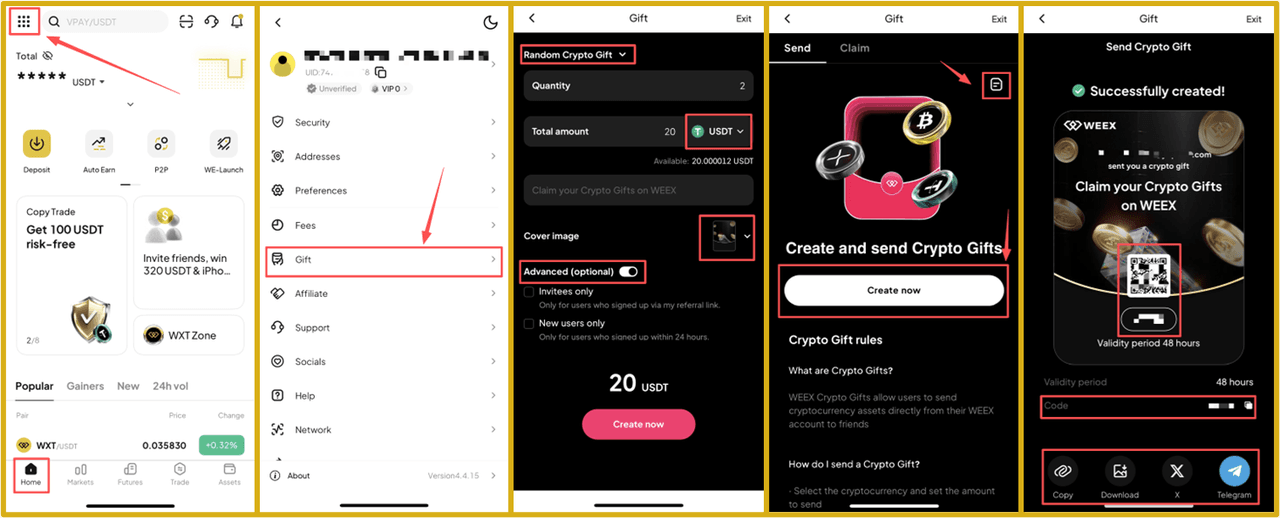
WEEX Crypto Gift(8).png

2.Claiming tutorial

I. On the Crypto Gift page, enter the Crypto Gift Code and tap “Claim” to receive.

II. As shown below, once claimed successfully, funds are automatically credited to your account.
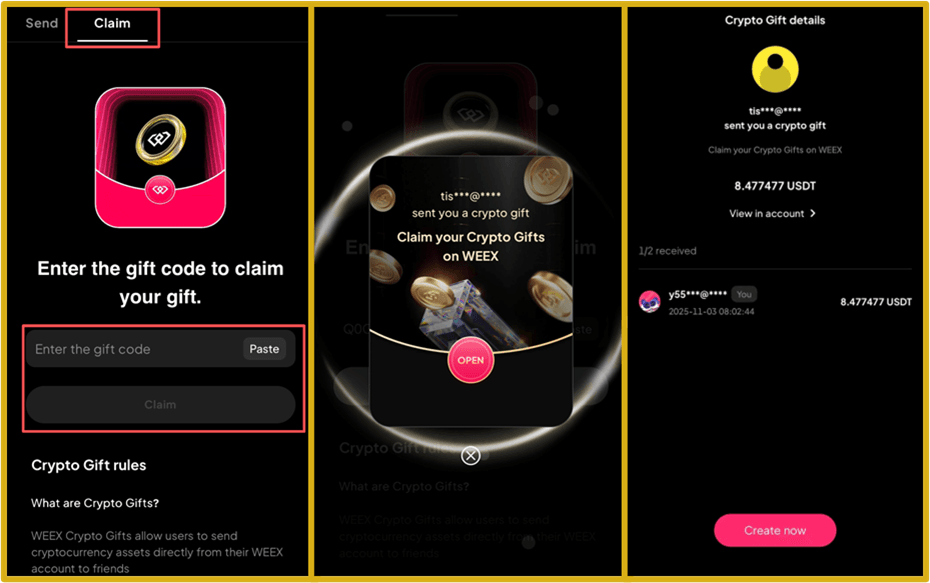
WEEX Crypto Gift(9).png

-- Price

--

FAQ

1.What does it mean when funds are "frozen" while sending a gift? Does it affect my trading?

The gifted amount is temporarily frozen to ensure that the Crypto Gift is valid. Once the gift is sent, the corresponding funds are deducted from your available balance and locked. These frozen funds cannot be used for trading or other operations until the gift is fully claimed. If the gift expires or is not fully claimed, the remaining funds will be unlocked and returned to your available balance.

2.Can I cancel a Crypto Gift after sending it?

Unfortunately, a Crypto Gift cannot be recalled once it's created and shared. You can wait for 24 hours before the unclaimed asset is returned to your account.

3.Why can't I claim a Crypto Gift after scanning the QR code?

There may be several reasons:

i. Crypto Gift fully claimed: All funds in the gift have already been claimed.

ii. Already claimed: Each user can only claim once per gift.

iii. Not eligible: The sender may have restricted the gift to "new users only" or "invited friends only."

iv. Expired: The 24-hour validity period has passed.

v. Network or app issue: Check your internet connection or try restarting the app.

4.Where can I view the funds I've claimed?

Once claimed, the funds are instantly credited to your account. You can view the balance changes under "Assets" → "Spot Account" for the received crypto asset.

5.Are there any restrictions on sending or claiming Crypto Gifts?

The platform has set limits on the maximum crypto amount per gift and the number of gifts a user can send per day to ensure fund security. Refer to the instructions on the page for the exact limits.

6.Where do the funds go when a Crypto Gift is returned? Where can I find it?

Expired or unclaimed funds are unfrozen and returned to your "Spot Account." Check your "Spot Account" instead of your "Funding Account."

7.What if my gift link or code is leaked?

Crypto Gifts are non-targeted by default. We recommend using the advanced settings to restrict claim eligibility for future gifts (such as invited friends only). For sent gifts, you'll need to wait for the 24-hour validity period to end. Any unclaimed funds will then be automatically returned to your account.


Related Reads

WEEX Voucher Center: Your All-in-One Voucher Hub

Get Up To 100% APR On WEEX Auto Earn USDT

You may also like

What Is Polymarket? A Beginner's Guide to Decentralized Prediction Markets

What Is Polymarket?

You have seen election odds on news sites. Ever wondered where those numbers come from? A chunk of them come from Polymarket.

So what is Polymarket exactly? It is a prediction market. But not the kind you are used to. It runs on blockchain. No casino. No sportsbook. Polymarket does not set its own odds. Instead, thousands of regular users trade shares on things that actually happen in the real world — politics, sports, finance, pop culture. The price you see? That is just the crowd's best guess.

You buy "Yes" or "No" shares on a question. Get it right, each share pays out 1. Get it wrong, you get 1. The price moves every time new information drops.

This guide walks through how Polymarket works, is Polymarket legal, the benefits of Polymarket, and the risks nobody talks about.

What Makes Polymarket Different From Traditional Betting?

Here is the real difference.

A traditional bookmaker sets the odds. Then they bake in a "house edge" — guaranteed profit for themselves. A casino? Same idea. The house wins over time. That is how they stay in business.

Polymarket does not work that way.

Every single trade on Polymarket is peer-to-peer. You buy shares from another user, not from the platform. When you see a "Yes" share priced at $0.65, that means the market collectively thinks there is a 65% chance the event happens.

No house. No hidden edge. Just real people betting their own money on what they believe.

How Polymarket Works

To really understand what is Polymarket, you need to look at three moving pieces: trading mechanics, blockchain settlement, and market resolution.

Trading and Order Books

Polymarket uses a central limit order book (CLOB). Same system stock exchanges use. You have two options:

Place a limit order: Name your price, then wait for someone to take it.Take an existing order: Buy or sell at whatever the best current price is.

Most markets are simple Yes or No. Share prices run from 0.01 up to 1.00.

The order book shows every pending buy and sell order. When news breaks — a poll update, an injury report, a surprise earnings number — traders react instantly. Prices move in real time.

Blockchain and USDC Settlement

Polymarket lives on Polygon. That is a fast, cheap network built on top of Ethereum. All trades use USDC, a stablecoin tied one-to-one with the US dollar.

Why does this matter for regular people?

Every trade gets recorded on-chain. Anyone can go verify it.Users hold their own funds in their own wallets. No middleman.No exchange sitting on your money between trades.

But here is the catch. You control your own security. Lose your wallet keys or get hacked? Your funds are almost certainly gone forever. No customer support line to call.

Polygon gas fees are tiny. But if you trade constantly, those tiny costs add up over time.

Is Polymarket Legal?

This question comes up constantly: is Polymarket legal?

In United States history:

2022: Polymarket got hit with a $1.4 million fine from the CFTC. The charge? Operating without proper registration.December 2025: That changed. Polymarket received CFTC approval to come back to the US market through a regulated Designated Contract Market (DCM) structure via QCX LLC.

Outside the US: Rules are all over the map. Some countries welcome prediction markets. Others ban them completely. Singapore and Thailand, for instance, keep tight restrictions.

Note: remember to check your local laws before using Polymarket. This is an educational introduction, not legal advice.

Benefits of Polymarket

So what are the actual benefits of Polymarket compared to traditional platforms?

BenefitWhat It MeansNo house edgePeer-to-peer means no built-in platform advantageReal-time sentimentPrices move as news breaks — live crowd opinionTransparencyEvery trade lives on-chain. Anyone can verifyWide market selectionPolitics, sports, crypto, finance, culture, weatherSelf-custodyYou hold your own money until settlement

Academic research backs this up. Liquid prediction markets often outperform traditional polls and even expert forecasters. They pull together diverse opinions, reward people who actually know what they are talking about, and update instantly when new information arrives.

Risks to Know Before Using Polymarket

No platform is perfect. Polymarket has real risks.

Market risk: You can lose every dollar you put into a wrong position. That is true for any trading.Low liquidity: Unpopular markets might not have enough buyers or sellers. Getting in or out at a fair price becomes hard.Oracle disputes: Sometimes market wording is unclear. Or something unexpected happens. That can trigger disputes and delay payouts for days.Smart contract risk: Polymarket runs on code. Bugs and exploits happen — even on platforms that have been audited.Wallet security risk: Self-custody sounds great until you lose your seed phrase or get phished. Recovery is nearly impossible.Regulatory risk: Laws change. A platform that is legal today might face restrictions tomorrow.

Only put in money you can afford to lose. This is not financial advice. Just common sense.

Polymarket vs. Traditional Betting: Quick ComparisonFeaturePolymarketTraditional SportsbookWho sets the odds?The crowd (buyers and sellers)The house (bookmaker)House edge?None. Peer-to-peer.Built-in. Always.TransparencyOn-chain. Anyone can verify.Private. You trust them.SettlementSmart contract + oracleCentralized authorityCustodyYour wallet. Your keys.Platform holds your funds.Market typesPolitics, sports, finance, cultureMostly sportsConclusion

Polymarket is not gambling in the traditional sense. Call it a market. A place where people buy and sell opinions on what happens next.

The platform gives you transparency, no house edge, and a real-time look at crowd sentiment. But it also carries real risks: market loss, low liquidity, regulatory uncertainty, and smart contract vulnerabilities.

For anyone still asking "what is Polymarket" or "is Polymarket legal," here is the honest answer. It is a powerful tool for aggregating information. But it is not risk-free. Understand how it works. Protect your wallet. Check your local laws before jumping in.

FAQQ: What is Polymarket?

A: Polymarket is a decentralized prediction market on Polygon. Users trade Yes/No shares on real-world events. Prices show crowd-sourced probabilities.

Q: Is Polymarket legal in the US?

A: As of December 2025, yes — with conditions. Polymarket received CFTC approval to operate through a regulated Designated Contract Market (QCX LLC). Before that, it had been restricted since a 2022 fine.

Q: Is Polymarket legal in my country?

A: That depends on where you live. Laws vary a lot by jurisdiction. Check your local regulations before using any prediction market platform.

Q: How does Polymarket work without a house?

A: Every trade is peer-to-peer. Buyers and sellers set prices through an order book. The platform never takes the opposite side of your trade.

Where Are the Market Opportunities in the AI Supercycle?

Since the start of 2026, U.S. stocks have continued to strengthen amid a convergence of factors, including the materialization of interest rate cut expectations, resilient corporate earnings, and loose liquidity.

The core driver behind all of this is, without a doubt, AI.

However, the market’s trading focus has undergone a structural shift. Currently, capital is making forward-looking bets on the comprehensive expansion of AI infrastructure from “computing” to “storage” and “networking.”

The Comprehensive AI Bull Market: From Computing Power to Storage

Since ChatGPT burst onto the scene in late 2022, NVIDIA has consistently dominated the boom in AI infrastructure.

However, after NVIDIA surpassed a $5 trillion market capitalization on April 24, 2026, the returns from simply chasing the computing leader have significantly diminished.

Market capital is now beginning to delve into those segments that were invisible yet indispensable during the early stages of AI development. Behind this shift lies a structural opportunity in the AI industry chain investment landscape:

Layer 1: Computing Core Layer (GPUs/AI Accelerators)

Representatives: NVIDIA (NVDA), AMD (AMD), Intel (INTC)Rationale: The “brain” of AI training and inference remains at the top of the value chainCurrent Status: NVIDIA’s valuation already reflects growth over the next 2–3 years; AMD and Intel are catching up and experiencing a catch-up rally

Layer 2: Infrastructure Support Layer (Storage/Memory/Networking/Energy, etc.)

Key Players: Micron (MU), SanDisk (SNDK), Seagate (STX), Western Digital (WDC), etc.Rationale: AI inference requires massive storage; HBM (High Bandwidth Memory) is the performance bottleneck for GPUs; fiber-optic networks connect everythingCurrent Status: The hottest sector in 2026, with valuations expanding rapidly

Layer 3: Platform and Application Layer (Cloud Service Providers/Enterprise Software)

Representatives: Microsoft (MSFT), Google (GOOGL), Amazon (AMZN), Meta (META), etc.Rationale: The endpoints that convert AI computing power into commercial valueCurrent Status: Heavy capital expenditure phase; profit margins are under short-term pressure but hold immense long-term potential

If we compare AI to the electricity revolution, then 2023–2024 represents the design and production phase of generators—corresponding to GPU chips—while 2026 marks the phase of laying the power grid, which aligns precisely with the infrastructure of the second layer mentioned above.

This narrative shift is indeed supported by similar industrial logic:

The paradigm shift from training to inference: Training AI models is a one-time investment, but inference is an ongoing process. Inference places far greater demands on storage capacity, read/write speeds, and memory bandwidth than the training phase.Supply-demand mismatch creates pricing power: Gartner notes that DRAM prices are expected to rise by 125% by 2026, and “any meaningful price relief is not expected until late 2027” . Scarcity = pricing power = margin expansion.Oligopolistic market structure: The storage industry is highly concentrated, with SanDisk, Seagate, and Western Digital controlling the majority of the market; the competitive environment is more favorable than that of the GPU market.Storage Sector: Four Major Storage Stocks Accelerate Their Uptrend

The storage/memory segment has become the most certain and resilient hotspot in current AI infrastructure. The following are the most closely watched representative stocks in the storage sector:

Micron Technology (MU)

As of the date of this report, Micron has a market capitalization of $847 billion. It is one of only three global DRAM giants and a core supplier of high-bandwidth memory (HBM) for AI.

Core Businesses: DRAM (79% of revenue), NAND flash storageKey Products: HBM (High Bandwidth Memory) for AI GPUs, DDR5 for data center serversPerformance: Q1 FY2026 revenue of $13.64 billion (YoY +57%), with cloud memory business nearly doubling and gross margin reaching 66%. Management guidance projects Q2 revenue of $18.7 billion and a median EPS of $8.42; analysts expect FY2026 EPS to reach $57.10, rising further to $95.65 in 2027.

Trade MUON/USDT now

SanDisk (SNDK)

As of the date of this report, SanDisk has a market capitalization of approximately $200 billion. Since its spin-off from Western Digital in 2025, the company has emerged as a pure-play NAND flash player and has become the undisputed leader in enterprise-grade SSDs and high-performance storage for AI data centers.

Core Business: NAND flash storage (led by data center/enterprise SSD business)Key Products: High-capacity enterprise-grade SSDs and QLC flash platforms for high-throughput hot data storage in AI data centersFinancial Results: FY2026 Q3 total revenue of $5.95 billion (YoY +251%, QoQ +97%), gross margin of 78.4%, and adjusted EPS of $23.41 (YoY +approx. 278%), significantly exceeding market expectations of $14.50. Data center business revenue reached $1.467 billion (up 233% quarter-over-quarter, up 645% year-over-year). Analysts project full-year FY2026 revenue to exceed $20 billion, with EPS approaching $100.

Trade SNDKON/USDT Now

Western Digital (WDC)

Market cap: approximately $195 billion. After spinning off the SanDisk business by the end of 2025, the company will focus on enterprise-class storage following the separation from the flash memory business in 2025.

Core Business: Enterprise-class mechanical hard drives (accounting for approximately 89% of revenue), cloud data center storage solutionsKey Products: High-capacity nearline hard disk drives (Nearline HDD), ePMR and UltraSMR platforms for massive data archiving and cold storage in AI data centersPerformance: Q2 FY2026 revenue of $3 billion (YoY +25%), with the cloud business contributing 89%; Non-GAAP gross margin expanded to 46.1% (up 770 bps YoY), with EPS reaching $2.13 (up 78% YoY). Management guidance projects Q3 revenue of $3.2 billion (±$100 million), with gross margin further improving to 47%-48%.

Trade WDCON/USDT Now

Seagate Technology (STX)

As of the date of this report, Seagate Technology has a market capitalization of approximately $130 billion. It is the undisputed global leader in HDD storage and one of the most critical suppliers of massive-capacity storage for AI data centers.

Core Business: HDD storage (primarily data center-focused)Key Products: High-capacity hard drives based on the Mozaic HAMR platform, used for massive data storage following AI training/inference and cloud archivingFinancial Results: Q3 FY2026 revenue of $3.11 billion (YoY +44%), with data center business revenue of $2.5 billion (+55%); Non-GAAP gross margin hit a record high of 47.0%, with diluted EPS at $4.10 (up 115% YoY). The company guides Q4 revenue at $3.45 billion (±$100 million), with operating margin expected to exceed 40%.

Trade STXON/USDT Now

What Opportunities Remain in the AI Supercycle?

The storage sector has taken over from computing power as the current main driver of AI. Although some observers argue that the storage sector’s valuation expansion has entered its latter stages—or even that an AI bubble is re-emerging—the sector’s fundamentals remain solid. Storage has moved beyond the traditional semiconductor cycle and is evolving into a “foundational asset” of AI infrastructure, with a high degree of certainty regarding its compound growth.

The three key industry factors underpinning this assessment remain valid:

The supply-demand gap will persist at least through 2027: Gartner notes that “any meaningful price relief is not expected until late 2027.”Capital expenditures by hyperscale clients are still accelerating: Meta and Microsoft’s capital expenditure guidance far exceeds market expectations.The era of AI inference has only just begun: Current AI infrastructure primarily serves training, while the large-scale deployment of inference lies ahead.

From the perspective of the AI industry chain, new opportunities are emerging downstream of the storage sector:

Downstream: Liquid cooling—As AI chip power consumption continues to rise, NVIDIA’s Blackwell architecture has already designated liquid cooling as a mandatory requirement. Stocks in data center infrastructure related to energy consumption and thermal management are poised for a catch-up rally.Upstream: Energy and materials—A recent research report from Bank of America notes that commodities and materials stocks represent the most explosive growth opportunities in the current sector rotation.At the application layer: Monetization of AI agents — 2026 marks the first year of realization: Anthropic’s revenue is projected to surge to $30 billion, and the AI agent market is expected to exceed $9 billion.

In summary, the storage sector in 2026 is positioned at a critical juncture in the evolution of AI infrastructure from a “computing power core” to a “memory and scheduling core.”

As computing power continues to expand, the true bottlenecks will progressively shift downstream—from liquid cooling, packaging, and testing, to energy infrastructure and application-layer software. The full narrative of the AI supercycle is unfolding, and storage may be the first leg to cross the finish line in this marathon.

WEEX Copy Trading vs Bitget Copy Trading: Which is Better 2026?

What Is Copy Trading, and How Does It Work?

Copy trading does exactly what the name suggests: you copy another trader's moves automatically.

You pick an experienced trader on a platform. You decide how much money to allocate. When that trader opens a position, your account opens the same position. When they close, you close. You pay them a percentage of your profit. You do not need to read charts. You do not need to understand support and resistance. The platform handles the execution.

Is Copy Trading a Good Idea?

This depends on what you are trying to achieve. Copy trading solves specific problems. You do not have time to study charts. You keep making emotional mistakes like panic selling. You want exposure to strategies you do not understand yet.

But copy trading also introduces new risks. You are trusting another person with your money. Past performance does not guarantee future results. And leverage amplifies losses just as much as gains.

When to consider copy trading:

You have a small account and want to learn from experienced tradersYou lack time for daily market analysisYou struggle with emotional trading decisionsIs Copy Trading Profitable?

This is the question everyone asks. The answer requires separating platform capability from trader performance.

Some copied traders are profitable. Most are not over long timeframes. Data from various platforms suggests that fewer than 30% of lead traders maintain positive returns after six months.

That does not mean copy trading is a scam. It means you need to choose your lead traders carefully.

What to look for in a profitable lead trader:

MetricWhat to Look ForWin rate50-70% is solid. Above 80% is suspiciousMaximum drawdownBelow 30% is saferTotal tradesAt least 100+ closed tradesActive durationAt least 3-6 months

WEEX's platform shows all these metrics upfront. You can see maximum drawdown before committing a single dollar .

WEEX Copy Trading vs Bitget: The Key DifferencesAccount Structure and Risk Isolation

WEEX recently completed a major upgrade to its copy trading system. The core change: full isolation between copy trading and personal trading.

WEEX now uses a three-account structure:

Account TypePurposeFutures AccountYour personal manual tradingCopy AccountFollowing elite traders' strategiesElite AccountLead traders executing their strategies

Each account runs independently with separate margin, risk, and profit/loss calculations .

This matters more than most traders realize. On platforms without isolation, your copy trading positions can eat up margin needed for your personal trades. One losing copy trade could trigger liquidation on an unrelated position you opened yourself.

Bitget also offers some isolation. Their copy trading system uses a dedicated copy trading account separate from the main account . And their newer CFD copy trading product uses independent MT5 accounts with asset risk isolation .

But Bitget's isolation is product-specific rather than platform-wide. You get isolation within each copy trading feature, but the overall account structure is less unified than WEEX's three-account approach.

Minimum Investment and Accessibility

Bitget's copy trading minimums vary by product:

Futures/spot copy trading: Minimum copy amount of 50 USDTCFD copy trading: 50 USDT minimum for followers, 100 USDT minimum for lead traders

WEEX does not publish a fixed minimum on their landing page, but emphasizes flexibility: "Set your own trading pairs, leverage mode, investment amount, and risk control settings" .

The takeaway: Bitget has clearer published minimums (50 USDT). WEEX emphasizes customizable parameters without hard minimums.

Profit Sharing and Fees

WEEX profit-sharing ratios typically range from 5-13%, depending on the lead trader. Standard trading fees apply on top, and all costs are disclosed upfront .

Bitget offers higher potential payouts for lead traders. Their profit sharing follows the High Water Mark (HWM) model, where lead traders earn only from new profits generated. Maximum profit share can reach 30% for top traders .

Bitget's base futures fees: 0.02% maker / 0.06% taker .

Which is better? Higher profit share attracts better lead traders. But no minimum guarantee means lead traders must perform consistently to earn anything. The HWM model is more fair to followers but less attractive to lead traders.

Why WEEX Copy Trading Stands Out

Three specific advantages make WEEX worth a closer look.

Full Position Isolation

The March 2026 upgrade to WEEX's copy trading system created separate accounts for every type of trading activity. Your copy trades cannot accidentally liquidate your personal positions. Your personal wins and losses do not affect your copy trading performance.

Bitget offers isolation, but typically requires you to use their separate CFD accounts or dedicated copy trading sub-accounts. WEEX's three-account structure is simpler and more consistent .

Transparent Lead Trader Data

WEEX shows everything. Win rate. Drawdown. Trade count. Active duration. Assets under management. Profit-sharing ratio. All before you click copy.

Bitget provides data but across multiple dashboards. Their elite trader center shows follower counts, retention rates, and profit leaderboards . The information exists. It just takes more clicks to find.

Which Platform Should I Choose?

Choose WEEX copy trading if:

You want clear separation between copy trading and personal tradingYou value transparent risk metrics before committing fundsYou are a beginner who wants spot copy trading optionsYou prefer simpler, more unified account structures

Choose Bitget copy trading if:

You want access to CFDs (forex, gold, oil, indices)You are a lead trader seeking higher profit share (up to 30%)You already use Bitget for other productsYou understand how to navigate multiple product dashboards

For most retail crypto traders, WEEX offers the cleaner, more transparent experience. The full isolation between accounts is a genuine safety feature that Bitget cannot match with their current product-specific structure.

Conclusion

WEEX and Bitget both offer legitimate copy trading products. WEEX wins on risk isolation, transparency, and beginner-friendly spot options. Bitget wins on product range and potential lead trader payouts.

Neither platform will make you rich overnight. Copy trading is a tool, not a shortcut. The platform you choose matters less than the lead traders you follow and the risk management you practice.

If you decide to start, allocate a small amount first. Copy multiple traders with different styles. Monitor performance weekly. And always remember: past performance does not guarantee future returns.

Ready to start copy trading? Sign up on WEEX Now and Start Trading!

FAQWhat is copy trading on WEEX?

Copy trading on WEEX lets you automatically mirror the trades of experienced lead traders in real time.

Is copy trading profitable on WEEX?

Profitability depends entirely on which lead traders you copy.

Can I copy multiple traders on WEEX?

Yes. WEEX allows you to copy multiple lead traders simultaneously.

Which is safer: WEEX copy trading or Bitget copy trading?

WEEX offers stronger account isolation with their dedicated three-account structure, which prevents copy trading positions from affecting personal trading margin. Bitget provides product-specific isolation but has a more fragmented account structure overall.

How to Trade Crude Oil Futures on WEEX: Complete 2026 Guide

Oil moves when markets sleep. OPEC announces a cut at 3 AM. A report drops on a Sunday. By Monday morning, crude oil futures have already gapped 5%.

That is the problem with traditional oil futures. Exchange hours. Limited access. No weekends.

WEEX solves this. You can trade crude oil futures 24/7, just like crypto. This guide walks you through everything—what crude oil futures are, how to trade them on WEEX, and the risks you need to manage.

What Are Crude Oil Futures?

Crude oil futures are contracts to buy or sell a specific amount of oil at a fixed price on a future date. They are the backbone of global energy trading.

On WEEX, you trade a perpetual contract called CLUSDT. It tracks the price of crude oil but never expires. All profits and losses settle in USDT.

Here is the simple version. You are not buying barrels of oil. You are betting on price direction. Up? Go long. Down? Go short.

Why Trade Crude Oil Futures on WEEX?

Traditional oil futures have limits. WEEX removes most of them.

1. 24/7 trading

No waiting for NYMEX or ICE to open. Trade through weekends. Trade at 2 AM. Trade whenever news breaks.

2. Leverage

WEEX offers up to 100x leverage on crude oil futures. Standard brokers offer 10-20x at best.

3. Low minimums

Traditional oil futures require large contract sizes. On WEEX, you start small.

How to Trade Crude Oil Futures on WEEX: Step-by-Step

Here is exactly how to trade crude oil futures on WEEX.

Step 1: Create a WEEX Account

Go to the official WEEX website. Click Sign Up. Complete registration and verify your email.

Step 2: Fund Your Futures Account

Navigate to Wallet → Transfer. Move USDT from your Spot account to your Futures account. You cannot trade futures with spot balance directly. CLUSDT requires USDT margin.

Step 3: Find the CLUSDT Contract

Go to the Futures trading page. Search for CLUSDT in the pair search bar. You can also find it under the Commodities or TradFi category.

CLUSDT is the ticker for WEEX crude oil perpetual futures.

Step 4: Choose Your Margin Mode

WEEX defaults to Isolated Margin for new users. Keep it that way.

Isolated Margin: Risk is limited to one position. Your oil trade will not affect your other futures positions.Cross Margin: Margin is shared across all positions. Advanced users only.Step 5: Set Your Leverage

WEEX offers up to 100x leverage for crude oil futures.

For beginners: Start at 5x or 10x. Crude oil can move 3-5% in a single session. At 20x, a 5% move wipes out your position.

Click the leverage button, slide to your chosen multiplier, and confirm.

Step 6: Place Your Order

Two options:

Long (Buy): You expect crude oil price to go upShort (Sell): You expect crude oil price to go down

Enter your position size. Minimum is small—fractional contracts available.

Before confirming, set your:

Take Profit (TP): Price where you lock in gainsStop Loss (SL): Price where you cut losses

Never enter a crude oil futures trade without both.

Step 7: Confirm and Monitor

Click Buy/Long or Sell/Short to open your position.

Check the Positions panel at the bottom of the screen for:

Unrealized profit/lossLiquidation priceCurrent margin used

You can add more margin at any time to avoid liquidation.

Step 8: Close Your Position

When you are ready to exit, click the Close button on your open position. Or let your take profit order close it automatically.

Crude Oil Futures Risk Management

Oil is volatile. Add leverage and 24/7 trading, and risks multiply.

Leverage risk: At 50x leverage, a 2% move against you causes liquidation. That is a normal daily move for crude oil.

Gap risk: Even with 24/7 trading, major news can cause sudden price spikes. Stop losses may not fill perfectly.

Geopolitical risk: OPEC decisions. Middle East tensions. Supply disruptions. Oil reacts fast to world events.

How to stay safe:

Start with 2-3x leverage, not 50xUse stop-loss orders on every tradeNever risk more than 2% of your account per tradeStick to isolated margin modeWatch oil inventory reports (Wednesdays) and OPEC newsConclusion

Crude oil futures on WEEX give you something traditional brokers cannot: 24/7 access, high leverage, and fractional trading. The CLUSDT perpetual contract tracks oil prices without expiration hassles.

But oil is not crypto. It has its own drivers. Supply reports. Geopolitics. OPEC. Do your homework before trading.

Start small. Use 2-3x leverage. Set stop losses. Never risk money you cannot afford to lose.

Ready to trade? WEEX offers zero fees, instant execution, and the security you need. Sign up on WEEX Now and Start Trading!

FAQDoes WEEX offer crude oil futures?

Yes. WEEX offers crude oil perpetual futures under the ticker CLUSDT. You can trade 24/7 with up to 100x leverage.

How to trade crude oil futures on WEEX?

Create a WEEX account, transfer USDT to Futures, search CLUSDT, set leverage (up to 100x), choose long or short, set TP/SL, and confirm.

What is the ticker for crude oil futures on WEEX?

CLUSDT. It is a USDT-margined perpetual contract tracking crude oil prices.

What leverage can I use for crude oil futures on WEEX?

WEEX offers up to 100x leverage for CLUSDT. Beginners should start with 5x or 10x.

Can I trade crude oil futures 24/7 on WEEX?

Yes. Unlike traditional exchanges, WEEX crude oil futures trade 24 hours a day, 7 days a week.

How to Trade Tesla (TSLA) Futures on WEEX: Complete Guide for 2026

Tesla stock moves fast. Really fast. One Elon tweet. One delivery report. One earnings call. The price can swing 10-15% before traditional markets even open. That is where TSLA futures come in.

On WEEX, you can trade Tesla futures 24/7. Not just during Nasdaq hours. Not just Monday through Friday. Any time. Any day. This guide walks you through exactly how to trade Tesla futures on WEEX, what the risks are, and why you might choose futures over traditional TSLA shares.

What Are Tesla Futures?

Tesla futures are derivative contracts that track the price of Tesla Inc. (TSLA) shares on the Nasdaq. On WEEX, the ticker is TSLAUSDT. It is a USDT-margined perpetual contract.

You are not buying actual Tesla stock. You do not get voting rights. You do not receive dividends. Instead, you are trading a contract that mirrors TSLA's price movement. All profits and losses settle in USDT.

The concept is simple. If you think Tesla price will go up, you go long. If you think it will go down, you go short.

Tesla Futures vs. Traditional Tesla Stock

Why trade TSLA futures instead of just buying shares on a broker?

FeatureTraditional TSLA StockTSLA Futures on WEEXTrading hoursNasdaq hours (9:30 AM - 4:00 PM ET, Mon-Fri)24/7, including weekendsShort sellingDifficult (borrowing required)Easy (click short)LeverageNone or limitedUp to 5xMinimum investmentOne full share (~$175-200)0.01 TSLA (fractional)DividendsYesNoVoting rightsYesNo

The biggest difference? Time. Traditional markets close. WEEX does not.

If Tesla announces something at 2 AM on a Saturday, TSLA futures traders can react immediately. Stock holders wait until Monday.

Benefits of Trading Tesla on WEEX Exchange

WEEX offers TSLAUSDT futures with several advantages.

1. 24/7 market access

This is the main reason traders choose crypto exchanges for stock exposure. No waiting for Nasdaq to open.

2. Fractional trading

Minimum trade size is 0.01 TSLA. You do not need 200togetstarted.200togetstarted.2 is enough.

3. Leverage up to 50x

Amplify your exposure with smaller capital. But remember—leverage cuts both ways.

4. Low fees

WEEX keeps costs competitive. Check the current fee schedule for TSLAUSDT.

Isolated margin by default. Your Tesla position does not affect your other crypto futures trades.

Risk Management for TSLA Futures

Tesla is volatile on its own. Add leverage and crypto-style trading hours, and risk multiplies.

Leverage risk: WEEX offers up to 50x on TSLA futures. At 50x leverage, a 20% drop against your position wipes out your entire margin. That is called liquidation.Volatility risk: Tesla has dropped 15% in a single day before. Multiple times. Combine that with after-hours news, and losses can stack fast.

How to stay safe:

Use stop-loss orders on every tradeStart with 2x or 3x leverage, not 5xNever risk more than 2% of your account per tradeStick to isolated margin mode as a beginnerHow to Trade Tesla (TSLA) Futures on WEEX: Step-by-Step

Here is exactly how to trade Tesla futures on WEEX.

Step 1: Create a WEEX Account

Go to the official WEEX website. Click Sign Up. Complete registration and verify your email.

Step 2: Fund Your Futures Account

Navigate to Wallet → Transfer. Move funds from your Spot account to your Futures account. You cannot trade futures with spot balance directly. USDT is required for TSLAUSDT.

Step 3: Find the TSLAUSDT Contract

Go to the Futures trading page. Search for TSLAUSDT in the pair search bar. You can also find it under the TradFi category.

Step 4: Choose Your Margin Mode

WEEX defaults to Isolated Margin for new users. Keep it that way.

Isolated Margin: Risk is limited to one position. Your Tesla trade will not affect your other futures positions.Cross Margin: Margin is shared across all positions. Advanced users only.Step 5: Set Your Leverage

WEEX offers up to 50x leverage for TSLA futures.

For beginners: Start at 2x or 3x. Do not max out leverage just because it is available.

Click the leverage button, slide to your chosen multiplier, and confirm.

Step 6: Place Your Order

Two options:

Long (Buy): You expect Tesla price to go upShort (Sell): You expect Tesla price to go down

Enter your position size. Minimum is 0.01 TSLA.

Before confirming, set your:

Take Profit (TP): Price where you want to lock in gainsStop Loss (SL): Price where you cut losses

Never enter a futures trade without both.

Step 7: Confirm and Monitor

Click Buy/Long or Sell/Short to open your position.

Check the Positions panel at the bottom of the screen for:

Unrealized profit/lossLiquidation priceCurrent margin used

You can add more margin at any time to avoid liquidation.

Step 8: Close Your Position

When you are ready to exit, click the Close button on your open position. Or set a take profit order and let it close automatically.

TSLA Futures Trading Tips

Follow Tesla news closely. Delivery numbers. China production. Cybertruck updates. Elon tweets. All of it moves the price.

Watch Nasdaq hours even though you trade 24/7. Most volume and volatility still cluster around the US market open.

Do not over-leverage. 5x leverage on a stock that moves 5-10% daily is riskier than it sounds.

Use smaller position sizes on weekends. Liquidity can be thinner. Moves can be weirder.

Conclusion

Trading Tesla futures on WEEX is straightforward. The contract tracks TSLA price. You can go long or short. You trade 24/7 with leverage.

But straightforward does not mean easy. Tesla is volatile. Futures add leverage. Leverage amplifies losses.

Start small. Use 2x leverage. Set stop losses. Trade fractional sizes. And never risk money you cannot afford to lose. WEEX gives you the tools. The rest is up to you.

Ready to trade? WEEX offers zero fees, instant execution, and the security you need. Sign up on WEEX Now and Start Trading!

FAQWhat are Tesla futures on WEEX?

Tesla futures are USDT-margined perpetual contracts that track the price of TSLA stock. You trade price movements, not the actual shares.

How to trade Tesla futures on WEEX?

Create an account, transfer USDT to Futures, search TSLAUSDT, set leverage (up to 5x), choose long or short, set TP/SL, and confirm.

Can I short Tesla on WEEX?

Yes. Unlike traditional brokers, WEEX allows short selling with one click.

Is TSLA futures trading available 24/7?

Yes. WEEX offers Tesla futures trading 24 hours a day, 7 days a week, including weekends.

What leverage can I use for TSLA futures?

WEEX offers up to 50x leverage for the TSLAUSDT contract. Beginners should start with 2x or 3x.

What if I invested $10,000 in Tesla 5 years ago?

If you'd invested $10,000 in Tesla stock five years ago, you'd be sitting on nearly $138,600 now.

DeFi vs TradFi: Which is Better for You?

You've seen the word "TradFi" thrown around crypto Twitter. Usually followed by someone calling it outdated. Or slow. Or broken.

But here's the thing: TradFi moves trillions of dollars every single day. Banks. Stock exchanges. Insurance companies. Pension funds.

Love it or hate it, you still use it. So what does TradFi meaning actually cover? And how does it compare to DeFi? Let's break it down without the buzzwords.

What Is TradFi?

TradFi stands for Traditional Finance. It's the system you grew up with. Banks hold your money. Brokers execute your stock trades. Regulators oversee everything. Central banks print currency and set interest rates.

The whole system runs on centralized control and intermediaries. Every transaction involves at least one middleman—usually more. And every player answers to some government regulator. When someone says "the financial system," they mean TradFi.

How Traditional Finance Works

Let's walk through a simple example. You want to send $100 to a friend in another city.

In TradFi, you log into your bank app. The bank deducts 100fromyouraccount.Thenitsendsamessagetoyourfriend′sbankthroughaclearingsystemlikeACHorSWIFT.Yourfriend′sbankfinallyadds100fromyouraccount.Thenitsendsamessagetoyourfriend′sbankthroughaclearingsystemlikeACHorSWIFT.Yourfriend′sbankfinallyadds100 to their account. Three days later, the money settles. Not instant. And at least two banks made money off your simple transfer.

That's TradFi. Slow. Safe for the most part. But absolutely full of middlemen taking cuts at every step. Now apply this to stocks, bonds, loans, or insurance. Same pattern. Intermediaries everywhere. Each one adding delay and extracting fees.

DeFi vs TradFi: The Core Difference

DeFi, or Decentralized Finance, removes the middlemen entirely. No bank. No broker. No clearinghouse. Just code running on a blockchain.

Here's how the two systems compare side by side:

FeatureTradFiDeFiControlCentralized (banks, governments)Decentralized (code, token holders)AccessRequires KYC, approvalPermissionless (wallet only)SpeedDays for settlementMinutes or secondsIntermediariesMany (banks, brokers, clearinghouses)None (smart contracts)RegulationHeavyLight or noneCustodyBank holds your moneyYou hold your keysDowntimeBusiness hours only24/7/365

TradFi keeps everything centralized. Your bank controls your money. The government backs it with insurance. But you wait days for settlements and can only trade during business hours.

DeFi flips this. Anyone with a wallet can participate. No approval needed. Transactions settle in minutes or seconds. The system never sleeps. But there's a catch: if you send funds to the wrong address, that money is simply gone. No customer support line. No chargeback button.

The trade-off is clear. TradFi is slower and more expensive, but you have recourse when something goes wrong. DeFi is faster and cheaper, but you assume full responsibility for your own mistakes.

TradFi vs DeFi: Which is Better?

Neither. They solve completely different problems.

TradFi wins when you need:

Consumer protection (fraud disputes, chargebacks)Stability (FDIC insurance, central bank backing)Large institutional capital (pension funds, corporate treasuries)Regulatory clarity (you know the rules)

DeFi wins when you need:

Speed (settle in minutes, not days)Access (no bank account? No problem)Transparency (anyone can audit the code)Control (you hold your own assets)

Here's the reality most people miss: you'll probably use both. Your paycheck hits a TradFi bank account. You move some to DeFi for better yield or faster trading. Then you transfer back to TradFi to pay rent and buy groceries. That's not a battle. That's the future.

What Is TradFi and DeFi Together?

Here's where things get interesting. Major TradFi institutions aren't ignoring crypto—they're already using blockchain infrastructure behind the scenes.

BlackRock tokenized a money market fund on Ethereum. JPMorgan runs its own blockchain for institutional payments. Siemens issued a digital bond on a public blockchain. These aren't small experiments. They're real products moving real money.

This is called Hybrid Finance, or HyFi for short. TradFi rails with DeFi efficiency built underneath. You don't have to choose one system over the other. The lines are blurring faster than most people realize.

Conclusion

TradFi meaning isn't complicated. It's the system we've used for centuries—banks, brokers, regulators, and centralized control.

DeFi is the new approach. Faster, permissionless, but riskier.

You don't have to pick a side. Use TradFi for stability and protection. Use DeFi for speed and control. The smart money uses both.

And don't believe the hype that TradFi is "dying." The traditional system processes hundreds of trillions of dollars annually. Crypto's entire market cap still sits below $3 trillion. That's not a war. That's TradFi doing what it's always done while crypto finds its own lane alongside it.

FAQWhat is TradFi?

TradFi stands for Traditional Finance. It includes banks, stock exchanges, insurance companies, and regulated financial intermediaries that operate under government oversight.

What does TradFi mean in crypto?

In crypto contexts, "TradFi" refers to the legacy financial system of centralized institutions like banks, brokers, and clearinghouses, as opposed to decentralized finance protocols.

Is TradFi safer than crypto?

For most people, yes. TradFi offers FDIC insurance, fraud protection, and regulated recourse. Crypto offers self-custody and transparency but no safety net if you make a mistake.

What is an example of TradFi crypto security?

A bank holding Bitcoin for clients must comply with custody regulations, maintain audited reserves, and carry insurance. That's TradFi security applied to crypto assets.

Earn USDT daily with Auto Earn. Enjoy flexible USDT savings. Auto earn passive income while you trade. Simple, secure, no lock-up.
Start Earning Now

Popular coins

iconiconiconiconiconiconicon
Customer Support:@weikecs
Business Cooperation:@weikecs
Quant Trading & MM:bd@weex.com
VIP Program:support@weex.com