
WEEX API Rate Limits Explained: The Numbers Beginners Miss

 Prefer us on Google

WEEX API rate limits cap how many requests your code can send in a given window — 100 spot orders per minute, 50 futures orders per minute, 20 public market-data calls every 2 seconds — and blowing past them returns HTTP 429 plus a short ban. Most guides to exchange rate limits explain the concept and stop there. This one gives you the actual WEEX ceilings, where they are enforced per IP versus per account, and the arithmetic that shows how quickly a beginner bot runs into them.
All figures below come from the WEEX Spot and Futures API documentation, last updated 2026-04-14. Rate limits change with system upgrades, so treat the official docs as the live source and this page as the map.
What are WEEX API rate limits, and why does the exchange set them?
A rate limit is a ceiling on request frequency. Send more calls than the ceiling allows inside the measurement window and the server stops answering — on WEEX, with HTTP status 429 Too Many Requests.
The reason is not stinginess. An exchange matching engine serves every user off shared infrastructure, and a single misconfigured loop polling prices 200 times a second imposes real cost on everyone else's fills. Limits also blunt order-spam manipulation. If you have used the WEEX API for automated trading, you have already been operating inside these budgets whether or not you noticed.
The practical framing that helps beginners: think of the rate limit as a spending allowance that refills on a timer, not as an on/off switch. Your job is to design a request budget, not to react after the account gets throttled.
WEEX API rate limits by endpoint: the numbers that matter
Here is the part most rate-limit articles skip. These are the published WEEX ceilings by business type.
| Market | Operation | Published limit | Effective pace |
|---|---|---|---|
| Spot | Place order | 100 per minute | ~1 order every 0.6s |
| Spot | Cancel order | 80 per 10s, or 200 per minute | 8/s in bursts, ~3.3/s sustained |
| Futures | Place order | 50 per minute | ~1 order every 1.2s |
| Futures | Cancel order | 50 per minute | ~1 cancel every 1.2s |
| Public endpoints (market data) | Ticker, depth, K-line | 20 per 2 seconds | 10 requests per second |
| Futures REST | Default unless the endpoint says otherwise | 10 per second | Per-endpoint overrides exist |
| Network | New REST/WS connection | 300 per 5 minutes per IP | ~1 new connection per second, 100 concurrent max |
| WebSocket | Channel subscription | 240 per hour per connection | ~1 subscribe every 15s, 100 channels max |
Four details in that table catch people out. First, spot and futures order limits are different — 100/min versus 50/min — so a strategy ported from one market to the other will not inherit its safety margin. Second, the cancel-order allowance has two shapes: 80 per 10 seconds lets you burst at eight per second, but 200 per minute means you cannot hold that pace. Third, the connection limit is separate from the request limit; you can be well under your order budget and still get blocked for opening too many sockets, and the WebSocket documentation adds a hard ceiling of 100 concurrent connections per IP and 100 channels per connection.
Fourth, batching is the cheapest optimization available where it applies. The futures access restrictions page states that a batch order comprising four trading pairs with ten orders each counts as one request. That said, individual endpoint pages publish their own per-request caps and weights, and they do not always agree with the general guidance — so check the specific endpoint you are calling rather than assuming a batch is always free.
WEEX also states that each endpoint's rate limit is calculated independently and marked on its own documentation page. Do not assume one global pool. Spot V3 in particular meters market data by per-endpoint IP weight rather than a flat request count, so the weight figure on each endpoint page is the number that binds you.
Are WEEX limits enforced per IP or per account?
Both, depending on what you are calling — and confusing the two is the single most common source of "I'm under the limit, why am I throttled?" tickets.
Requests carrying a valid API key are metered against the key or account (userId). Requests without a key — public market data — are metered against your public IP address.
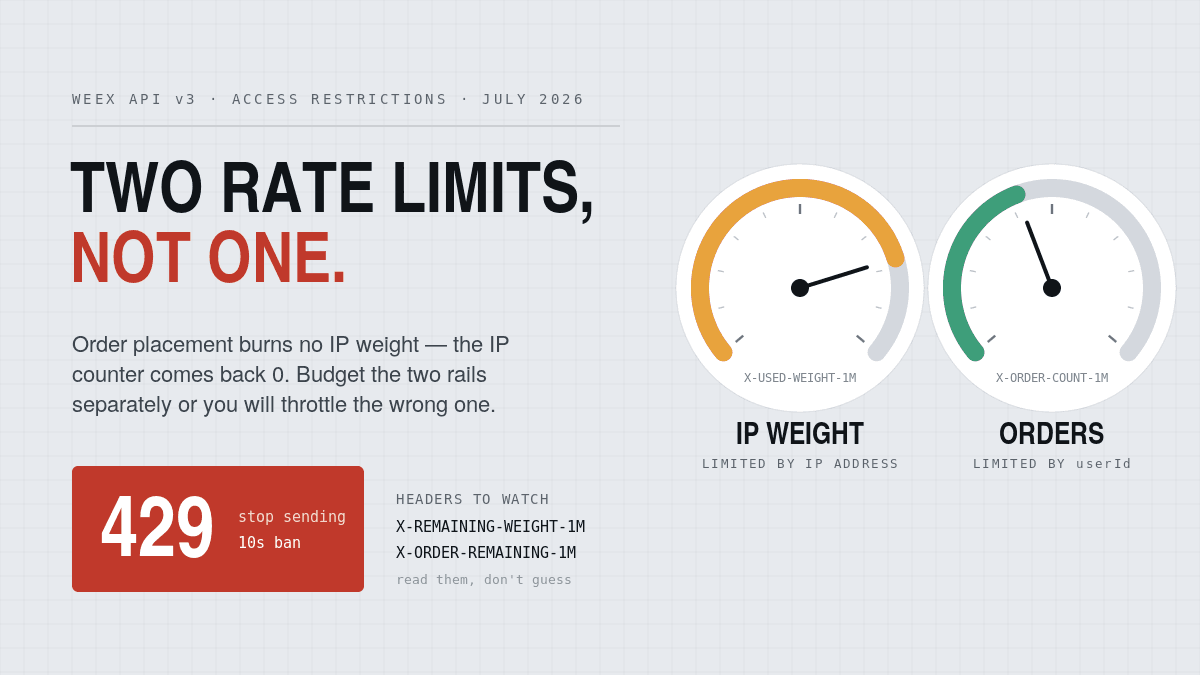
The V3 spot API sharpens this further. Every endpoint except order placement is rate limited by IP using a weight system, where heavier endpoints consume more of your budget per call. Order placement endpoints are metered under a separate ORDERS type keyed to your account, and according to the spot access restrictions documentation they do not consume IP weight — though some individual endpoint pages still list an IP weight, so read the page for the endpoint you actually call.
The operational consequence is easy to miss: running three bots from one cloud VM shares one IP budget for market data, no matter how many separate API keys you hold. Conversely, moving order flow to a second server does nothing for an account-level order cap.
How to read the WEEX rate limit headers before you hit 429
Every response tells you how much budget you have left. Beginners almost never read these headers, which is why the first sign of trouble is usually an error rather than a warning.
| Header | Tells you |
|---|---|
X-USED-WEIGHT-(intervalNum)(intervalLetter) | Weight consumed by your IP in the window |
X-REMAINING-WEIGHT-(intervalNum)(intervalLetter) | Weight still available to your IP |
X-ORDER-COUNT-(intervalNum)(intervalLetter) | Orders your account has placed in the window |
X-ORDER-REMAINING-(intervalNum)(intervalLetter) | Orders your account can still place |
The interval letters are S, M, H, D for second, minute, hour and day, so X-USED-WEIGHT-1M is the weight your IP has burned in the last minute. Log these on every response and you convert an invisible constraint into a gauge you can throttle against — pause when remaining weight drops below, say, 20% rather than waiting for the server to say no.
What a 429 on WEEX actually costs you
Exceeding the limit is not a free retry. The request fails with 429, and the spot documentation states that violating the limits results in a 10-second ban. Ten seconds is an eternity if you are holding a leveraged position and your cancel-order call is the one that got rejected.
The second-order risk is worse. WEEX notes that accounts triggering platform risk controls — including sustained high-frequency invalid requests — can have API permissions automatically disabled, with reactivation requiring a support ticket. A retry loop that hammers a failing endpoint does not just get throttled; it can look like abuse.
Two related failure modes produce errors that beginners misread as rate limiting. A request whose ACCESS-TIMESTAMP deviates more than 30 seconds from server time is rejected outright (error -1046), which on a drifting clock looks like random intermittent failure. And a WebSocket connection opened without a User-Agent header is blocked by the firewall with a 403, not a 429 — the fix is a header, not a slower loop.
Four ways beginners burn the WEEX API rate limit
The arithmetic here is the useful part, because the limits only feel generous until you multiply.
Polling every symbol individually. Requesting tickers for 50 symbols once per second is 50 separate calls per second, five times the 10-per-second pace that a 20-per-2-seconds public allowance permits — and permanently over. Most market-data endpoints accept a list of symbols, so the same job is often one call. Better still, move it to a WebSocket stream that pushes updates instead of you asking.
Re-quoting a grid too fast. A 20-level grid that cancels and replaces every level every 10 seconds generates 120 placements per minute. That clears the spot ceiling of 100 and more than doubles the futures ceiling of 50. Widening the re-quote interval to 30 seconds brings the same strategy inside both.
Reconnect storms. A WebSocket client that drops and immediately retries in a tight loop can consume the 300-connections-per-5-minutes IP budget in under a minute. Every reconnect needs backoff and a jitter delay, not an instant retry.
Retrying the 429 itself. The most expensive mistake is treating 429 as a transient network error and retrying immediately. WEEX is explicit that on receiving a 429 you are responsible for stopping. Exponential backoff — double the wait each time, cap it, add jitter — is the standard answer and the one the exchange expects.
How to build a bot that stays under the WEEX API rate limits
Design the budget before you write the strategy. Decide how many orders per minute the logic actually needs, compare it against the ceilings in the table above, and leave 30–40% headroom for volatility spikes when your bot naturally wants to trade more.
Then split transport by job. REST for discrete actions — placing, cancelling, querying balances. WebSocket for anything you would otherwise poll: order book updates, tickers, fills. Moving market data to a stream typically removes the majority of a naive bot's request volume in one change, and it lowers latency at the same time.
Add a client-side rate limiter rather than relying on the server to tell you no. A token bucket sized slightly below the published limit means your code queues its own excess instead of collecting bans. Log every 429 with its endpoint and timestamp so you can see which call is actually the offender — it is frequently not the one you suspect.
Finally, keep permissions tight while you are experimenting. Scope API keys to what the bot needs, enable IP whitelisting, and remember that newly created or modified keys take roughly 15 minutes to propagate across the system, so an immediate authentication failure after key creation is usually propagation rather than a coding error. Endpoint-level details for each market live in the WEEX Spot API FAQ and the WEEX Futures API FAQ.
The takeaway on WEEX API rate limits
WEEX API rate limits are not an obstacle to route around; they are a design constraint that separates a bot which survives a volatile session from one that gets banned during it. Learn the three numbers that govern your strategy — your order cap, your public data cap, and your connection cap — instrument the response headers so you can see your remaining budget, and back off properly when you do get a 429. That is most of the work.
Ready to test a strategy against real endpoints? Create an API key in your WEEX account, start with read-only permissions and a single symbol, and confirm your request accounting is correct before enabling trading scopes.
FAQ
1. What happens if I exceed the WEEX API rate limit?
The request fails with HTTP status 429 Too Many Requests, and the spot documentation states that violating the limits results in a 10-second ban. Sustained high-frequency invalid requests can also trigger platform risk controls, which may disable API permissions until you contact support.
2. Are WEEX API rate limits per IP address or per API key?
Both. Endpoints that require an API key are metered against the account, while public endpoints without a key are metered against your IP. In the V3 spot API, order placement is capped by account (userId) under the ORDERS type, and everything else is capped by IP weight.
3. How many orders per minute can I place on WEEX?
As of the documentation last updated 2026-04-14, spot allows 100 order placements per minute and futures allows 50 per minute. Spot cancellations are capped at 80 per 10 seconds or 200 per minute; futures cancellations at 50 per minute.
4. Does WebSocket count against the WEEX REST rate limit?
Not directly, but WebSocket has its own budgets: 300 REST/WS connection requests per 5 minutes per IP with a maximum of 100 concurrent connections, and 240 channel subscriptions per hour per connection with a maximum of 100 channels open at once. Moving market data to WebSocket is the most effective way to cut REST request volume.
5. Why am I getting errors even though I am under the rate limit?
Check three things before assuming throttling. A timestamp more than 30 seconds off server time is rejected as -1046. A WebSocket connection without a User-Agent header returns 403. And a newly created or modified API key takes roughly 15 minutes to propagate system-wide.
6. Do batch orders count as one request on WEEX?
The futures access restrictions page states that a batch order covering four trading pairs with ten orders each counts as a single request, which makes batching a cheap way to stretch a limited budget. Individual endpoint pages publish their own per-request caps and weights, though, and those do not always match the general guidance — verify against the endpoint you are calling before sizing a batch.
Risk Warning
Crypto assets are highly volatile and trading them may result in partial or total loss of capital. API and automated trading add risks that manual trading does not: a rate-limit ban can leave you unable to cancel or close a position during a fast move, a reconnect failure can leave a strategy blind to fills, and a coding error can execute unintended size in seconds. Leveraged futures amplify every one of these outcomes and can lead to liquidation. Compromised API keys are a direct custody risk — scope permissions to the minimum needed, enable IP whitelisting, and never share keys or secrets. Rate limits, endpoints, and error codes may change with system upgrades; always verify against the current official WEEX API documentation before deploying. Nothing here is investment advice.
This content is provided for general informational purposes only and doesn't constitute financial, investment, legal, or tax advice. Any events, rewards, online promotions, or related information mentioned herein should not be considered a recommendation, solicitation, or invitation to purchase, sell, trade, or otherwise deal in any crypto assets. Crypto assets are highly volatile and may result in loss. The availability of WEEX services, products, and related events may vary by region. You are responsible for ensuring that your participation is in accordance with applicable local laws and regulations.
You may also like

XST Coin Buyer's Safety Guide: How to Verify the Real XSolut Token on Solana

XST Coin Holder Concentration Risk: What On-Chain Analysis Shows About XSolut's Supply Distribution

Is Reddit Stock a Buy After Falling From Its Highs? What the S&P 500 Inclusion Actually Changes
Reddit Stock Jumps 11% After S&P 500 Inclusion: What Joining the Index on August 18 Actually Changes

Is Santander Stock a Buy After Its Strongest First Half Ever? What Record EUR 3.8 Billion Profit Actually Implies
Santander Stock and the Webster Acquisition: What the Federal Reserve Approval Actually Changes

What Is IREN? How the AI Data Center Company Behind Microsoft's $9.7 Billion Contract Actually Works

Ondas Stock Falls After Record Q2 Revenue: What the $83.8 Million Beat and EPS Miss Actually Mean
Bill Ackman's Pershing Square Re-Enters Netflix: What the Hedge Fund Legend's Return Actually Signals
IonQ Stock Q2 2026: What 287% Revenue Growth and a $1.87 Billion Net Loss Actually Tell Investors
IREN Stock and the Microsoft Delivery: What Completing Horizon 1 and Getting Nvidia's Exemplar Status Actually Mean

XST AI Infrastructure Explained: What XSolut Is Actually Building on Solana

Why XSolut (XST) Chose Solana Over Ethereum: What the Blockchain Choice Actually Means

What Is Crypto Institutional Trading? How Professional Traders and Fund Managers Access Markets Differently
How to Monetize a Crypto Trading Community in 2026: What the Broker API Model Actually Changes
SanDisk Stock Has 95% Upside According to Evercore: What the $2,800 Target Actually Requires

WEEX Mini App Launch Promotion: How to Earn Up to 10 USDT and Win an iPhone 17 Pro
SanDisk Stock Jumps After Investor Day: What the 80% Margin Target and 2030 Roadmap Actually Mean

XST Crypto Price: Why XSolut's Valuation Is So Hard to Pin Down
WEEX Mini App: How to Trade Crypto in Countries Where the App Is Blocked
MU Stock After the 28% Drop: What Micron's HBM Backlog Says
SPCX Has Four Tickers. Which One Are You Actually Trading?
What Is XST Coin and Should You Buy It? A No-Nonsense Guide for Crypto Investors
SpaceX Stock Could Be Worth Tens of Trillions in the 2030s: What the Mach33 Forecast Actually Claims
SpaceX Stock Has 66% Upside According to Wall Street: What the $231 Consensus Target Actually Requires
Morgan Stanley Says SpaceX Stock Can More Than Double: What the Overweight Thesis Actually Requires
SpaceX Stock Price Targets Range From $62 to $800: What the Analyst Disagreement Actually Reveals
XST Coin vs Akash Network: How Two AI Infrastructure Tokens Compare
XST Coin Tokenomics Explained: What 1 Billion Supply and 100% Circulation Actually Mean
How to Sell XST Coin: When and How to Exit Your XSolut Position
XST Coin Buyer's Safety Guide: How to Verify the Real XSolut Token on Solana
XST Coin Holder Concentration Risk: What On-Chain Analysis Shows About XSolut's Supply Distribution
Is Reddit Stock a Buy After Falling From Its Highs? What the S&P 500 Inclusion Actually Changes
Reddit Stock Jumps 11% After S&P 500 Inclusion: What Joining the Index on August 18 Actually Changes
Is Santander Stock a Buy After Its Strongest First Half Ever? What Record EUR 3.8 Billion Profit Actually Implies
Santander Stock and the Webster Acquisition: What the Federal Reserve Approval Actually Changes
Contents
Popular coins
Latest articles


