
SpaceX IPO Stock Performance: SPCX From $135 to the Lock-Up Test

 Prefer us on Google


SpaceX finally became a stock on June 12, 2026, listing on the Nasdaq under the ticker SPCX at $135 a share. Six weeks later, the SpaceX IPO stock performance tells a familiar hot-listing story: a euphoric debut, a spike, and a hard reset. As of July 22, 2026, SPCX traded near $129 — below its IPO price and down roughly 36% from its post-listing high. The next real test is not a rocket launch. It is the August lock-up, when tens of billions of dollars of previously restricted stock become sellable.
This piece tracks how SPCX has actually traded since the debut, why it pulled back, what the unlock calendar does to the setup, and how traders outside the US are getting exposure through tokenized products rather than a US brokerage account.
SpaceX stock performance since the June 2026 IPO
The listing itself was a record. SpaceX priced at $135, raised about $75 billion, and carried an implied valuation near $1.77 trillion — the largest IPO ever completed. The stock opened around $150, ran through the session, and closed near $161 on day one, a 19% pop. Momentum carried it above $200 in the following weeks before sentiment turned.
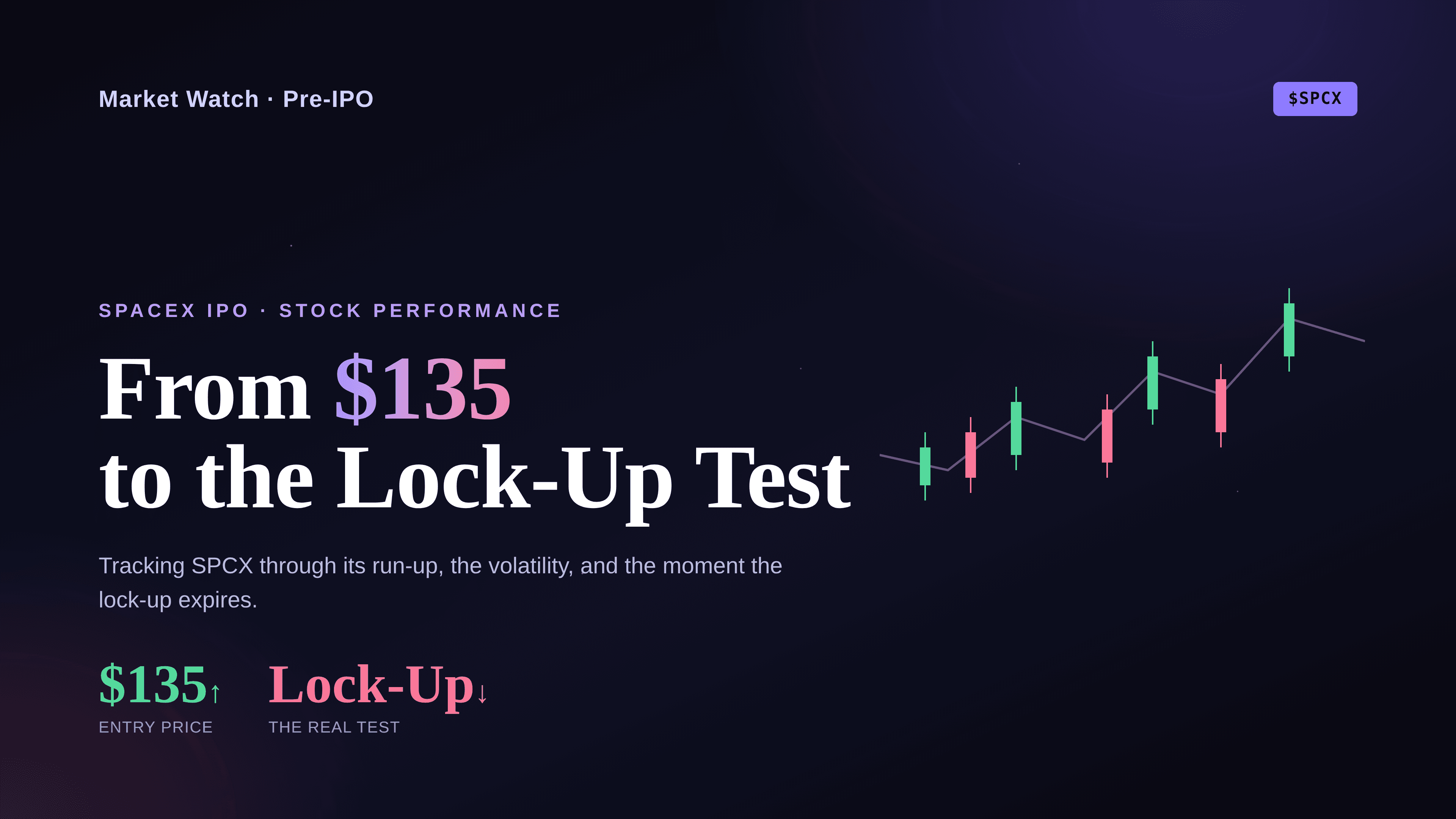
Here is the dated performance line, compiled from the debut through late July:
| Milestone | Date | SPCX price | Move |
|---|---|---|---|
| IPO price | Jun 12, 2026 | $135 | — |
| First-day close | Jun 12, 2026 | ~$161 | +19% vs IPO |
| Post-IPO peak | late June 2026 | above $200 | +49%+ vs IPO |
| Recent price | Jul 22, 2026 | ~$129 | −4% vs IPO, ~−36% from peak |
Two numbers frame everything else. The stock is only modestly below its IPO price, so debut buyers are close to flat. But it is down about 36% from the peak, so anyone who chased the spike is deep in the red. That gap between "IPO buyer" and "peak buyer" is the whole story of the first six weeks.
Why has SPCX fallen 36% from its peak?
Three forces did the work, and they matter in this order.
First, valuation. At the peak, SPCX carried a price-to-sales ratio around 88x against 2025 revenue of roughly $18.67 billion. That multiple prices in Starlink scaling across 164 countries plus Starship reaching commercial cadence — years of flawless execution assumed today. Any richly priced debut is one disappointment away from a repricing, and the market simply took some of that optimism back out.
Second, a tiny float met heavy demand and then profit-taking. Only about 555 million shares — roughly 5% of the company's ~13 billion total — actually trade. A thin float exaggerates moves in both directions: it helped push SPCX above $200 on limited supply, and it made the retreat sharper once early momentum buyers started ringing the register.
Third, the calendar started working against the stock. As the first lock-up expirations came into view, traders began pricing in the supply that is about to hit the market. That is the single most important driver of SpaceX IPO stock performance from here, so it deserves its own section.
The lock-up calendar is the next big test for SPCX
Newly public companies almost always face a supply shock when insider and pre-IPO shares become tradable. For SPCX, that shock is scheduled, large, and tied to the company's first earnings report on August 4, 2026. The stock's reaction to earnings also decides whether a conditional tranche unlocks early.
| Unlock date | Shares released | Share of total | Approx. value |
|---|---|---|---|
| Aug 6, 2026 (base) | 911.5M (20%) | ~7% | part of $175B+ combined |
| Aug 6, 2026 (conditional) | 455.8M (10%) | ~3.5% | released only if SPCX trades ≥30% above the $135 IPO price on 5 of the 10 trading days ending at earnings |
| Aug 21, 2026 | 319M (7%) | ~2.5% | ~$40.8B |
| Sep 10, 2026 | 319M (7%) | ~2.5% | ~$40.8B |
Set against a float near 555 million shares, an Aug 6 base release of 911.5 million shares is enormous — it can multiply the tradable supply several times over in a matter of days. Whether the extra conditional tranche unlocks is itself performance-dependent: it only releases if the stock has been strong into earnings, which is a neat illustration of how price action and supply feed each other here.
One offsetting detail matters for anyone modeling worst-case supply: Elon Musk's roughly 6.4 billion shares sit under a separate extended lock-up until June 2027. The single largest holder is not part of the August wave, which caps how bad the near-term overhang can get.
What could move SpaceX stock next: earnings, Starlink, Starship
Beyond the mechanical supply story, the fundamental catalysts cluster around a few events. The better reading is that the first earnings print on August 4 matters less for the exact revenue figure and more for what management guides on Starlink margins and Starship cadence — that guidance is what justifies or punctures the 88x multiple.
The bull case is straightforward: Starlink keeps compounding subscribers across its 164-country footprint, Starship reaches reliable commercial flights, and the multiple gets a growth story to grow into. The bear case is equally clean: the August unlocks flood a thin float, earnings guidance disappoints against a demanding valuation, and the stock drifts toward its IPO price or below. One widely cited historical-precedent model even projects SPCX around $112 by June 2027, roughly 17% under the IPO price — a reminder that record debuts frequently spend their first year digesting the hype rather than extending it.
How to trade SpaceX (SPCX) exposure on WEEX
A practical wrinkle for a global audience: SPCX is a Nasdaq stock, so direct access runs through a US-eligible brokerage, during US market hours, subject to local availability. Traders outside that perimeter have been reaching the same price exposure through crypto-native, tokenized instruments instead.
On WEEX, the relevant product is SPCXON, a tokenized SpaceX instrument built on Ondo's tokenized-stock framework and designed to mirror the economics of holding SPCX for eligible non-US traders. It trades as an SPCXON/USDT spot pair, settles in USDT, and uses mint-and-redeem mechanics to keep its price anchored near the underlying's net asset value. Two things to be clear-eyed about: holders get price exposure only — no shares, no voting rights, no direct dividends (dividends are reinvested into the token's value) — and because it tracks a listed stock, fills track US market hours and can stall when that market is closed. WEEX lists similar tokenized versions of other equities, such as MSTRON (MicroStrategy) and MUON (Micron), alongside crypto-settled SPCX-style perpetual futures for traders who want leverage rather than spot.
If you are weighing the routes, WEEX's own explainer on what the record SPCX IPO means and how to trade it lays out the trade-offs, the SpaceX IPO investment-options and access guide maps direct versus indirect exposure, and the broader guide to trading space stocks on WEEX in 2026 covers SPCX alongside other names in the sector. The practical caution is the same one that applies to any tokenized-equity wrapper: you are trading a synthetic that depends on the issuer's mint/redeem plumbing and on the underlying staying liquid, so size positions with the August supply overhang in mind, not the June momentum.
Frequently asked questions
1. Has the SpaceX IPO been a good performance so far?
Mixed. Anyone who bought at the $135 IPO price on June 12, 2026 is roughly flat as of July 22 (SPCX near $129). Anyone who bought the post-IPO spike above $200 is down about 36%. The debut was a record; the aftermarket has been a reset.
2. Why is SPCX trading below its IPO peak?
A rich ~88x price-to-sales multiple, a thin ~555 million-share float that amplified both the rally and the drop, and the approaching August lock-up expirations that add large amounts of new sellable supply.
3. When do SpaceX shares unlock?
The first and largest tranche unlocks on August 6, 2026 (911.5 million shares, with a conditional 455.8 million more if the stock was strong into earnings), followed by roughly 319 million shares each on August 21 and September 10, 2026. Musk's ~6.4 billion shares stay locked until June 2027.
4. Can I buy SpaceX stock outside the US?
Direct SPCX shares require a US-eligible broker and trade in US hours. Outside that, eligible non-US traders use tokenized products such as SPCXON/USDT on WEEX for spot exposure, or crypto-settled SPCX-style perpetuals for leverage. These track the price but confer no shareholder rights.
5. What is the price outlook for SPCX?
There is no reliable forecast. The bull case rests on Starlink and Starship execution justifying the multiple; the bear case is that August supply plus a demanding valuation pushes the stock toward or below its IPO price. One historical-precedent model points to about $112 by June 2027. Treat all such figures as scenarios, not predictions.
Risk Warning
SpaceX (SPCX) is a newly listed, richly valued stock, and tokenized products that track it carry additional layers of risk. The shares are volatile and have already swung roughly 50% from peak to recent price within weeks of listing; a small public float can move the price sharply on modest order flow. The August–September 2026 lock-up expirations release billions of dollars of new supply and can pressure the price regardless of fundamentals. Tokenized instruments such as SPCXON add smart-contract, issuer, custody, redemption-liquidity, and counterparty risk on top of the underlying equity risk, confer no shareholder rights, and depend on the issuer's mint/redeem mechanism holding its peg; leveraged SPCX-style perpetuals can be liquidated well before any thesis plays out. Availability of these products is restricted by jurisdiction. Nothing here is investment advice — crypto and tokenized-equity trading can result in partial or total loss of capital. Do your own research and only risk what you can afford to lose.
Disclaimer: This content is provided for general branding and informational purposes only and doesn't constitute financial, investment, legal, or tax advice. Any events, rewards, online events, or related information mentioned herein should not be considered a recommendation, solicitation, or invitation to purchase, sell, trade, or otherwise deal in any crypto assets or to use any services. Crypto assets are highly volatile and may result in loss. WEEX services and online events may not be available in all regions and are subject to applicable laws, regulations, and eligibility requirements. You are responsible for ensuring that your use of WEEX services complies with local laws and for carefully assessing the risks before participating in any crypto-related activities.
You may also like

What Is a Broker? The Complete Guide to Understanding Financial and Crypto Brokers

How to Compare Crypto Brokers: What the Rankings Don't Tell You and What Actually Matters
Oracle Stock Price Prediction 2026-2027: Can ORCL Reach $250 After the Pentagon Deal?

Is Oracle Stock a Buy After the $7 Billion Pentagon Deal? What the Defense Contract Changes
SPCX Stock Price Is Down $1 Trillion From Its Peak: Is Now the Time to Buy?
Is Tesla Stock a Buy at $320 After the Q2 Earnings Crash?

SPCX Stock Price and Starship Flight 13: What Tonight's Launch Needs to Deliver

Why Tesla Stock Crashed 14% on Record Revenue: What the 1.4% Operating Margin Actually Means
Tesla Stock Is Betting Everything on Robotaxi and Optimus: What Investors Are Actually Paying For
Intel Stock vs AMD Stock: Which Chip Giant Is the Better Buy After Q2?
Intel Stock Price Prediction 2026-2027: Can INTC Reach $150 After the Foundry Turnaround?

What Is Tokenized USO/USOS and How Do Commodity-Backed RWAs Function in DeFi Trading in 2026
What Are the Risks and Rewards of Trading Tokenized Equities Like GME On-Chain in 2026

Is Intel Stock a Buy After Q2 Earnings? What 163% Year to Date Gain and Raised Guidance Tell Investors
How Does Tokenized GameStop (GMEx) Differ From the GME Meme Coin on Blockchains in 2026
Goldman Sachs CEO Backs Senate Crypto Bill: The Institutional Blueprint for Wall Street On-Chain Liquidity in 2026
Intel Stock Soars After Q2 Earnings Beat: What the Strongest Revenue Growth in 15 Years Actually Means
Why Did Goldman Sachs CEO David Solomon Endorse the Senate Crypto CLARITY Act in 2026
WEEX API Compatibility: What Changes When You Migrate From Another Exchange
WEEX API Python SDK: How to Sign and Call It End to End
CRUDEOIL Airdrop: Share 50,000 USDT Rewards on WEEX
USDC Use Cases Explained: Payments, DeFi, Cross-Border Transfers, and Key Risks
Top Crypto Brokers in 2026: Types, Rankings and How to Choose the Right One
What Is a Crypto Broker? How Is It Different From a Crypto Exchange?
What Is a Futures API? How to Call It and Keep It Safe
Robinhood Chain Explorer: How to Find the Official One
WEEX API Guide: Setup, Calls, Permissions, and Security
5 Reasons WEEX Poker Party Series 4 Is the Event You Don't Skip
The Joker Is Back: Draw Your Share of a $1,000,000 USDT Pool on WEEX
How to Start Crypto Quantitative Trading as an Individual
What Is a Broker? The Complete Guide to Understanding Financial and Crypto Brokers
How to Compare Crypto Brokers: What the Rankings Don't Tell You and What Actually Matters
Oracle Stock Price Prediction 2026-2027: Can ORCL Reach $250 After the Pentagon Deal?
Is Oracle Stock a Buy After the $7 Billion Pentagon Deal? What the Defense Contract Changes
SPCX Stock Price Is Down $1 Trillion From Its Peak: Is Now the Time to Buy?
Is Tesla Stock a Buy at $320 After the Q2 Earnings Crash?







