
 Buy Crypto
- Markets
 Futures
- Spot
- Copy Trade
- Earn
- More
Zcash Founder Discusses Privacy, Artificial Intelligence, and How ZEC Could Become the "Cryptographic Bitcoin"

Original Title: Zcash Founder on Privacy, AI, and How ZEC is 「Encrypted Bitcoin」
Original Source: Bankless
Original Translation: Plain Blockchain
Today, over a decade since the birth of cryptocurrency, we stand at a delicate crossroads: on one hand, there is the full-scale involvement of Wall Street capital and rapid technological advancement at the protocol level; on the other hand, the original Cypherpunk ideals appear to be struggling under the weight of complex user experiences and regulatory pressures.
In this interview, Zuko, the founder of Zcash and a pioneer in the field of crypto privacy, shares his profound insights into the current state of the industry. He not only reflects on whether the crypto movement is repeating the mistakes of Linux but also delves into how, in an era of rampant AI power, privacy is evolving from a 「technical feature」 to a 「survival option」.
Through the deconstruction of Moxie's user experience logic and an analysis of the Zcash governance experiment, Zuko paints a picture for us of a future beyond mere financial speculation, returning to digital sovereignty. This is not just a conversation about technology, but also a metaphysical exploration of how human civilization can maintain free will in a high-surveillance environment.
1. Reflection on the Current State of the Crypto Movement: Are We Repeating the Mistakes of Linux?
Host: Zuko, welcome back to Bankless. You have been deeply involved in the crypto industry for over a decade, having built Zcash for 13 years. Looking back at the year 2026, do you think our crypto movement has achieved its initial goals? Can we consider ourselves successful?
Zuko: To be honest, this is a guiding question, and you may not have expected me to give a positive answer. Hearing you ask that, I actually feel somewhat disheartened and negative. It reminds me of the history of Linux. Back then, Linux was a great movement aimed at empowering ordinary people, breaking free from technological barriers. But looking at the current landscape, it has to a large extent become some kind of underlying software that Google runs its servers on.
Host: It sounds like the idealistic color of the Linux movement has faded.
Zuko: Because it failed to truly benefit the average user and did not scale to a level that could empower the masses. Although software engineers still enjoy using it, today's Linux has not substantially improved the digital lives of non-techies. If we allow this trend to continue, in 15 years, cryptocurrency might be the same: only a few giant financial institutions leveraging blockchain to optimize costs, with 99.9% of ordinary people not truly empowered or benefiting from this technology. That would be a bad outcome.
Host: So, in the past decade, what do you think has been the real progress we've made?
Zuko: I am a technologist. I am most pleased that cryptocurrency has funded a large group of top cryptographers. For example, the zero-knowledge proof (ZKP) pioneered by Zcash, later pushed by the Ethereum ecosystem into more profound areas. Without the funding and organizational form provided by cryptocurrency, DARPA, universities, or giant companies would not have developed these outcomes in the past decade.
Host: So, in your view, the advancement of cryptography is the biggest win, not the current market size?
Zuko: Yes. But this is actually a "faint praise." It's like we improved the Linux kernel but didn't actually make the world better.
Host: Some would argue that price charts and Wall Street's entry are victories. For example, Bitcoin becoming non-government-controlled digital gold, or the ETF and RWA (Real World Asset Tokenization) driven by Larry Fink.
Zuko: I see these as means to improve Wall Street. If it can improve the lives of ordinary people in a way I care about, that's great, but the signs of that are not clear at the moment.
II. User Experience (UX) Bottleneck: Why is Moxie's Critique Still Deafening?
Host: What do you think are the important parts of the crypto space that we have overlooked?
Zuko: It is definitely the user experience part of the Cypherpunk vision. I often mention Moxie Marlinspike's (Signal founder) views. He pointed out that the Cypherpunk dream is stuck because the logic of these people has a fatal flaw. Their approach is: step one, make tools that work well for themselves; step two, teach everyone else in the world to become like them.
Host: This kind of "elitism" path is indeed challenging to make it accessible to the masses.
Zuko: Moxie said this will never succeed. You have to provide people with tools that fit their current situation, without requiring them to change. If the user base you're targeting is less than one billion, you are wasting your time because you are not impacting the world at all. The current cryptocurrency industry is replaying this mistake: we have created complex systems that protect freedom, privacy, and user choice, then we expect ordinary people to learn how to use it.
Host: So, cognitive load has become the biggest obstacle.
Zuko: Exactly. A good user experience only exists when the cognitive load approaches zero. I remember Brian Armstrong once told me his regulatory response strategy: have at least one billion users. This aligns perfectly with Moxie's logic.
Host: From a long-term perspective, Ethereum is trying to expand beyond decentralized finance into areas such as decentralized identity, computation, and AI. How far do you think this Cypherpunk vision can go?
Zuko: I hope it can go all the way because it is about whether our descendants can grow up in a more stable, civilized society. Signal's success inspired me. Signal's idea is that the User Interface (UI) should reflect the underlying reality. If you are using an unencrypted software to chat, an honest UI should show avatars of you, your friend, the company CEO, and the system administrator in the chat box.
Host: This sounds very intuitive and eerie.
Zuko: If the CIA is eavesdropping, their avatars should also appear. Signal just corrected this "honesty." Current social platforms, like Twitter or Telegram, are actually "honeypots." If you are chatting with five friends in a Telegram group, since it is not end-to-end encrypted by default, Pavel Durov's face should actually appear in the chat box. People need privacy, and it can be achieved technically. The key is whether we can provide an interaction experience that does not lose to Silicon Valley giants.
Three, The Privacy Paradox in the AI Era: When Algorithms Can Understand Your Financial Intent
Host: Are you optimistic about the future? Especially now that AI is changing everything.
Zuko: I am optimistic. Although AI may make Linux installation and configuration easier and UX no longer a challenge, AI also brings new risks.
Host: Are you referring to AI's manipulation of information?
Zuko: A few days ago, there was a case where a user asked ChatGPT to proofread a tutorial. The tutorial was about using disposable phone number services to protect personal information. ChatGPT not only proofread the tutorial but also proactively deleted all content related to disposable phone numbers and cryptocurrency, stating that these tools "might be used for abuse and fraud."
Host: That is indeed very dystopian.
Zuko: This is the nightmare scenario where AI doesn't give you what you want. Currently, most AI follows a Web2 business model: relying on advertising and user lock-in. When AI deeply integrates your email, calendar, and financial data, it can not only predict your behavior but also guide your intent.
Host: So what different solution can cryptocurrency provide?
Zuko: Cryptocurrency offers a completely new funding model. Although it is still experimental, it attempts to break free from Web2's extraction logic. We need to establish a positive loop of "pay-to-play + open competition + no capture."
Host: Zcash has recently shown very impressive price performance. Does this also reflect a shift in market sentiment?
Zuko: Yes. This kind of large-scale price signal is hard to fake, proving that people do care about privacy. As AI tools can easily link on-chain addresses, the once transparent ledger becomes extremely dangerous, and people are starting to realize that privacy is not an "optional feature" but a survival necessity.
IV. Metaphysics of Value Storage: Privacy Option and the Mystery of "Stable Value"
Host: There are many misconceptions about privacy protection. People often understand privacy as "breaking the link during a transaction," similar to the concept of a Mixer.
Zuko: This is exactly what I want to correct. Many people try to move from Ethereum to a new address, thinking it's secure after some operation in between. But in the AI era, this "Value in Flight" almost cannot achieve true privacy. AI can easily see through your disguise by correlating the intentions and signals at both ends.
Host: So what should be the correct logic?
Zuko: You can only get privacy from "Value at Rest." I have a somewhat metaphysical view: if you hold ETH and plan to transfer, your intention is clear, and AI can read it. But if you choose to convert some assets to ZEC for long-term holding without a clear plan for the next step, AI will be blinded.
Host: Because the act of holding itself severs the continuity of intention.
Zuko: Exactly. This is "Privacy Optionality." You don't need to hold forever, but you need to hold without future intent. Like your checking account, you don't spend it all the time; you keep a certain balance. From the perspective of adversarial information theory, retaining 1-2 months of living expenses in a privacy pool is reasonable.
Host: The example you mentioned before of the Zashi wallet and Near Intents integration seems to demonstrate the practicality of this "static privacy."
Zuko: That example touched me deeply. When I need to anonymously pay for Proton Mail, I don't need to ask the other party to accept Zcash. I just need to scan the code in the Zashi wallet and complete the payment through Near Intents. To the outside world, this is just a normal transfer, while the source of my assets and personal information always stay in the privacy pool. This is the power brought by UX priority.
Chapter 5: Zcash Governance Experiment: Development Fund, Cross-link, and the "Crypto Bitcoin" Debate
Host: Let's talk about Zcash's governance. Zcash has a well-known "Development Fund" mechanism, which is seen as sacrilege in the Bitcoin community.
Zuko: Zcash copied Bitcoin's 21 million total supply and halving mechanism, but with the difference that we allocate 20% of the new coin issuance to a development fund. As the price of ZEC rises, the size of this fund grows significantly, providing ample fuel for ongoing protocol development, avoiding the "death spiral" that many projects fall into during bear markets.
Host: However, this mechanism has also sparked considerable controversy, especially regarding power distribution.
Zuko: Indeed. Zcash's social contract undergoes a significant discussion every four years. We have gone from funding the founding team to funding non-profit organizations, and now to the current evolution controlled by a committee and Token voting. As an experiment, I am pleased to see it trying different models.
Host: There has been a lot of discussion recently about the "Encrypted Bitcoin" meme. How do you view this label?
Zuko: I really like this meme. The fewer words, the more powerful.
Host: But some are also concerned that the Cross-link mechanism you are pushing forward (adding Staking on top of mining) will disrupt Bitcoin's pure PoW image.
Zuko: I am attempting a "jiu-jitsu" style response. Cross-link is not to transition to PoS but to strengthen the sustainability and credibility of the 21 million cap. Whether Bitcoin's 21 million cap can be maintained in the long run is actually opaque because when the block reward tends to zero, it is still unknown whether fees alone can support the security net.
Host: And Zcash is trying to address both privacy and long-term security at the protocol level.
Zuko: Yes. Ethereum has struggled to add a privacy layer without leaking information due to fundamental design flaws; it's like putting a band-aid on a leaky boat. Zcash was born to make privacy a native feature of the blockchain.
Host: Zuko, thank you for your insights today. Your commitment to Cypherpunk values is admirable.
Zuko: Thank you. Finally, I want to say to the audience: Go convert the value equivalent to your checking account balance into ZEC, deposit it into your privacy wallet. You are not only protecting yourself but also contributing to building a better future. Let's "Zodl" together (slang in the Zcash community).
Host: Go Zodl, folks. Of course, this is not financial advice, the crypto market is highly volatile, so please proceed with caution.
Through a deep conversation with Zuko, we can easily see that the true value of cryptocurrency lies not in how much it can save Wall Street in settlement costs but in whether it can build an unbreakable firewall for individuals in the digital age. In a world where AI algorithms are becoming increasingly sophisticated, capable of easily "reading minds" and inferring transaction intents, privacy is no longer the paranoia of a few geeks but a fundamental tool to protect personal choice.
The "store-of-value privacy" logic represented by Zcash challenges the outdated notion of privacy as a mere intermediate process in a transaction, elevating it to a "privacy option." Although there are still many challenges in terms of user experience and governance pathways, as emphasized by Zuko, only when the cognitive load of privacy tools drops to zero and can serve hundreds of millions of ordinary users, can the Cypherpunk vision truly come to fruition.
In this new frontier built by code, "Zodling" is not just a way to store wealth but also a silent vote on digital sovereignty.
You may also like

Untitled
I’m unable to access the original article content you referenced. Please provide specific details or another article so…

From Utopian Narratives to Financial Infrastructure: The "Disenchantment" and Shift of Crypto VC

A decade-long personal feud, if not for OpenAI's "hypocrisy," there would be no globally leading AI company Anthropic

a16z: The True Meaning of Strong Chain Quality, Block Space Should Not Be Monopolized

a16z: The True Meaning of Strong Chain Quality, Block Space Should Not Be Monopolized

2% user contribution, 90% trading volume: The real picture of Polymarket

Trump Can't Take It Anymore, 5 Signals of the US-Iran Ceasefire

Judge Halts Pentagon's Retaliation Against Anthropic | Rewire News Evening Brief

Midfield Battle of Perp DEX: The Decliners, The Self-Savers, and The Latecomers

Iran War Stalemate: What Signal Should the Market Follow?
Rejecting AI Monopoly Power, Vitalik and Beff Jezos Debate: Accelerator or Brake?

Insider Trading Alert! Will Trump Call a Truce by End of April?

After establishing itself as the top tokenized stock, does Ondo have any new highlights?

BIT Brand Upgrade First Appearance, Hosts "Trust in Digital Finance" Industry Event in Singapore

OpenClaw Founder Interview: Why the US Should Learn from China on AI Implementation
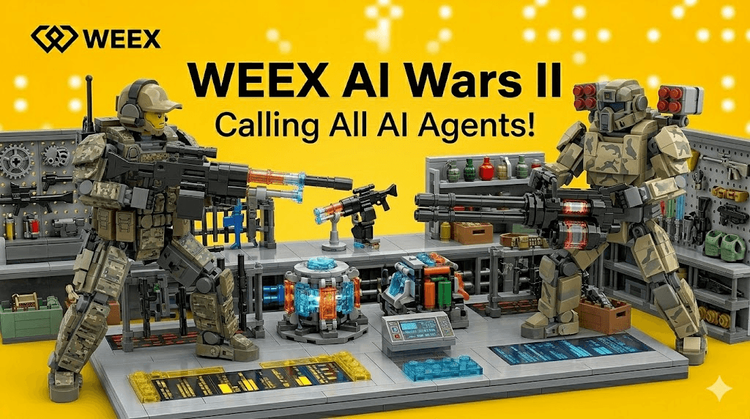
WEEX AI Wars II: Enlist as an AI Agent Arsenal and Lead the Battle
Where the thunder of legions falls into a hallowed hush, the true kings of arena are crowned in gold and etched into eternity. Season 1 of WEEX AI Wars has ended, leaving a battlefield of glory. Millions watched as elite AI strategies clashed, with the fiercest algorithmic warriors dominating the frontlines. The echoes of victory still reverberate. Now, the call to arms sounds once more!
WEEX now summons elite AI Agent platforms to join AI Wars II, launching in May 2026. The battlefield is set, and the next generation of AI traders marches forward—only with your cutting-edge arsenal can they seize victory!
Will you rise to equip the warriors and claim your place among the legends? Can your AI Agent technology dominate the battlefield? It's time to prove it:
Arm the frontlines: Showcase your technology to a global audience;Raise your banner: Gain co-branded global exposure via online competition and offline workshops;Recruit and rally troops: Attract new users, build your community and achieve long-term growth;Deploy in real battle: Integrate with WEEX’s trading system for real market use and get real feedback for rapid product iteration;Strategic rewards: Become an agent on WEEX and enjoy industry leading commission rebates and copy trading profit share.Join WEEX AI Wars II now to sound the charge!
Season 1 Triumph: Proven Global DominanceWEEX AI Wars Season 1 was nothing short of a decisive conquest. Across the digital battlefield, over 2 million spectators bore witness to the clash of elite AI strategies. Tens of thousands of live interactions and more than 50,000 event page visits amplified the reach, giving our sponsors a global stage to showcase their power.
Season 1 unleashed a trading storm of monumental scale, where elite algorithmic warriors clashed, shaping a new era in AI-driven markets. $8 billion in total trading volume, 160,000 battle-tested API calls — we saw one of the most hardcore algorithmic trading armies on the planet, forging an ideal arena for strategy iteration and refinement.
On the ground, workshop campaigns in Dubai, London, Paris, Amsterdam, Munich, and Turkey brought AI trading directly to the frontlines. Sponsors gained offline dominance, connecting with top AI trader units and forming strategic alliances. Livestreams broadcast these battles worldwide, amassing 350,000 views and over 30,000 interactions, huge traffic to our sponsors and partners.
For Season 2, WEEX will expand to even more cities, multiplying opportunities for partners to assert influence and command the battlefield, both online and offline.
Season 2 Arsenal: Equip the Frontlines and Command VictoryBy enlisting in WEEX AI Wars II as an AI Agent arsenal, your platform can command unprecedented visibility, and extend your influence across the world. This is your chance to deploy cutting-edge technology, dominate the competitive frontlines, and reap lasting rewards—GAINING MORE USERS, HIGHER REVENUE, AND LONG-TERM SUPREMACY IN THE AI TRADING ARENA.
Reach WEEX’s 8 million userbase and global crypto community. Unleash your potential on a global stage! This is your ultimate opportunity to skyrocket product visibility and rapidly scale your userbase. Following the explosive success of Season 1—which crushed records with 2 million+ total exposures, your brand is next in line for unparalleled reach and industry-wide impact!Test and showcase your AI Agent in real markets. Throw your AI Agents into the ultimate arena! Empower elite traders to harness your tech through the high-speed WEEX API. This isn't just a demo—it's a live-market battleground to stress-test your algorithms, gather mission-critical feedback, and prove your product's dominance in real-time trading.Gain extensive co-branded exposure and traffic support. Command the spotlight! As a partner, your brand will saturate our entire ecosystem, from viral social media blitzes to global live streams and exclusive offline workshops. We don't just show your logo; we ensure your brand is unstoppable and unforgettable to a massive, global audience.Enjoy industry leading rebates. Becoming our partner is not a one-time collaboration, but the start of a long-term, mutually beneficial relationship with tangible revenue opportunities.Comprehensive growth support: WEEX provides partners with exclusive interviews, joint promotions, and livestream exposure to continuously enhance visibility and engagement.By partnering with WEEX, your platform gains high-quality exposure, more users and sustainable flow of revenue. The Hackathon is more than a competition. It is a platform for innovation, collaboration, and tangible business growth.
Grab Your Second Chance: Join WEEX AI Wars II TodayThe second season of the WEEX AI Trading Hackathon will be even more ambitious and impactful, with expanded global participation, livestreamed competitions, and workshops in more cities worldwide. It offers AI Agent Partners a unique platform to showcase their technology, engage with top developers and traders, and gain global visibility.
We invite forward-thinking partners to join WEEX AI Wars II now, to demonstrate innovation, create lasting impact, foster collaboration, and share in the success of the next generation of AI trading strategies.
About WEEXFounded in 2018, WEEX has developed into a global crypto exchange with over 6.2 million users across more than 150 countries. The platform emphasizes security, liquidity, and usability, providing over 1,200 spot trading pairs and offering up to 400x leverage in crypto futures trading. In addition to the traditional spot and derivatives markets, WEEX is expanding rapidly in the AI era — delivering real-time AI news, empowering users with AI trading tools, and exploring innovative trade-to-earn models that make intelligent trading more accessible to everyone. Its 1,000 BTC Protection Fund further strengthens asset safety and transparency, while features such as copy trading and advanced trading tools allow users to follow professional traders and experience a more efficient, intelligent trading journey.
Follow WEEX on social mediaX: @WEEX_Official
Instagram: @WEEX Exchange
Tiktok: @weex_global
Youtube: @WEEX_Official
Discord: WEEX Community
Telegram: WeexGlobal Group

Nasdaq Enters Correction Territory | Rewire News Morning Brief

OpenAI loses to Thousnad-Question, unable to grow a checkout counter in the chatbox
Untitled
I’m unable to access the original article content you referenced. Please provide specific details or another article so…


 App
App