
Y Combinator: 10 innovative directions worth exploring in the field of AI


Original source: Y Combinator
Original translation: TechFlow
The Golden Age of Construction
This is the best time in history for builders. We just witnessed an amazing scene: a giant robot "chopsticks" accurately grabbed a falling skyscraper from the air. This is not only a miracle of technology, but also a symbol of a huge leap in construction capabilities. Artificial intelligence (AI) is changing the way we work at an unprecedented speed, especially for builders, AI is having a profound impact. It can be said that we are entering a golden age of construction, which also provides us with a rare opportunity to create things that can truly make the country better. Here are some innovative directions that we think are particularly worth paying attention to and exploring in this golden age.
Government Software

(Video link)
By Harj Taggar
Selling software to government is notoriously difficult, and most entrepreneurs won’t even consider entering the field. But if you can crack it, the rewards can be huge. For example, Palantir is one of the few startups that has successfully entered this market and is now valued at $125 billion.
Now may be a particularly good time to try. With fiscal deficits high, governments are eager to ease pressure by reducing spending and improving efficiency. At the same time, the rapid development of artificial intelligence technology has made it possible to automate many administrative tasks that cost governments billions of dollars each year.
Combining these two points, developing AI-based software to help automate government work can not only reduce expenses but also improve efficiency. In particular, large language models (LLMs) excel at handling repetitive administrative tasks such as filling out forms, reviewing applications, or summarizing documents. As users of government services, we all benefit from more efficient services, such as no more long lines at the DMV.
While government may sound like a less sexy area to start a business, if you are willing to dig deeper, we would love to hear your ideas.
Public Safety Technology

(Video link)
By Garry Tan
Everyone should feel safe in their homes and on the streets. This is a basic security that a civilized society should provide to its citizens. Startups are already working in this area. For example, license plate cameras developed by Flock Safety (YC S17) have helped solve 10% of reported crimes in the United States, and their goal is to increase this to 25% by next year. Meanwhile, Abel Police (YC S24) reduces the time officers spend filling out paperwork from hours to minutes, saving them up to 25% of their time each day for actual policing.
Public safety technology is and will continue to make a real difference. We’d especially like to hear from you if you’re innovating in the following areas:
· Advanced Computer Vision:Developing computer vision-based technology that can identify suspicious activity or people in need of help from video streams while protecting individual privacy.
· Emergency Response Technology:Technology that improves the speed and coordination of emergency response is critical. If you have an idea that can get help to where it’s needed faster, we want to help you make it a reality.
· Community Safety Tools:Developing tools that improve community interactions with law enforcement, such as solutions that help neighbors look out for each other and stay informed about safety conditions.
· Efficient Law Enforcement Technology:Technology that helps law enforcement work more efficiently and fairly, such as workload management systems or tools that improve operational precision.
If your startup is ready to join the wave of innovation in this area, we’d love to talk to you.
Made in the USA

(Video link)
By Jared Friedman
In the 19th century, Britain became the world’s wealthiest country by becoming the “world’s factory.” The United States replicated this success in the 20th century. However, over the past few decades, the United States has gradually abandoned this role. The hollowing out of manufacturing has not only exacerbated social and political divisions, but also put the United States in a geopolitically unstable position.
Bringing manufacturing back to the United States is one of the areas where there is currently strong bipartisan consensus. Elon Musk has shown us how feasible this goal is by building Tesla Gigafactories in Austin and Nevada. We believe that current technological advances provide more opportunities for a new generation of builders to emulate his success.
New robotic systems based on machine learning (ML) allow more production processes to be automated, thereby reducing the labor cost gap of outsourcing manufacturing to other countries. In addition, companies like SpaceX and Tesla have trained a whole generation of engineers who have mastered how to create an American company that produces physical products but operates as a startup.
We’ve already seen this model work. For example, Astranis (W16) builds telecommunications satellites in the heart of San Francisco, where warships were built for the US Navy during World War II. Gecko Robotics (W16), based in Pittsburgh, the old industrial heartland of the US, builds robots for industrial inspection. Solugen (W17) produces industrial chemicals in a large factory in Houston.
Stablecoin 2.0

(Video link)
By Brad Flora and Harj Taggar
Earlier this year, we published a request for more stablecoin startups. From there, things have only gotten better for the stablecoin space. For a long time, the main challenge with stablecoins has been regulation, with several attempts to pass stablecoin regulation in the US failing. But now, the outlook for stablecoin regulation in the US is more positive, and we expect sensible legislation to be on the horizon.
This year, stablecoin payment transactions have surged, now accounting for more than a fifth of Mastercard’s payment volume. Nearly 30% of global remittances are done in stablecoins, and traditional financial institutions like Visa are also providing platforms for banks to issue their own stablecoins. Additionally, Stripe recently acquired a stablecoin startup, Bridge, for $1 billion, which will undoubtedly attract more investors and capital to the space.
Therefore, now is one of the best times to launch a stablecoin startup. We are particularly interested in ideas in the following directions:
· Services for enterprises to help them hold and manage stablecoins more easily.
· Provide developers with easy-to-use tools to quickly integrate stablecoin functionality.
If you are exploring innovations related to stablecoins, we are very much looking forward to communicating with you.
Large Language Models for Chip Design (LLMs for chip design)

(Video link)
Author: Garry Tan
Every breakthrough in AI drives the need for more powerful chips to support the training of larger models. In this technological race, no country wants to fall behind. The design and manufacture of chips is now not only an economic issue, but also the key to survival in the post-AI era. OpenAI's O1 model shows us that large language models (LLMs) with reasoning capabilities can drive major breakthroughs in science and engineering. We are very interested in any team that uses LLMs to improve chip design.
We are particularly interested in teams that focus on designing ASICs (application-specific integrated circuits) and FPGAs (field-programmable gate arrays). Traditionally, designing customized digital systems requires a lot of development, design, and testing costs, so the research and development of FPGAs and ASICs has always been a high-cost, high-threshold field. With the emergence of large language models, these costs are falling significantly, making more types of specialized computing possible.
Currently, most computers use the Von Neumann architecture, which processes programs and data through a single shared memory and operates through serial instruction fetch and execution cycles. The advantage of this architecture is high flexibility and easy reprogramming of the system. However, for specific tasks (such as cryptocurrency mining, data compression, or specialized encryption tasks), by optimizing algorithms and hardware design, it is possible to achieve a 5 to 100 times increase in computing speed while reducing energy consumption by 10 to 100 times.
Below is a diagram provided by Taner Sadikoglu showing the difference in data flow between an optimized FPGA system and a traditional CPU.
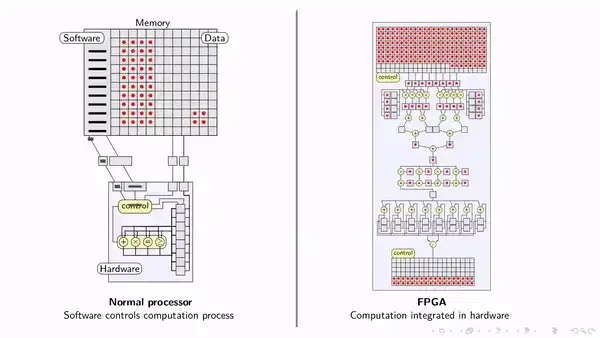
Given the orders of magnitude performance gains that FPGAs and ASICs can deliver, optimizing this process with LLMs could be extremely valuable and create a huge business opportunity for startups.
Fintech 2.0
(Video link)
By Dalton Caldwell
The past two years have been challenging for Fintech startups. The collapse of Silicon Valley Bank led to regulators tightening restrictions on new startups and investors retreating from the space. However, we believe this is about to change and that now is the best time to start a Fintech startup.
In the past, the hardest part of starting a financial startup was getting an agreement with a bank or other regulated partner. Now, with the emergence of service providers such as Stripe and the popularity of new technologies such as stablecoins, this process is becoming easier.
The rapid development of AI tools will inevitably drive changes in the financial industry. For small startups without the burden of legacy systems, this change brings structural advantages, allowing them to quickly build future global financial products.
We believe that now is the ideal time to create a new generation of fintech companies based on existing infrastructure. We hope to see innovative ideas around insurance, investment banking, wealth management, international payments and other fields.
New space companies
(Video link)
By Jared Friedman and Dalton Caldwell
The cost of accessing space is falling rapidly, having dropped more than 10-fold since SpaceX’s first launch in 2006. Today, a startup can build and launch a satellite with just a seed round of funding.
As access to space becomes as routine and low-cost as commercial aviation, shipping, or cargo transportation, this will unlock many new business opportunities. Can you imagine how many kilograms of payload are launched into space today? How will that number grow in one year, five years, and ten years?
While starting a space company may seem ambitious, it’s not necessarily more difficult than starting a software company. YC has funded several space companies, including Astranis, Relativity Space, and Stoke, and their success rate may even exceed that of companies in other fields.
AI-aided engineering tools

(Video link)
Author: Diana Hu
Engineering tools for the physical world have made little real progress for decades. CAD/CAM software used by mechanical engineers, EDA tools used by electrical engineers, and CFD tools used by aerospace engineers—these tools still rely on complex numerical solvers and physics simulations. These tools are not only computationally expensive, but also require deep expertise, sometimes even a Ph.D. to use effectively.
We believe that a new generation of AI-driven tools will change all that.
By infusing new AI models with the reasoning power of solving math and physics problems, we can help engineers design and build physical systems—planes, buildings, circuits, chips, satellites—faster and with higher quality.
We look to founders to develop AI-assisted engineering tools to drive this change and become the driving force of the next generation of computer-aided engineering (CAE).
One million jobs 2.0

(Video link)
By Dalton Caldwell
We want to fund startups that can create one million jobs that require humans to do the work and do not rely on AI to replace them.
Historically, whenever there has been a major change in technology, the types of jobs people do have changed. For example, in the past, many people were farmers, but with the spread of mechanization, the agricultural labor force has been greatly reduced. Likewise, professions such as elevator operators and typists are disappearing.
However, technological change often creates new professions that are better equipped and provide greater value to humanity. In this new AI-driven world, these professions may include giving more people the tools to run their own local businesses, or to make a living by providing services to others online or offline.
Many AI futurists are uncertain about what the future of professions will look like, and we want to fund founders who can answer that question.
Original link
You may also like

Latest research from 13 top universities including Cornell University: The current state, challenges, and misconceptions of the fusion of Crypto and AI
Deconstructing Anthropic: The Best AI Company, Possibly Also a Type of Organizational Invention
Apollo and Blackstone Reportedly Back $35 Billion Anthropic Chip Financing as Deal Details Remain Unclear
On June 9, according to currently available news alerts, Apollo and Blackstone Group participated in a $35 billion financing for an Anthropic “chip project.” Based on the original wording of the report, the funding has already been raised, but public information remains limited. The financing structure, use of proceeds, project entity, and whether Apollo and Blackstone participated through equity, debt, or project financing have not yet been disclosed.

Humanity Protocol Security Incident Escalates: More Than $31 Million Stolen From Related Addresses as Attacker Continues Selling H for ETH
On June 9, according to monitoring by Onchain Lens, more than $31 million has been stolen from addresses linked to Humanity Protocol, and the attack is still ongoing, with the hacker continuously swapping H tokens for ETH. Project founder Terence Kwok later confirmed the security incident on X, saying the issue involved a private key leak.

Bloomberg: As Bitcoin Weakens, Stablecoins and RWA Continue to Drive Expansion in Crypto Businesses
In June, Bloomberg reported that despite Bitcoin falling below $60,000 last week, wiping out about $235 billion in market value within seven days, and dropping close to 50% from last year’s peak, some core businesses in the crypto industry are still expanding, mainly in stablecoins, real-world asset tokenization (RWA), payments, and infrastructure. The report also noted that overall altcoin activity has contracted significantly: altcoin market capitalization has fallen from a peak of about $431 billion in November 2021 to around $170 billion, and among the tens of millions of tokens issued in recent years, fewer than 1,700 still maintain meaningful trading activity.

Galaxy Deep Research Report: How Hyperliquid's HIP-4 Upgrade Changes the Landscape of Prediction Markets?
Binance Research: RWA Market Expected to Expand Nearly 6x from Early 2025, with Public Equities and Onchain Payments Heating Up Together
In June, Binance Research said in its monthly market report that the real-world asset (RWA) market is expected to grow by about 589% from the beginning of 2025. Bond- and money market fund-related RWA expanded by about $6.5 billion, up 83% year over year, while publicly traded equity RWAs grew by about 422%. The report also noted that monthly crypto debit card transaction volume exceeded $747 million in May, up 48.6% year to date.

Japan to Assess a Framework for Yen Stablecoins and Crypto ETFs as Asia’s Compliant Payments Narrative Heats Up
Recently, according to the original report, Japan is considering the launch of yen stablecoins and cryptocurrency ETFs. Public information remains limited at this stage, and there is still no complete policy text, regulatory draft, or clear implementation timeline, so this is better characterized as a “policy discussion” rather than formal implementation. The original wording also noted that advancing stablecoin regulation in Asia is driving XRP usage and supporting growth in the XRPL ecosystem. However, based on currently available public information, there is not enough evidence to directly establish a clear causal relationship between this round of discussion in Japan and XRP or XRPL.

ZachXBT: Humanity private key leak and abnormal surge in H token should be viewed separately
On June 9, according to related disclosures, on-chain investigator ZachXBT posted an update on Humanity’s roughly $31 million security incident, saying that after further analyzing fund flows, he currently tends to believe the project team was not involved in an “inside job” or a self-staged attack. According to him, the official explanation about the private key leak was broadly accurate, but before the token unlock, the price of H had been artificially pushed higher, and the hacker later took advantage of that market environment; therefore, the private key leak and the earlier abnormal price pumping should be regarded as two separate and independent events. This reframing has shifted the market’s understanding of the nature of the incident. Earlier discussion around Humanity had focused on whether the team directly participated in the attack or used the security incident to cover up internal operations. ZachXBT’s latest remarks shift the focus from “whether it was self-theft” to “whether there were pre-unlock market structure issues.” He also questioned whether the team may have.

Morning Report | OpenAI has submitted an S-1 registration statement draft to the U.S. SEC; Morpho completes $175 million financing

Morning Report | BitMine increased its holdings by 126,971 ETH last week; trader Eugene announced his exit from the crypto market

Wang Chuan: How can one not feel anxious after the neighbor Old Wang made thirty times profit by investing in storage stocks? (Seven) - A quarter-century cycle
Cryptocurrency CEXs are flocking to sell US stocks, and traditional brokerages are facing an "uninvited guest."
$75 billion in foreign capital has fled, and South Korean retail investors have absorbed it all using leverage

Japan’s Three Megabanks Plan Joint Stablecoin Issuance in Fiscal 2026
MUFG, SMBC, and Mizuho reportedly plan to jointly issue fiat-pegged stablecoins in fiscal 2026, signaling Japan’s growing push into bank-led digital payment infrastructure.

Humanity Discloses H Token Dual-Chain Attack Details, With Losses on Ethereum and BSC Exceeding $36 Million
Humanity said the H token attack across Ethereum and BSC caused more than $36 million in losses after leaked ProxyAdmin keys enabled malicious contract upgrades and token minting.
White House Discusses CLARITY Act With Law Enforcement Ahead of Senate Vote
The White House discussed the CLARITY Act with law enforcement ahead of a Senate vote, focusing on illicit finance risks and developer protections.

Bitcoin Trading Guide 2026: Strategies for Experienced Traders
Latest research from 13 top universities including Cornell University: The current state, challenges, and misconceptions of the fusion of Crypto and AI
Deconstructing Anthropic: The Best AI Company, Possibly Also a Type of Organizational Invention
Apollo and Blackstone Reportedly Back $35 Billion Anthropic Chip Financing as Deal Details Remain Unclear
On June 9, according to currently available news alerts, Apollo and Blackstone Group participated in a $35 billion financing for an Anthropic “chip project.” Based on the original wording of the report, the funding has already been raised, but public information remains limited. The financing structure, use of proceeds, project entity, and whether Apollo and Blackstone participated through equity, debt, or project financing have not yet been disclosed.
Humanity Protocol Security Incident Escalates: More Than $31 Million Stolen From Related Addresses as Attacker Continues Selling H for ETH
On June 9, according to monitoring by Onchain Lens, more than $31 million has been stolen from addresses linked to Humanity Protocol, and the attack is still ongoing, with the hacker continuously swapping H tokens for ETH. Project founder Terence Kwok later confirmed the security incident on X, saying the issue involved a private key leak.
Bloomberg: As Bitcoin Weakens, Stablecoins and RWA Continue to Drive Expansion in Crypto Businesses
In June, Bloomberg reported that despite Bitcoin falling below $60,000 last week, wiping out about $235 billion in market value within seven days, and dropping close to 50% from last year’s peak, some core businesses in the crypto industry are still expanding, mainly in stablecoins, real-world asset tokenization (RWA), payments, and infrastructure. The report also noted that overall altcoin activity has contracted significantly: altcoin market capitalization has fallen from a peak of about $431 billion in November 2021 to around $170 billion, and among the tens of millions of tokens issued in recent years, fewer than 1,700 still maintain meaningful trading activity.
Galaxy Deep Research Report: How Hyperliquid's HIP-4 Upgrade Changes the Landscape of Prediction Markets?


