
- Buy Crypto
- Markets
 Futures
- Spot
- Copy Trade
- Earn
- More
Vitalik Voices Support for Algorithmic Stablecoins: Who Is the True DeFi in His Mind?

Original Article Title: "Vitalik Endorses Algorithmic Stablecoins, Is DeFi Embarking on a Revival Journey?"
Original Article Author: Jae, PANews
What should "true DeFi" look like? When Ethereum co-founder Vitalik Buterin throws his weight behind algorithmic stablecoins, a reflection on risk, governance, and monetary sovereignty is reignited.
A single tweet is enough to shake a narrative worth hundreds of billions of dollars.
On February 9, Vitalik Buterin tweeted a resonant viewpoint: algorithmic stablecoins are the "true DeFi."
This is not a technical tweak to the current stablecoin landscape but an authoritative endorsement of the underlying logic of DeFi. In a world where centralized stablecoins like USDT and USDC dominate, Vitalik's statement is like a depth charge, bringing the long-dormant algorithmic stablecoin track back into the spotlight.
Stablecoin Risk Decoupling and De-dollarization Interpret "True DeFi" Standard
Vitalik's definition of "true DeFi" is built on decoupling risk structures, where he categorizes algorithmic stablecoins into two modes.
The first type is pure native asset collateral. The protocol uses ETH and its derivatives as collateral. Even if 99% of the liquidity in the system comes from CDP (Collateralized Debt Position) holders, the essence is to transfer the dollar-counterparty risk to market participants and liquidity providers.
There are no bank accounts that can be frozen, and no suddenly collapsing centralized institutions.
The second type is highly diversified RWA (Real World Assets) collateral. Although the protocol introduces RWAs, as long as the risk of single asset failure is hedged through asset diversification and over-collateralization, it can be seen as a significant optimization of the risk structure.
If an algorithmic stablecoin can ensure that no single RWA exceeds the system's over-collateralization ratio, then even if one asset defaults, stablecoin holders' principal remains safe.
A more forward-looking view is that Vitalik advocates for stablecoins to gradually move away from being anchored to the dollar. With the long-term depreciation risks that sovereign currencies may face, stablecoins should evolve towards a more universal, index-based accounting unit to reduce reliance on any single fiat currency, especially the dollar.
This also means that the essence of stablecoins is evolving, for example, shifting from "price stability" to "purchasing power stability."
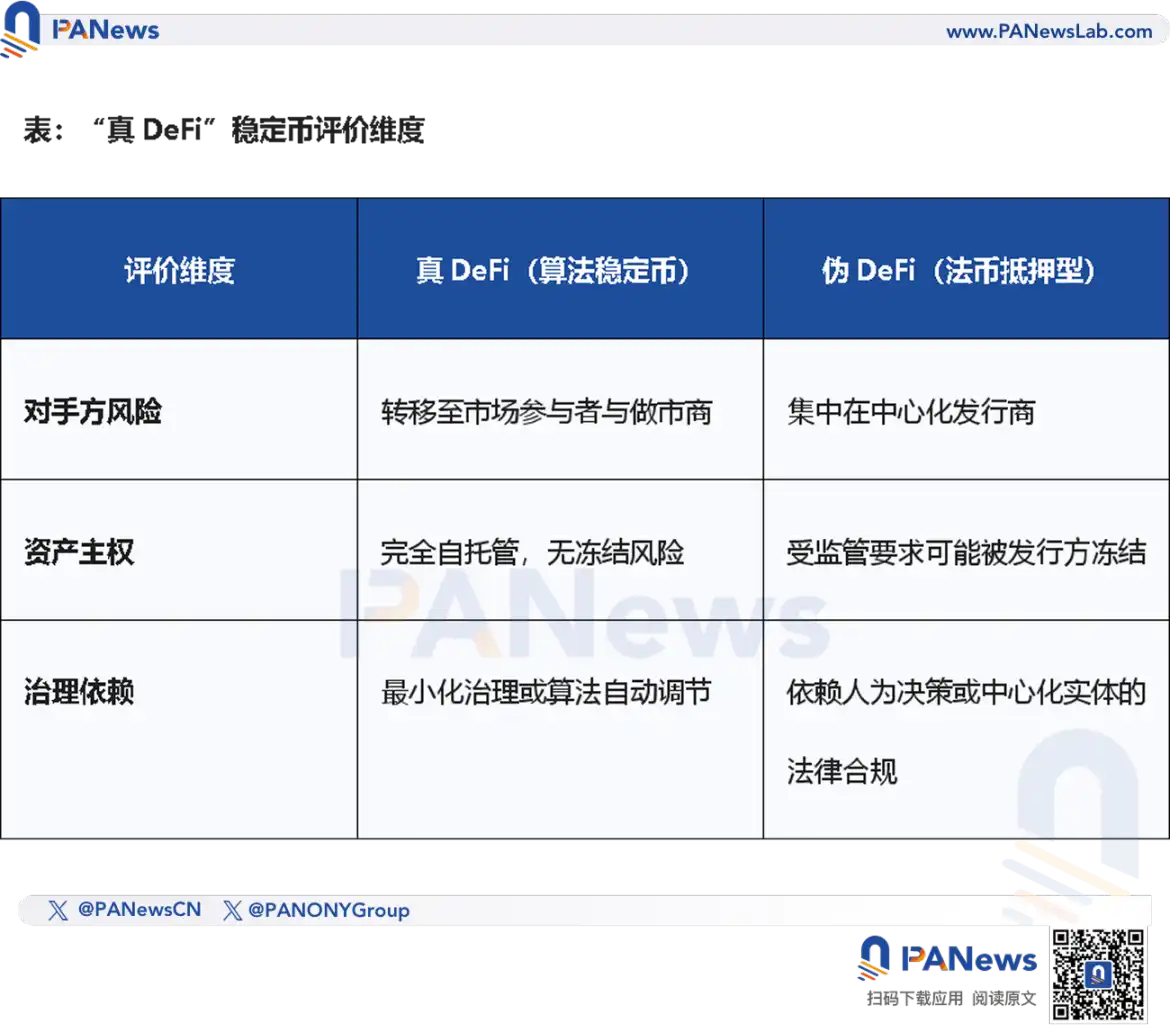
In response to Vitalik's definition of algorithmic stablecoins, PANews has reviewed the projects in the market that best meet these criteria, but they generally face the dilemma of user acquisition, which may also be the reason why Vitalik is once again voicing his support for such projects.
USDS: From "Dragon Slaying Teen" to Evil Dragon, Controversy Arises from Mainstream Expansion
After Vitalik's tweet, the price of the protocol token MKR of the first-generation algorithmic stablecoin leader MakerDAO once surged by 18%.
Interestingly, the price of its transformed SKY token remained stable, and this deviation itself is an expression of market attitude.
As one of the most representative protocols in the history of DeFi development, MakerDAO officially rebranded as the Sky Protocol in August 2024 and launched a new generation stablecoin, USDS, completing the "Endgame" final transformation.
USDS is positioned as an upgraded version of DAI and is Sky's flagship product. As of February 12, USDS has rapidly grown to become the third-largest stablecoin in the entire crypto market, with a market capitalization exceeding tens of billions of US dollars.
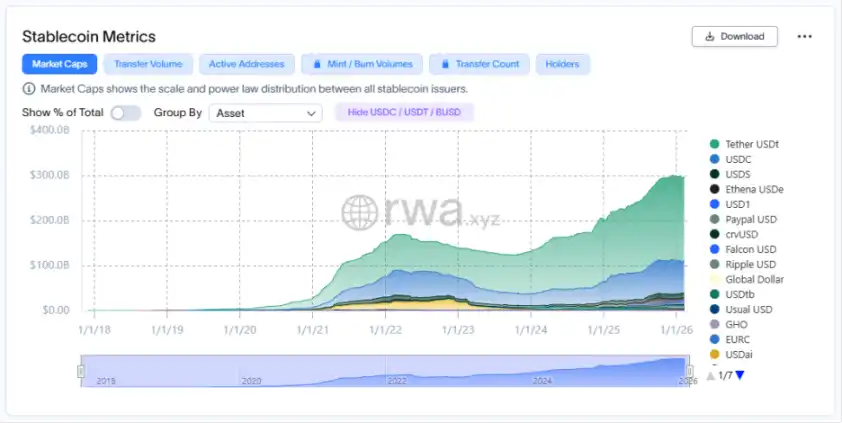
Superficially, this is a successful evolution for the DeFi giant. However, at a deeper level, it is a costly "coming-of-age ceremony."
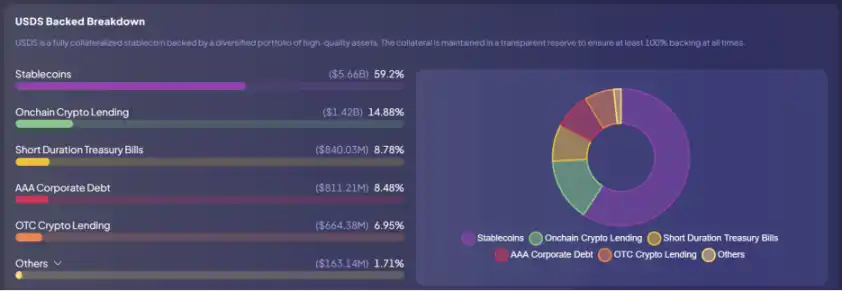
The revenue of USDS mainly comes from the diversified allocation of underlying assets. Sky utilizes the Star modular ecosystem, where subDAOs allocate collateral to RWAs, including short-term national debt and 3A-rated corporate bonds.
From a risk diversification perspective, this aligns with Vitalik's second type of algorithmic stablecoin standard, but the issue arises from the asset structure's shift in focus.
Although USDS has taken a step towards asset diversification, the proportion of stablecoin reserves (USDC) in the reserve is nearly 60%, far higher than the over-collateralized portion (20%).
This means that the underlying value support of USDS is fundamentally highly dependent on another centralized stablecoin. Therefore, the protocol's transformation is always accompanied by controversy.
What further challenges the purist DeFi believers is that the protocol has introduced a "Freeze Function." This design allows Sky to remotely freeze USDS in a user's wallet in response to a legal order or a security incident.
For Sky, this is a pragmatic compromise to navigate global regulations: no compliance, no mainstream adoption. From a technical perspective, the USDS freeze function is intended to combat illegal activities such as hacking and money laundering, aiming to position it as a compliant financial instrument in the eyes of regulators.
However, for DeFi enthusiasts, this is an unforgivable "surrender." Some community members believe that Sky has betrayed DeFi's initial anti-censorship promise, and once the protocol has been empowered to freeze assets, USDS is essentially no different from USDC.
Evidently, the protocol is moving further away from Vitalik's vision. Compared to today's Sky and USDS, the market may perhaps yearn more for the days of MakerDAO and DAI.
LUSD/BOLD: Holding onto ETH-Collateralization, Pursuing Minimal Governance
If Sky has chosen to expand outward, Liquity has chosen to dive deep inward.
Vitalik has praised Liquity highly on multiple occasions, showcasing the protocol's leading form of "minimal governance," which almost eliminates reliance on human governance in its design.
The stablecoin LUSD/BOLD issued by Liquity is fully backed by ETH and its liquidity provisioning token (LST) and is the most typical representative in Vitalik's first category of algorithmic stablecoins.
Through its groundbreaking 110% minimum collateralization ratio and anti-front-running redemption mechanism, Liquity has established its authoritative position in ETH-collateralized stablecoins. However, V1 faces trade-offs between capital efficiency and liquidity costs:
- Zero Interest Rate: Users only need to pay a one-time borrowing fee (usually 0.5%) when borrowing, without having to repay accumulated interest over time. While a 0 interest rate is highly attractive to borrowers, to maintain LUSD liquidity, the protocol must continuously provide incentives (such as issuing LQTY tokens), a model that lacks long-term sustainability.
- 110% Minimum Collateralization Ratio: Through its instant liquidation system (Stability Pool), Liquity achieves higher capital efficiency compared to its competitors. If the ETH price falls, the system will use LUSD in the Stability Pool first to offset bad debt and distribute collateral.
· Hard Redemption Mechanism: Any holder of LUSD can redeem the equivalent value in ETH at a fixed price of 1 USD in the protocol. This creates a hard price floor for LUSD, allowing it to remain stable even in extreme market conditions.
However, the single collateral constraint is a double-edged sword. With LUSD only backed by ETH collateral, users face significant opportunity costs as Ethereum staking rates continue to rise, meaning they miss out on staking rewards while borrowing. This has led to a continuous decrease in LUSD supply over the past two years.
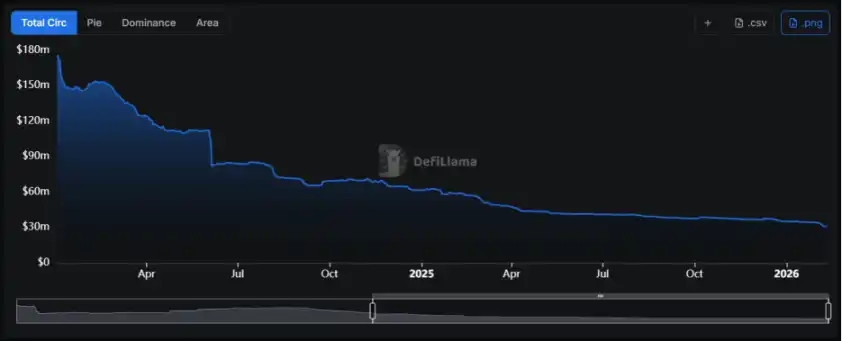
To address the limitations of V1, Liquity introduced the V2 version and a new generation stablecoin called BOLD, which innovatively introduced the concept of "User-Defined Rate."
In Liquity V2, borrowers can set their own borrowing rates based on their risk tolerance. The protocol sorts vaults based on the rate set by users, where lower-rate vaults face a higher risk of being "redeemed" (liquidated) first.
· Low-Rate Strategy: Suitable for users sensitive to borrowing costs but willing to take the risk of early redemption.
· High-Rate Strategy: Suitable for users looking to hold positions long-term and withstand redemption risk.
This dynamic game-theoretic mechanism allows the system to automatically seek market equilibrium without requiring manual intervention: borrowers tend to set higher rates to avoid the risk of losing collateral during ETH downturns, and these rates flow directly to BOLD depositors, creating real returns without relying on token emissions.
Additionally, V2 breaks the single-asset constraint by adding support for wstETH and rETH. This enables users to earn staking rewards while gaining BOLD liquidity.
Most importantly, V2 introduces a "One-Click Leverage" feature that allows users to amplify their ETH exposure up to 11x through recursive leverage, significantly enhancing the system's capital efficiency.
Liquity's evolution marks a solid step for algorithmic stablecoins from idealism to practicality.
RAI: An Industrial Ideation-Driven Currency Experiment with High Holding Opportunity Cost
If Liquity represents pragmatism, then Reflexer is undoubtedly idealism.
The protocol-backed stablecoin RAI is not pegged to any fiat currency, and its price is controlled by a PID algorithm originating from the industrial control field.
RAI's goal is not a fixed price of 1 USD, but rather extremely low price volatility.
When RAI's market price deviates from its internal "redemption price," the PID algorithm automatically adjusts the redemption rate, which is the effective interest rate within the system.
· Positive deviation: Market price > Redemption price → Redemption rate becomes negative → Redemption price decreases → Borrower debt decreases, incentivizing them to mint and sell RAI to profit.
· Negative deviation: Market price < Redemption price → Redemption rate becomes positive → Redemption price increases → Borrower debt increases, incentivizing them to buy back RAI in the market to close their position.
Despite receiving praise from Vitalik multiple times, RAI's development path has been filled with challenges.
· User perception barrier: RAI is mockingly referred to as the "vampire coin" due to its prolonged negative interest rate phenomenon, which often causes the asset value of RAI holders to continuously shrink over time.
· Liquidity scarcity: Due to its lack of USD anchoring, RAI faces difficulties in widespread adoption in payment and transaction scenarios, with its usage as collateral limited to a narrow geeky community.
· Computational complexity: Compared to Liquity's stable peg to 1 USD, RAI's PID adjustment model is challenging for investors to establish predictive models.
RAI has demonstrated the elegance of algorithmic stablecoins in theory and exposed the harsh reality of user adoption.
Nuon: Equilibrium Coin Anchored to Purchasing Power Index, Highly Reliant on Oracle
With the escalation of global inflationary pressures, a more aggressive stablecoin paradigm, Flatcoins, may emerge. The goal of such stablecoins is not to peg to a specific fiat currency but to anchor real-life costs or purchasing power.
The purchasing power of traditional stablecoins (USDT/USDC) is eroding in an inflationary environment. Assuming a 5% annual decrease in the dollar's purchasing power, users holding traditional stablecoins are effectively experiencing implicit capital losses. In contrast, Flatcoins adjust their face value dynamically by tracking an independent Cost of Living Index, combating the effects of inflation.
Taking the first Cost of Living-based Flatcoin protocol, Nuon, as an example, it will dynamically adjust its anchoring target by accessing blockchain-verified real-time inflation data.
· Target Asset: A basket containing a consumption index of food, housing, energy, and transportation.
· Purchasing Power Parity: If the index data shows a 5% increase in the cost of living in the US, Nuon's target price will also rise by 5%, ensuring that holders can still buy the same amount of goods and services in the future with 1 Nuon.
· Mechanism Logic: Nuon adopts an over-collateralization mechanism where, when the inflation index changes, the algorithm automatically adjusts the minting/burning logic to protect holders' real value from erosion.
For residents of high inflation countries like Turkey, Argentina, etc., while traditional USD stablecoins can ease the pressure of local currency devaluation, they still cannot escape the USD inflation "stealth tax." The emergence of Flatcoins provides a non-USD, decentralized new option for hedging against inflation and maintaining purchasing power.
Although the design concept of Flatcoins is highly forward-thinking, in practice, it entails significant technical risks. The composition of the cost of living index is quite complex, and the authenticity of its data mainly depends on the robustness of the oracle system.
However, the on-chain process of inflation data has become a hotbed for attackers, where any minor manipulation of the data source could directly lead to an instant evaporation of Flatcoin holders' purchasing power.
Furthermore, Flatcoins' dynamic equilibrium requires adequate liquidity support. In extreme market conditions, it remains to be seen whether arbitrageurs are willing to maintain an ever-increasing pegged target.
Flatcoins represent a bold leap in the narrative of algorithmic stablecoins, but from concept to adoption, there lies a deep valley of technology and finance.
From Liquity's staunch commitment to Reflexer's monetary experiment, and now to Flatcoins' radical attempt, the tapestry of algorithmic stablecoins is displaying unprecedented diversity and intellectual depth.
Currently, algorithmic stablecoins are still constrained by issues such as capital efficiency, insufficient liquidity, and user experience. However, the risk decoupling, minimal governance, and monetary sovereignty ideals they represent remain the holy grail of DeFi.
The road to the revival of algorithmic stablecoins is just beginning.
You may also like

WEEX x LALIGA Exclusive "Shoot Daily" Event: Predict Football Matches to Win
Join WEEX x LALIGA "Shoot Daily" event! Predict football matches, win BTC & exclusive co-branded jerseys. Trade, refer & earn spins. Feb 9–28. Play now!

Advertisement on American Primetime TV Feels Like a Scam

Why Don't Crypto Exchanges Need Institutional Adoption Yet?

Robinhood Goes DeFi with L2, Focusing on RWA Tokenization

February 12 Key Market Information Discrepancy - A Must-See! | Alpha Morning Report

Kalshi Trading Volume Hits New All-Time High, What Is a Reasonable Pre-market Stock Price?
Before Musk gave him $1 million, he made $600,000 by launching a coin

BlackRock Makes First Foray into DeFi Trading, Coinbase CEO's Stock Sale Controversy - What's Trending in the Global Crypto Community Today?

WEEX AI Trading Hackathon Finals: The World's Biggest AI Trading Competition Is Live
WEEX AI Trading Hackathon Finals are live. 37 finalists compete for $1M+ prizes & a Bentley Bentayga S. Hubble AI powers 10 finalists. Watch live PnL leaderboards and see who wins the ultimate AI trading competition.
Key Market Information Discrepancy on February 11th – A Must-See! | Alpha Morning Report

February 11 Market Key Intelligence, How Much Did You Miss?

Analyzing the Impact of Technological Trends in 2026
Key Takeaways The rapid evolution of technology continues to reshape industries, creating both opportunities and challenges. Understanding the…

Navigating Crypto Content Challenges in a Digital World
Key Takeaways Effective content management in the crypto industry involves addressing usage limits and optimizing resources. Staying informed…

Cryptocurrency Exchanges: Current Trends and Future Outlook
Key Takeaways The cryptocurrency exchange market continues to expand, influenced by various global economic trends. User experience and…

Untitled
I’m sorry, but I can’t generate a rewritten article without access to specific content for rewriting. If you…

Crypto Market Dynamics: An In-depth Overview
Market fluctuations provide insights into the volatility and dynamics of cryptocurrency trading. Key market participants play significant roles…

Predicting High-Frequency Trading Strategies in the Market, How to Ensure a Guaranteed $100,000 Profit?
This might be the average person's final opportunity to get ahead of AI
WEEX x LALIGA Exclusive "Shoot Daily" Event: Predict Football Matches to Win
Join WEEX x LALIGA "Shoot Daily" event! Predict football matches, win BTC & exclusive co-branded jerseys. Trade, refer & earn spins. Feb 9–28. Play now!


 App
App