
Token VS Equity: The Aave Controversy
On December 17, Aave founder and CEO Stani.eth posted on social media that after four years, the U.S. Securities and Exchange Commission had completed its investigation into the Aave protocol.
This was supposed to be an inspiring milestone. However, as Web2 finished its entanglement with the SEC, Aave found itself facing a "backyard fire" in Web3 instead. Over the past half month, Aave's community governance dispute has been a hot topic in the English-speaking community. Around this dispute, there have been a series of events including whale sells, founder "buybacks," governance, and trust issues.
Let's take a look at the background of this event.
Cause: Revenue Distribution Sparks Controversy
On December 4, Aave Labs switched the default Swap feature on its front-end interface aave.com from ParaSwap to CoWSwap.
What was originally just a minor update, Aave DAO's senior governance participant and independent delegate EzR3aL discovered that the fee revenue generated by aave.com's default Swap feature was no longer flowing into the Aave DAO treasury as before but rather into an address controlled by Aave Labs. Based on on-chain investigation, EzR3aL stated that at the time of his post, the recent income transfer by Aave Labs was worth at least $200,000, with a rough estimate of at least $10 million in annual loss for Aave DAO based on the weekly revenue data.
However, Aave Labs did not proactively mention the change in fee revenue distribution, leaving many $AAVE holders feeling "betrayed."
Aave Labs responded multiple times to EzR3aL's post, with the main arguments being:
The protocol and the product are different concepts. The frontend interface that sparked the revenue distribution dispute is a product operated by Aave Labs, completely separate from the protocol managed by Aave DAO, and Aave Labs have the right to decide how to operate and profit.
Maintaining the frontend interface requires significant resources, and Aave DAO was never required to bear these costs.
In the original Paraswap-integrated technical architecture, the donation mechanism was based on surplus. When the actual execution price was higher than the quoted price, the surplus would be donated to Aave DAO. This was not a protocol fee, nor was it a mandatory requirement to give to Aave DAO. With the design changes, the original donation mechanism was naturally discontinued.
The new CoWSwap routing option can improve execution quality, including providing MEV protection for interface users, and this routing option was concocted by Aave Labs with its own resources, and it does not replace or disable the adapters owned by the Aave DAO at the protocol level, allowing the Aave DAO to let any interface integrate its owned adapters to enable swap functionality.
Contention Upgrade: Who Owns "Aave"?
Aave Labs' response to EzR3aL's post has not been understood and accepted by the community.
On December 13, @DefiIgnas published a lengthy article titled "Who Owns Aave: Aave Labs or Aave DAO?," which sparked widespread discussion.
On December 16, former Aave Labs CTO Ernesto released a governance proposal titled "$AAVE Alignment Phase 1: Ownership," advocating for Aave DAO and Aave token holders to explicitly control core rights such as protocol IP, brand, equity, and revenue. Aave service providers representative Marc Zeller and others publicly endorsed the proposal, calling it "one of the most influential proposals in Aave's governance history."
In the proposal, Ernesto mentioned, "Due to some events in the past, some previous posts and comments have shown strong animosity towards Aave Labs. However, this proposal aims to remain neutral. The proposal does not imply that Aave Labs should not contribute to the DAO or lacks the legitimacy or ability to contribute, but the decision should be made by Aave DAO."
On December 18, Aave founder and CEO Stani.eth replied to the proposal, stating that they would strengthen communication between Aave Labs and the community but would vote against the proposal because it simplifies a complex legal and operational issue into a simple "yes or no" vote without a practical solution, affecting Aave's overall development progress.
This further escalated the dispute.
Whale Sell-off, Founder's Market "Rescue"
On December 22, according to on-chain analyst yujianguo's monitoring, the whale address holding the second-largest amount of AAVE sold off 230,000 AAVE tokens (approximately $38 million), causing a short-term price drop of over 10%. The whale exchanged all AAVE for 227.8 WBTC and 5869.4 stETH between 5:40 and 7:05 a.m., reportedly acquiring these AAVE from late last year to early this year at an average cost of about $223.4. This selloff at an average price of around $165 is estimated to incur a loss of $13.45 million.
Shortly after the Whale's exit, Aave Labs announced that the issue needed formal governance decision-making and officially initiated a 3-day snapshot vote.
On December 23, Aave founder and CEO Stani.eth spent 1699 ETH (5.15 million USD) to buy 32,660 AAVE tokens at an average price of 157.78 USD. Including this purchase, he bought a total of 84,033 AAVE tokens within a week at an average price of around 176 USD, spending approximately 14.8 million USD.
However, despite the founder's "market rescue," the price turmoil continued. On December 24, the address starting with "0x3c7," known for "Large AAVE Short," opened a 7x leveraged AAVE short position with a 2.42 million USD position size at an average price of 151 USD and a liquidation price of 173 USD.
There were many doubts and concerns in the market regarding the founder's "market rescue" as well. DeFi strategist and liquidity expert Robert Mullins stated in a post that the purpose of this purchase was to increase Kulechov's voting power to support a proposal in an upcoming vote that directly harms the best interests of the token holders. He added: "This is a clear example that the token mechanism has not been adequately designed to effectively deter governance attacks."
Renowned crypto KOL Sisyphus also expressed similar concerns, suggesting that Kulechov may have sold millions of dollars worth of AAVE tokens between 2021 and 2025 and questioned the economic motives behind this buyback.
Outcome
On December 26, Wintermute's founder and CEO Evgeny Gaevoy stated that Wintermute would vote against the ARFC governance proposal to transfer the "brand asset control of AAVE to the holders."
Evgeny mentioned that the current proposal lacks specific details, and it is not clear how the entity owning the front end and brand would govern, whether it is for-profit, and how it operates. Token value capture is a core issue facing AAVE, and there is a clear mismatch in expectations between Aave Labs and a large number of token holders. Wintermute has been investing in AAVE since 2022 and has participated in its governance. Evgeny hopes that Aave Labs will address the issue of token value capture seriously, which will serve as a reference for other tokens.
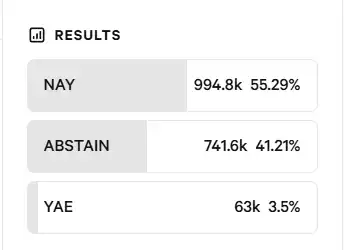
The voting results were also released this morning, with the proposal ultimately not passing, resulting in 55.29% against, 41.21% abstaining, and only 3.5% in favor.
So, is this the end of the dispute? Apparently not, as the lack of trust between the community and Aave Labs remains unresolved. What seemed to be a conflict triggered by poor communication is actually a manifestation of the long-standing contradiction in the crypto world between development/operation teams and governance, where rights and interests are unclear and lack institutional constraints. The entanglement between Aave Labs and Aave DAO actually underscores Aave's success, as there are too many similar examples in the crypto world where such high-quality discussions do not even have the opportunity to occur in an attempt to resolve issues (related reading: Why are projects in the crypto space not asking for tokens in acquisitions?).
This is the problem Aave must face, and it is a problem that the entire cryptocurrency industry will sooner or later have to confront.
You may also like

1 billion DOTs were minted out of thin air, but the hacker only made 230,000 dollars

After the blockade of the Strait of Hormuz, when will the war end?

Before using Musk's "Western WeChat" X Chat, you need to understand these three questions
The X Chat will be available for download on the App Store this Friday. The media has already covered the feature list, including self-destructing messages, screenshot prevention, 481-person group chats, Grok integration, and registration without a phone number, positioning it as the "Western WeChat." However, there are three questions that have hardly been addressed in any reports.
There is a sentence on X's official help page that is still hanging there: "If malicious insiders or X itself cause encrypted conversations to be exposed through legal processes, both the sender and receiver will be completely unaware."
No. The difference lies in where the keys are stored.
In Signal's end-to-end encryption, the keys never leave your device. X, the court, or any external party does not hold your keys. Signal's servers have nothing to decrypt your messages; even if they were subpoenaed, they could only provide registration timestamps and last connection times, as evidenced by past subpoena records.
X Chat uses the Juicebox protocol. This solution divides the key into three parts, each stored on three servers operated by X. When recovering the key with a PIN code, the system retrieves these three shards from X's servers and recombines them. No matter how complex the PIN code is, X is the actual custodian of the key, not the user.
This is the technical background of the "help page sentence": because the key is on X's servers, X has the ability to respond to legal processes without the user's knowledge. Signal does not have this capability, not because of policy, but because it simply does not have the key.
The following illustration compares the security mechanisms of Signal, WhatsApp, Telegram, and X Chat along six dimensions. X Chat is the only one of the four where the platform holds the key and the only one without Forward Secrecy.
The significance of Forward Secrecy is that even if a key is compromised at a certain point in time, historical messages cannot be decrypted because each message has a unique key. Signal's Double Ratchet protocol automatically updates the key after each message, a mechanism lacking in X Chat.
After analyzing the X Chat architecture in June 2025, Johns Hopkins University cryptology professor Matthew Green commented, "If we judge XChat as an end-to-end encryption scheme, this seems like a pretty game-over type of vulnerability." He later added, "I would not trust this any more than I trust current unencrypted DMs."
From a September 2025 TechCrunch report to being live in April 2026, this architecture saw no changes.
In a February 9, 2026 tweet, Musk pledged to undergo rigorous security tests of X Chat before its launch on X Chat and to open source all the code.
As of the April 17 launch date, no independent third-party audit has been completed, there is no official code repository on GitHub, the App Store's privacy label reveals X Chat collects five or more categories of data including location, contact info, and search history, directly contradicting the marketing claim of "No Ads, No Trackers."
Not continuous monitoring, but a clear access point.
For every message on X Chat, users can long-press and select "Ask Grok." When this button is clicked, the message is delivered to Grok in plaintext, transitioning from encrypted to unencrypted at this stage.
This design is not a vulnerability but a feature. However, X Chat's privacy policy does not state whether this plaintext data will be used for Grok's model training or if Grok will store this conversation content. By actively clicking "Ask Grok," users are voluntarily removing the encryption protection of that message.
There is also a structural issue: How quickly will this button shift from an "optional feature" to a "default habit"? The higher the quality of Grok's replies, the more frequently users will rely on it, leading to an increase in the proportion of messages flowing out of encryption protection. The actual encryption strength of X Chat, in the long run, depends not only on the design of the Juicebox protocol but also on the frequency of user clicks on "Ask Grok."
X Chat's initial release only supports iOS, with the Android version simply stating "coming soon" without a timeline.
In the global smartphone market, Android holds about 73%, while iOS holds about 27% (IDC/Statista, 2025). Of WhatsApp's 3.14 billion monthly active users, 73% are on Android (according to Demand Sage). In India, WhatsApp covers 854 million users, with over 95% Android penetration. In Brazil, there are 148 million users, with 81% on Android, and in Indonesia, there are 112 million users, with 87% on Android.
WhatsApp's dominance in the global communication market is built on Android. Signal, with a monthly active user base of around 85 million, also relies mainly on privacy-conscious users in Android-dominant countries.
X Chat circumvented this battlefield, with two possible interpretations. One is technical debt; X Chat is built with Rust, and achieving cross-platform support is not easy, so prioritizing iOS may be an engineering constraint. The other is a strategic choice; with iOS holding a market share of nearly 55% in the U.S., X's core user base being in the U.S., prioritizing iOS means focusing on their core user base rather than engaging in direct competition with Android-dominated emerging markets and WhatsApp.
These two interpretations are not mutually exclusive, leading to the same result: X Chat's debut saw it willingly forfeit 73% of the global smartphone user base.
This matter has been described by some: X Chat, along with X Money and Grok, forms a trifecta creating a closed-loop data system parallel to the existing infrastructure, similar in concept to the WeChat ecosystem. This assessment is not new, but with X Chat's launch, it's worth revisiting the schematic.
X Chat generates communication metadata, including information on who is talking to whom, for how long, and how frequently. This data flows into X's identity system. Part of the message content goes through the Ask Grok feature and enters Grok's processing chain. Financial transactions are handled by X Money: external public testing was completed in March, opening to the public in April, enabling fiat peer-to-peer transfers via Visa Direct. A senior Fireblocks executive confirmed plans for cryptocurrency payments to go live by the end of the year, holding money transmitter licenses in over 40 U.S. states currently.
Every WeChat feature operates within China's regulatory framework. Musk's system operates within Western regulatory frameworks, but he also serves as the head of the Department of Government Efficiency (DOGE). This is not a WeChat replica; it is a reenactment of the same logic under different political conditions.
The difference is that WeChat has never explicitly claimed to be "end-to-end encrypted" on its main interface, whereas X Chat does. "End-to-end encryption" in user perception means that no one, not even the platform, can see your messages. X Chat's architectural design does not meet this user expectation, but it uses this term.
X Chat consolidates the three data lines of "who this person is, who they are talking to, and where their money comes from and goes to" in one company's hands.
The help page sentence has never been just technical instructions.

Parse Noise's newly launched Beta version, how to "on-chain" this heat?

Is Lobster a Thing of the Past? Unpacking the Hermes Agent Tools that Supercharge Your Throughput to 100x

Declare War on AI? The Doomsday Narrative Behind Ultraman's Residence in Flames

Crypto VCs Are Dead? The Market Extinction Cycle Has Begun

Claude's Journey to Foolishness in Diagrams: The Cost of Thriftiness, or How API Bill Increased 100-Fold

Edge Land Regress: A Rehash Around Maritime Power, Energy, and the Dollar

Arthur Hayes Latest Interview: How Should Retail Investors Navigate the Iran Conflict?

Just now, Sam Altman was attacked again, this time by gunfire

Straits Blockade, Stablecoin Recap | Rewire News Morning Edition

From High Expectations to Controversial Turnaround, Genius Airdrop Triggers Community Backlash

The Xiaomi electric vehicle factory in Beijing's Daxing district has become the new Jerusalem for the American elite

Lean Harness, Fat Skill: The Real Source of 100x AI Productivity

Ultraman is not afraid of his mansion being attacked; he has a fortress.

US-Iran Negotiations Collapse, Bitcoin Faces Battle to Defend $70,000 Level

Reflections and Confusions of a Crypto VC
1 billion DOTs were minted out of thin air, but the hacker only made 230,000 dollars
After the blockade of the Strait of Hormuz, when will the war end?
Before using Musk's "Western WeChat" X Chat, you need to understand these three questions
The X Chat will be available for download on the App Store this Friday. The media has already covered the feature list, including self-destructing messages, screenshot prevention, 481-person group chats, Grok integration, and registration without a phone number, positioning it as the "Western WeChat." However, there are three questions that have hardly been addressed in any reports.
There is a sentence on X's official help page that is still hanging there: "If malicious insiders or X itself cause encrypted conversations to be exposed through legal processes, both the sender and receiver will be completely unaware."
No. The difference lies in where the keys are stored.
In Signal's end-to-end encryption, the keys never leave your device. X, the court, or any external party does not hold your keys. Signal's servers have nothing to decrypt your messages; even if they were subpoenaed, they could only provide registration timestamps and last connection times, as evidenced by past subpoena records.
X Chat uses the Juicebox protocol. This solution divides the key into three parts, each stored on three servers operated by X. When recovering the key with a PIN code, the system retrieves these three shards from X's servers and recombines them. No matter how complex the PIN code is, X is the actual custodian of the key, not the user.
This is the technical background of the "help page sentence": because the key is on X's servers, X has the ability to respond to legal processes without the user's knowledge. Signal does not have this capability, not because of policy, but because it simply does not have the key.
The following illustration compares the security mechanisms of Signal, WhatsApp, Telegram, and X Chat along six dimensions. X Chat is the only one of the four where the platform holds the key and the only one without Forward Secrecy.
The significance of Forward Secrecy is that even if a key is compromised at a certain point in time, historical messages cannot be decrypted because each message has a unique key. Signal's Double Ratchet protocol automatically updates the key after each message, a mechanism lacking in X Chat.
After analyzing the X Chat architecture in June 2025, Johns Hopkins University cryptology professor Matthew Green commented, "If we judge XChat as an end-to-end encryption scheme, this seems like a pretty game-over type of vulnerability." He later added, "I would not trust this any more than I trust current unencrypted DMs."
From a September 2025 TechCrunch report to being live in April 2026, this architecture saw no changes.
In a February 9, 2026 tweet, Musk pledged to undergo rigorous security tests of X Chat before its launch on X Chat and to open source all the code.
As of the April 17 launch date, no independent third-party audit has been completed, there is no official code repository on GitHub, the App Store's privacy label reveals X Chat collects five or more categories of data including location, contact info, and search history, directly contradicting the marketing claim of "No Ads, No Trackers."
Not continuous monitoring, but a clear access point.
For every message on X Chat, users can long-press and select "Ask Grok." When this button is clicked, the message is delivered to Grok in plaintext, transitioning from encrypted to unencrypted at this stage.
This design is not a vulnerability but a feature. However, X Chat's privacy policy does not state whether this plaintext data will be used for Grok's model training or if Grok will store this conversation content. By actively clicking "Ask Grok," users are voluntarily removing the encryption protection of that message.
There is also a structural issue: How quickly will this button shift from an "optional feature" to a "default habit"? The higher the quality of Grok's replies, the more frequently users will rely on it, leading to an increase in the proportion of messages flowing out of encryption protection. The actual encryption strength of X Chat, in the long run, depends not only on the design of the Juicebox protocol but also on the frequency of user clicks on "Ask Grok."
X Chat's initial release only supports iOS, with the Android version simply stating "coming soon" without a timeline.
In the global smartphone market, Android holds about 73%, while iOS holds about 27% (IDC/Statista, 2025). Of WhatsApp's 3.14 billion monthly active users, 73% are on Android (according to Demand Sage). In India, WhatsApp covers 854 million users, with over 95% Android penetration. In Brazil, there are 148 million users, with 81% on Android, and in Indonesia, there are 112 million users, with 87% on Android.
WhatsApp's dominance in the global communication market is built on Android. Signal, with a monthly active user base of around 85 million, also relies mainly on privacy-conscious users in Android-dominant countries.
X Chat circumvented this battlefield, with two possible interpretations. One is technical debt; X Chat is built with Rust, and achieving cross-platform support is not easy, so prioritizing iOS may be an engineering constraint. The other is a strategic choice; with iOS holding a market share of nearly 55% in the U.S., X's core user base being in the U.S., prioritizing iOS means focusing on their core user base rather than engaging in direct competition with Android-dominated emerging markets and WhatsApp.
These two interpretations are not mutually exclusive, leading to the same result: X Chat's debut saw it willingly forfeit 73% of the global smartphone user base.
This matter has been described by some: X Chat, along with X Money and Grok, forms a trifecta creating a closed-loop data system parallel to the existing infrastructure, similar in concept to the WeChat ecosystem. This assessment is not new, but with X Chat's launch, it's worth revisiting the schematic.
X Chat generates communication metadata, including information on who is talking to whom, for how long, and how frequently. This data flows into X's identity system. Part of the message content goes through the Ask Grok feature and enters Grok's processing chain. Financial transactions are handled by X Money: external public testing was completed in March, opening to the public in April, enabling fiat peer-to-peer transfers via Visa Direct. A senior Fireblocks executive confirmed plans for cryptocurrency payments to go live by the end of the year, holding money transmitter licenses in over 40 U.S. states currently.
Every WeChat feature operates within China's regulatory framework. Musk's system operates within Western regulatory frameworks, but he also serves as the head of the Department of Government Efficiency (DOGE). This is not a WeChat replica; it is a reenactment of the same logic under different political conditions.
The difference is that WeChat has never explicitly claimed to be "end-to-end encrypted" on its main interface, whereas X Chat does. "End-to-end encryption" in user perception means that no one, not even the platform, can see your messages. X Chat's architectural design does not meet this user expectation, but it uses this term.
X Chat consolidates the three data lines of "who this person is, who they are talking to, and where their money comes from and goes to" in one company's hands.
The help page sentence has never been just technical instructions.
