
The Trillion-Dollar Stablecoin Battle: Binance Decides to Step in Again

 Prefer us on Google


Original Title: "The Trillion-Dollar Stablecoin Battle, Binance Decides to Intervene Again"
Original Author: Lin Wanwan, Dongcha Beating
By 2024, the total on-chain transaction volume of stablecoins had reached $27.6 trillion, surpassing the sum of Visa and Mastercard for the first time.
This number was $300 billion five years ago and close to zero ten years ago.
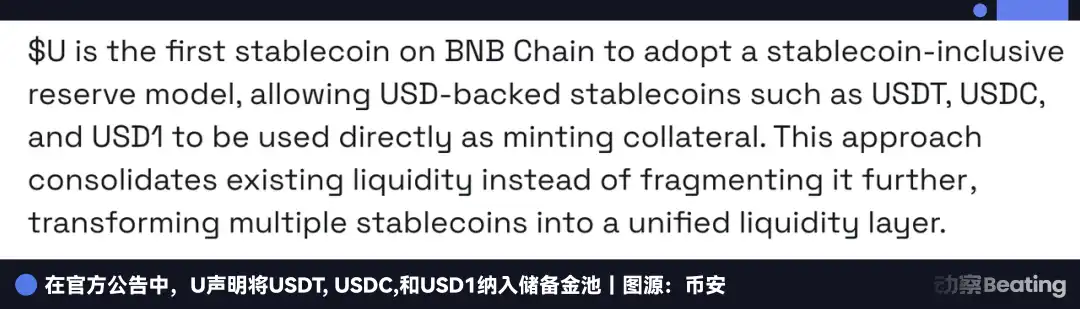
On December 18, a project named United Stables launched a new type of stablecoin $U in Dubai. Its reserve is not in US dollars or treasury bonds, but in a combination of USDC, USDT, and USD1 stablecoins. Using one stablecoin as collateral for another stablecoin is referred to as "nested doll."
Binance Wallet was the first to integrate, with endorsement from the BNB Chain official, and full support from PancakeSwap and Four.Meme.
The implications of this setup in the crypto community are clear: Binance is personally intervening.
$U itself may be insignificant. But the trend it represents: stablecoins transitioning from a wild growth phase to a fragmented landscape, a new battle is unfolding.
Stablecoin 1.0 Era: The Monopoly of the Early Movers
The essence of stablecoins is the "on-chain dollar," where users deposit 1 US dollar with the issuer and receive 1 token, which can circulate 24/7 on any global blockchain, with instant transactions and minimal fees.
Compared to Alipay or bank transfers, the core advantage of stablecoins is no real-name requirement, no need for a bank account, and no regulatory permission. A wallet address is the only barrier to entry.
In 2014, when Tether issued USDT, the entire crypto market cap was less than $5 billion. The window of opportunity Tether seized was: traditional banks widely refused to serve cryptocurrency companies. For those looking to cash out after profiting from trading, the only way was to convert crypto assets into USDT to lock in profits pegged to the dollar.
The rise of USDT was not only due to its excellent product but also because users had no other choice. This "passive monopoly" has continued to this day, with USDT having a market cap of around $199 billion as of December 2025, occupying 60% of the stablecoin market share.
In 2018, Circle teamed up with Coinbase to launch USDC, focusing on the compliance card: releasing monthly reserve audit reports, funds held by regulated financial institutions, and embracing the US securities regulatory framework. The implication was that Tether's black-box model would eventually face issues.
In 2022, the market capitalization of USDC once approached 70% of USDT's. Wall Street bet on the compliance camp to eventually win.
In March 2023, Silicon Valley Bank collapsed with Circle holding $3.3 billion in reserves there. USDC briefly broke its peg to $0.87, where an asset always equal to 1 US dollar lost 13%.

The lesson learned by the market was: Compliance is a bonus point but not a moat. Banks will collapse, regulations will shift, the real barrier is network effect—when your user base and liquidity are large enough, you are effectively the standard.
The survival rule of the Stablecoin 1.0 era was only one: First-mover advantage is greater than everything.
Binance's Three Reversals
A trading platform is the traffic hub of the crypto world, and a stablecoin is the unit of account for trading. Whoever controls the mainstream stablecoin holds the pricing power. Binance could not afford to lose this position.
In 2019, Binance partnered with the New York-regulated trust company Paxos to issue BUSD. This was a compliant stablecoin regulated by the New York Department of Financial Services, peaking at a market cap of $16 billion, second only to USDT and USDC.
BUSD once accounted for 40% of Binance's trading volume. It was the core tool for Binance to establish its own "minting right."
In February 2023, the SEC issued a Wells Notice to Paxos, accusing BUSD of being an unregistered security. On the same day, the New York Department of Financial Services ordered Paxos to cease minting new BUSD. Nine months later, Binance founder CZ pleaded guilty in the US, and Binance paid a $4.3 billion fine.
A $16 billion stablecoin asset was wiped out under the regulatory crackdown.
Binance's response was swift. Shortly after BUSD was halted, Hong Kong-based First Digital introduced FDUSD, coincidentally launching during the time window of the Hong Kong virtual asset licensing regime. FDUSD quickly became one of the main stablecoins on the Binance platform, although the two parties never publicly confirmed their partnership.
From BUSD to FDUSD was a passive move for survival; from FDUSD to $U was an active deployment.
The design logic of U is radically different from the former two: it does not compete directly with USDT, USDC, or USD1, but rather incorporates them all into its reserve pool. In a sense, U is a "stablecoin of stablecoins," or a "stablecoin ETF."
Binance's lesson is: a stablecoin reliant on a single regulatory framework always has its lifeline controlled by others.
Entry of the Presidential Family
The most noteworthy asset in U's reserve is USD1.
In March 2025, the Trump family issued the USD1 stablecoin through World Liberty Financial. As disclosed publicly, Trump family-related entities hold a 60% stake in the parent company and receive a 75% share of the net income. Trump himself serves as the "Chief Cryptocurrency Advocate," with his sons Eric and Little Donald serving as "Web3 Ambassadors."
By December 2025, the Trump family had made over $1 billion in profits from the project.
Two months after the USD1 issuance, it received its first major transaction: the Abu Dhabi sovereign wealth fund MGX invested $20 billion in Binance, with USD1 as the payment tool.
This marked the largest cryptocurrency payment in history, instantly providing a newborn stablecoin with a $2 billion "real-world endorsement."
As of December, USD1 had a market capitalization of around $2.7 billion, ranking seventh among stablecoins and becoming one of the fastest-growing stablecoins.
Now, USD1 has been included in U's reserve, implying an implicit chain of interests: Binance's ecosystem trading volume partially converts into USD1's use cases; USD1's use cases partially convert into the Trump family's income.
A deeper game is the realization of political capital. After Trump's return to the White House, the SEC suspended investigations into multiple crypto projects, including cases involving Sun Yuchen, the main investor in World Liberty Financial. Treasury Secretary Benet made a clear statement at the White House Cryptocurrency Summit: "We will use stablecoins to maintain the dollar's status as the world's reserve currency."
Stablecoins are no longer just financial instruments; they are becoming vehicles for political resources.
-- Price
Nesting Doll Logic
Collateralizing a stablecoin with another stablecoin may seem redundant. However, there are three underlying considerations behind this design.
Risk Diversification. USDT's vulnerability lies in its opaque reserve; USDC's vulnerability lies in its overreliance on the U.S. banking system, as evidenced by the Silvergate Bank incident; USD1's vulnerability lies in its deep ties to the political fate of Donald Trump. Holding any one of them alone exposes you to its specific risk. By combining all three, theoretically, risk can be hedged.
Liquidity Aggregation. The pain point of the stablecoin market is liquidity fragmentation. USDT has its own USDT liquidity pool, USDC has its own USDC liquidity pool, and funds are scattered across dozens of public chains and hundreds of DeFi protocols. $U attempts to connect these isolated pools, providing users with a unified liquidity gateway.
Narrative Upgrade. The competitive dimension of stablecoin 1.0 has been "who is more transparent" and "who is more compliant," a narrative that has been around for a decade. $U attempts to provide a new narrative framework: "a settlement currency designed for the AI era" and "support for gasless signature transfers."
Of course, gasless transfers are part of the EIP-3009 standard, existing since 2020, and already supported by USDC. Therefore, being "AI-native" is an all-encompassing label; any on-chain stablecoin can be called by smart contracts and achieve machine-to-machine payments. The true differentiation of $U lies not in technology but in its ecosystem and aggregation architecture.
Of course, a nesting structure also implies risk transmission; if one layer encounters issues, all layers are affected.
If USDT faces a meltdown someday, $U will not plummet to zero, but it will certainly suffer an impact: shrinking reserves, a sudden surge in redemptions, and increased risk of becoming unpegged.
The so-called "risk diversification" is more accurately described as "diversifying the impact intensity of single points of failure," ensuring that holders do not lose everything if any underlying asset encounters issues. This is a form of worst-case scenario thinking rather than risk-free design.
From Gray Area to Geopolitical Game
2025 marks the regulatory first year of stablecoins.
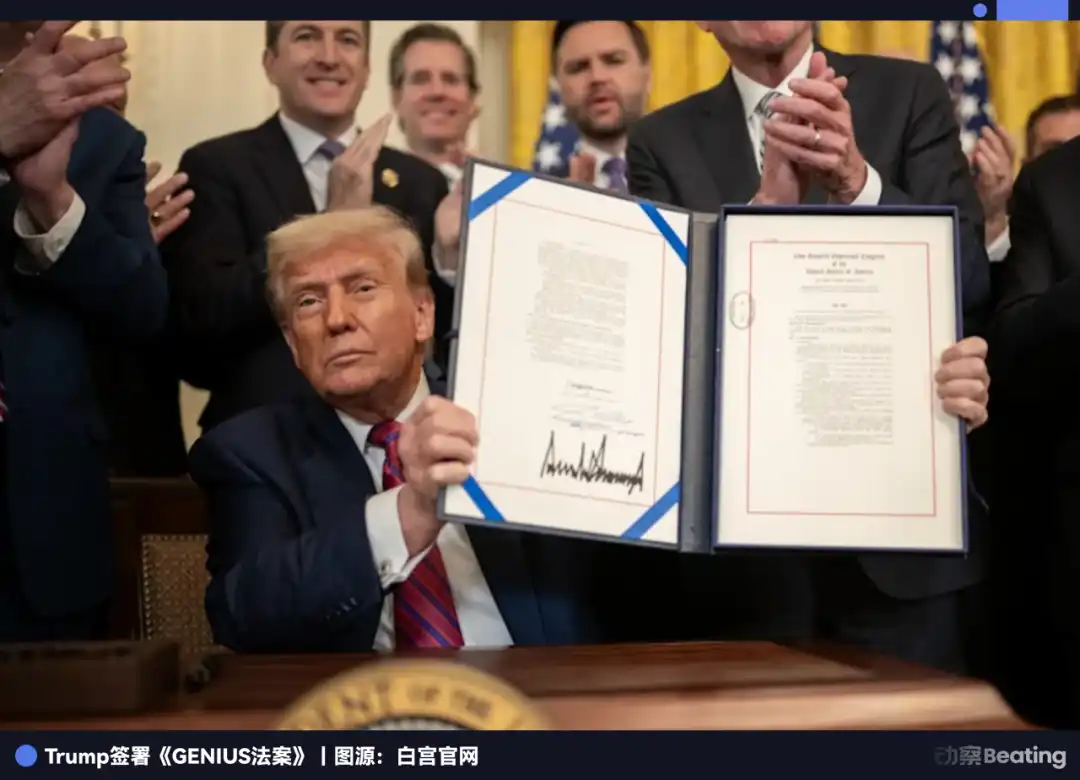
In June, Circle went public on the NYSE, with an IPO price of $31, closing at $69 on the first day, approaching a market value of $200 billion, becoming the "first stablecoin stock." The same month, the U.S. Senate passed the "GENIUS Act" with 68 votes, establishing a federal regulatory framework for stablecoins for the first time. The EU's MiCA regulation came into full effect, and licensing systems were successively introduced in Hong Kong, Japan, and Singapore.
Over the past decade, stablecoins have existed in a gray area where regulatory agencies lacked intervention grounds. Now, with transaction volumes surpassing the world's largest payment networks, no government can feign ignorance any longer.
Data shows: 34% of adults in Turkey hold USDT to hedge against the devaluation of the lira; nearly three tenths of Nigeria's diaspora remittances are completed via stablecoins; Argentina's tech professionals commonly receive salaries in USDC to bypass local currency inflation. In these countries, stablecoins have become the de facto "shadow dollar."
The foundation of the US dollar's dominance lies not in the Federal Reserve's capacity to print money, but in the inertia of global trade settlement pricing in dollars. If stablecoins become the new generation's cross-border payment infrastructure, controlling stablecoins means controlling the digital age's US dollar dominance.
This is the deep logic behind the Trump family's entry into the field and also why the "GENIUS Act" was able to achieve rare bipartisan consensus: in Washington, stablecoins are no longer a niche topic in the crypto community but a strategic resource that concerns national interests.
The Tipping Point
Whether $U will succeed is still up in the air. Its current circulating market value is negligible compared to the nearly $200 billion USDT and nearly $80 billion USDC.
But it represents a new paradigm of stablecoin competition.
In the 1.0 era, the competition was a solo battle: Tether established a monopoly with first-mover advantage, Circle attempted to leverage compliance to gain market share, and Binance vied for pricing power through BUSD. The core issue of the competition was "who can survive."
In the 2.0 era, the competition involves alliances. PayPal issued PYUSD, Ripple introduced RLUSD, Robinhood partnered with Galaxy Digital and Kraken to form the USDG Alliance. Traditional financial giants, native crypto players, sovereign capital, and political forces have all joined in.
The new core issue has become "who can bring more people together."
$U's strategy is to aggregate through "nesting dolls": not antagonizing any party but making everyone their "underlying asset." Binance's intention is to build a "decentralized centralization": using an aggregate architecture to disperse regulatory risks while maintaining control over the core ecosystem.
This battle of a hundred schools of thought has no final outcome. The regulatory balance is still swinging, technological boundaries are still expanding, and political variables are still accumulating.
One thing is certain: stablecoins have evolved from a sideshow of cryptocurrency to a critical infrastructure of the global financial system. With an annual transaction volume of $27 trillion, it is enough to make anyone underestimating it pay the price.
This content is provided for general informational purposes only and doesn't constitute financial, investment, legal, or tax advice. Any events, rewards, online promotions, or related information mentioned herein should not be considered a recommendation, solicitation, or invitation to purchase, sell, trade, or otherwise deal in any crypto assets. Crypto assets are highly volatile and may result in loss. The availability of WEEX services, products, and related events may vary by region. You are responsible for ensuring that your participation is in accordance with applicable local laws and regulations.
You may also like

TapeOut Implements 2.22Hz CPU on BNB Chain
BNB Chain Increases Transaction Capacity by 88% on BSC Test Network

Swan Treasury Private Key Leak Results in Loss of Approximately $625,000
Wemade's WEMIX Dollar Hacked, Unauthorized Issuance of Tokens Worth 8 Billion Won
61.7% of Benji Assets on BNB Chain

B² Network Suffers Hack with Losses of Approximately $3.86 Million
CardBox Partners with CGC to Deliver Over 10,000 Graded Cards Monthly

Uniswap's Proposal to Charge Fees on v4 Trades and Robinhood's v2 and v3 Protocols Enters Voting Phase

T. Rowe Price launches first actively managed multi-token crypto ETF TKNZ

BNB Plus Faces Nasdaq Trading Suspension, Stock Plummets 99.99%

Robinhood Chain Achieves $3.1 Billion in DEX Trading Volume in First Week

BNB Plus Corp. Receives Nasdaq Delisting Notice, to Transition to OTCQB Market
BNB Chain Updates Node Software for Faster Performance

He Yi Says Online Interactions Should Not Be Market Indicators, BNB Chain Meme Coins Need Better Aesthetics

He Yi Endorses Direct BNB Purchases from CZ or Himself
BNB Agent Studio now supports one-click connection to CoinMarketCap market data

The logistics supply chain RWA platform CARFI announces the issuance of CFUSD
YZi Labs has reached a cooperation agreement with CEA Industries to terminate the agency rights dispute
Web3 data analysis platform AiTraceRoot completes $3.5 million strategic financing

Humanity released a security incident investigation report, the main network bridge was not affected, and the attack tools and methods have characteristics of North Korean hackers

MILC Media Metaverse experienced a key leak incident on the cross-chain bridge between BNB and Ethereum, resulting in a loss of approximately $160,000

Slow Fog: The DTXT/USDT trading pair on BSC was attacked, resulting in a loss of approximately 35,000 USDT
Grayscale submitted the third version of the BNB ETF S-1 amendment to the U.S. SEC, with the code GBNB

TesseraDao was attacked, hackers minted 99 million TSR and cashed out 2.5 million dollars
B.AI, in collaboration with BNB Chain, has launched an AI Token subsidy event with a joint prize pool of $8,000
The BNB Chain MVB10 project BitRing is about to launch its genesis airdrop test and introduce the "fitness mining" mechanism
StandX revealed that it will conduct a TGE within the year and plans to launch the on-chain options product SIP-4 soon
BNB Chain launches the Agent Survival Toolkit, partnering with six major AI infrastructure partners to empower autonomous AI Agents with on-chain autonomous payment capabilities

Vitalik talks about the future of the Ethereum Foundation: a smaller, more distinctive, yet more enduring ship

The latest report from GrayScale indicates that regulatory clarity may prioritize mainstream blockchains in attracting institutional funding
TapeOut Implements 2.22Hz CPU on BNB Chain
BNB Chain Increases Transaction Capacity by 88% on BSC Test Network
Swan Treasury Private Key Leak Results in Loss of Approximately $625,000
Wemade's WEMIX Dollar Hacked, Unauthorized Issuance of Tokens Worth 8 Billion Won
61.7% of Benji Assets on BNB Chain
B² Network Suffers Hack with Losses of Approximately $3.86 Million

Contents
Latest articles



Latest coin listings on WEEX


