
- Buy Crypto
- Markets
 Futures
- Spot
- Copy Trade
 Earn
Earn- More
The derivatives track leads the next bull market. MYX Finance is about to issue a token. Can it take over Hyperliquid's "wealth-making legend"?

In 2024, Bitcoin broke through all the way, setting new highs in the fourth quarter, successfully breaking through the $100,000 mark, and detonating the crypto market. People exclaimed, "The familiar taste is back!"
Although the spectacular market of "thousands of coins rising together" has not yet arrived, with the reshaping of global geopolitical relations, the improvement of US regulatory expectations, and the acceleration of traditional finance to include BTC and other head tokens in its balance sheet, it can be confirmed that the "wealth code" will soon be on the stage - the author found through combing through the recent TGE project tokens that with the explosion of the popular derivatives protocol Hyperliquid, the derivatives track may lead this round of "wealth narrative".
"Derivatives Wealth Narrative" Leads the Way, Hyperliquid and MYX Finance "Scramble for Land" on the Chain
From the perspectives of macro regulation, market space, and protocol fundamentals, we can find that the decentralized derivatives trading track is undoubtedly one of the most promising tracks after a simple analysis.
First, with the Trump administration taking office in January next year, crypto regulation will usher in clear regulatory rules and a relaxed market environment. Mainstream institutions will accelerate their entry into the crypto trading market, which will increase the overall trading volume of spot and derivatives trading. Based on overseas users' preference for security and privacy, especially after the FTX crash in the United States, the decentralized derivatives protocol on the chain is undoubtedly more attractive than CEX in the market due to its transparency and security.
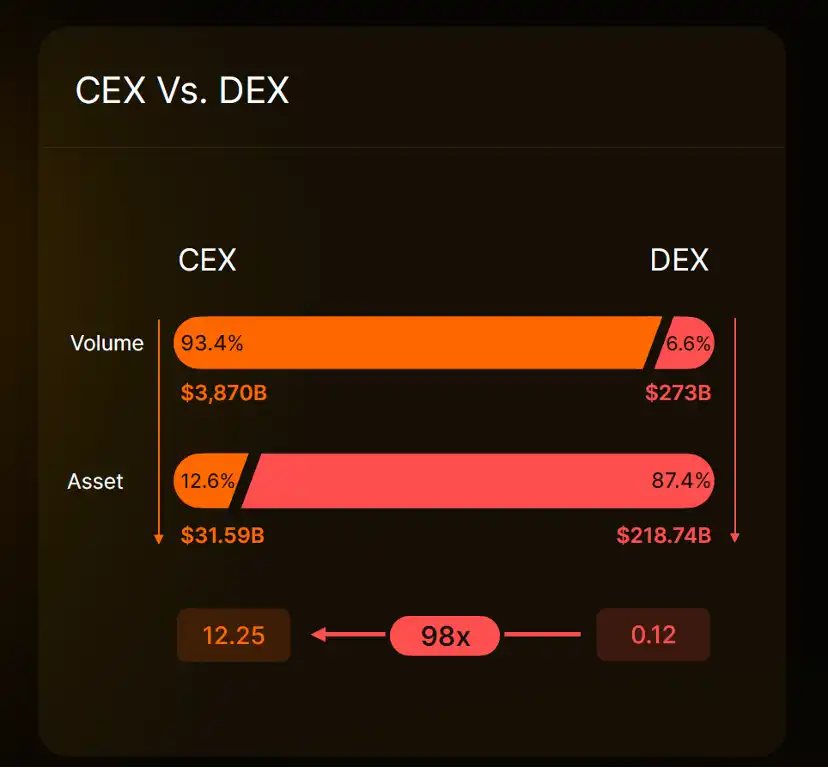
Secondly, judging from the stock capital data of the crypto market, crypto users have assets of approximately US$31.59 billion in CEX, accounting for only 12.6% of total assets, while the monthly spot trading volume of these users on CEX is as high as US$3.87 trillion, accounting for 93.4% of total trading volume. In contrast, crypto users have US$281.74 billion on-chain, accounting for 87.4% of total crypto assets, but the monthly spot trading volume on the chain is only US$273 billion, accounting for 6.6% of total trading volume. The "mismatch" of assets and trading volume shows us that CEX is still the main trading platform for crypto users, while DEX is more of a "test field" - if DEX can make breakthroughs in throughput, user experience, scalability, etc., and optimize user trading experience, on-chain assets will inevitably save the redundant steps of withdrawing coins to CEX transactions and trade directly on DEX, and decentralized DEX will be able to realize the potential trading market of huge assets on the chain and usher in a huge wave of growth.
From the perspective of DEX product experience, in the past few years, DEX and derivatives protocols have made great progress in product form, functional experience, etc. in response to the traditional pain points of CEX. For example, Hyperliquid and Synfutures, which have been listed, and MYX Finance, which has not yet been listed, have fixed their respective product positioning, provided high-level user experience, and attracted users in the on-chain world, which is quite similar to the domestic Internet era.
For example, Hyperliquid, which is in the limelight, tried to create a "CEX on the chain" by building a high-performance Hyperliquid L1. It once became the hottest Perp DEX in the English region, and it has the momentum to compete with dydx. After TGE, the total market value of HYPE tokens once reached 4.91 billion US dollars, exceeding the total market value of OKB, the token of the top CEX platform. MYX Finance, a popular project that is rumored to be launching a token soon, has opened up liquidity in cross-chain scenarios, linking isolated ecosystems and multiple chains, and has magnified asset liquidity by dozens of times by creating a "chain abstract liquidity layer" and its original MPM mechanism. It has swept the on-chain trading users and become the fastest growing multi-chain Perp DEX in 2024. The author mentioned these two projects to illustrate through the following analysis that HYPE and MYX may continue to ignite the derivatives track and bring a strong wealth effect.
Hyperliquid "wealth effect" with an average airdrop of $84,300
Driven by the above background, derivatives protocols such as Hyperliquid and Synfutures have successively held TGEs, creating extremely eye-catching market performances, among which Hyperliquid's market performance is particularly outstanding.
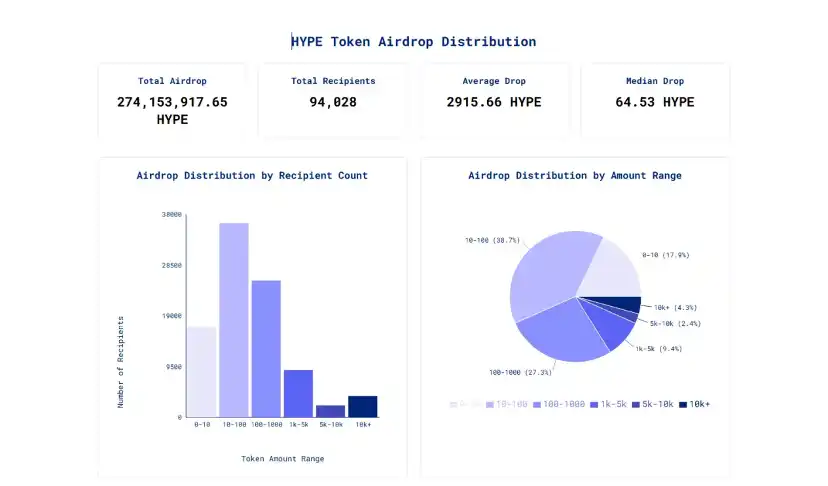
On November 29, the decentralized derivatives protocol Hyperliquid announced the creation of its native token HYPE. After HYPE went online, it soared from the opening price of $2 to $14.86 on December 7, a 643% increase in just one week. Since then, the price of the coin has continued to rise, reaching a high of $28.91 on December 17, an increase of 134.55%. According to statistics, a total of 310 million tokens were distributed in the Hyperliquid Genesis event. Even if calculated at the opening price of $2, the airdrop scale reached $620 million; if calculated based on the price on December 17, the total airdrop scale was as high as $9.325 billion. The actual number of Hyperliquid airdrops was about 274 million tokens, and a total of 94,000 addresses received airdrops - that is, the average HYPE airdrop received 2,915 HYPEs per person, worth about $84,300, or more than 600,000 yuan!
Based on strong product power, user base and reasonable token economics, HYPE has created a wave of "phenomenal" growth, but unfortunately, before and after Hyperliquid released the airdrop, the Chinese community did not give it due attention, and many KOLs and retail investors who focused on making money also missed this wave of "wealth codes" - HYPE's "like stepping into the air" made us have to carefully scan the derivatives protocol track so as not to miss the next wealth code.
"Chain Abstract Liquidity Layer" MYX Finance: The most anticipated derivatives wealth code in 2025
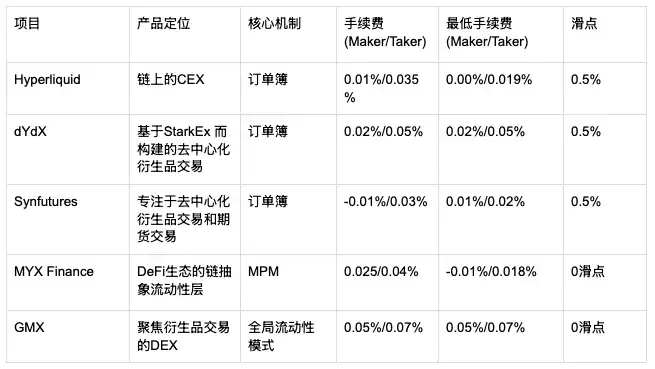
Hyperliquid's wealth effect has indeed brought a wave of "massive traffic" to the derivatives track. Many DEXs and even protocols in other tracks that have never been heard of want to take advantage of this wave of hot spots and bring some exposure to their projects, but this also brings a lot of interference information to investors. The author hopes to comprehensively sort out the derivatives trading protocols with comprehensive strength, including Hyperliquid, dYdX, Synfutures, MYX Finance, GMX, etc., from the dimensions of product positioning, growth potential, trading performance, and token economics, and compare various indicators to determine whether a project is worth looking forward to. On the whole, MYX Finance may be the derivatives protocol with the best chance to take over HYPE and become the wealth code in 2025.
Many CEX users may not be familiar with MYX Finance. The founding team of the MYX project comes from the TOP3 CEX, traditional financial institutions and VCs. The project received investment from Sequoia, Consensys, and Hack VC in last year's seed round of financing. In February of this year, the project was officially launched on the mainnet. It is currently deployed on three chains, Arbitrum, Linea and opBNB, and supports derivative transactions of more than ten assets including BTC and ETH. This also leads to a point that the author wants to emphasize very much. Let’s not look at the "empty" gimmicks such as financing and endorsement. Everything serves the user's trading experience.
The author has been trading in MYX Finance for more than half a year. From May to now, as a user, the perception on the product side is still relatively strong. It can be seen that MYX Finance is a very down-to-earth team that is willing to listen to the voice of users. Especially in the second half of 2024, MYX Finance has promoted product-side cooperation with Particle, zkPass, OKX Wallet, Halo Wallet and other protocols while optimizing protocols and products and launching Telegram trading applet. It has realized the automatic creation of wallets for social media/mobile phone logins and seamless cross-chain transactions, bringing users on the chain a trading experience equivalent to CEX.
(1) Product Advantages: Trading Scenarios
In terms of product positioning, MYX Finance aims to create a "chain abstraction liquidity layer" protocol to solve the two major problems of DEX "liquidity" and "ease of use". While providing a CEX-level trading experience, it retains the composability and scenario innovation potential of DEX.
In order to solve the liquidity problem, the current leading dYdX and the well-known Hyperliquid both adopt the traditional order book model (CLOB). Although this model provides similar trading depth and user experience to CEX, it requires a large number of market makers to provide liquidity, and the funds of market makers are fragmented and locked at different prices, resulting in extremely low capital utilization efficiency and high data storage and computing costs - this is obviously not in line with the ideal product form of DEX; GMX V2, GNS and other protocols use a hybrid mechanism of P2Pool, integrating the advantages of order books, AMMs, virtual AMMs and other mechanisms, with a good user trading experience, but due to the complexity of the system, it requires high development and operation capabilities, and due to the diversity of LP composition and different interests, governance is also difficult.
To address the liquidity issues in on-chain transactions, MYX Finance’s answer is the MPM (Matching Pool Mechanism) market-making mechanism. On the basis of introducing a liquidity pool, MYX Finance uses funding rates and Maker rebates to balance the interests of both long and short parties. Under the incentive of funding fees, the ratio of the number of open contracts between long and short parties is often close to 50:50, in order to solve the long-term position imbalance problem. By introducing high-frequency market makers through Maker rebates, MYX also solves the imbalance problem caused by medium and high-frequency users.
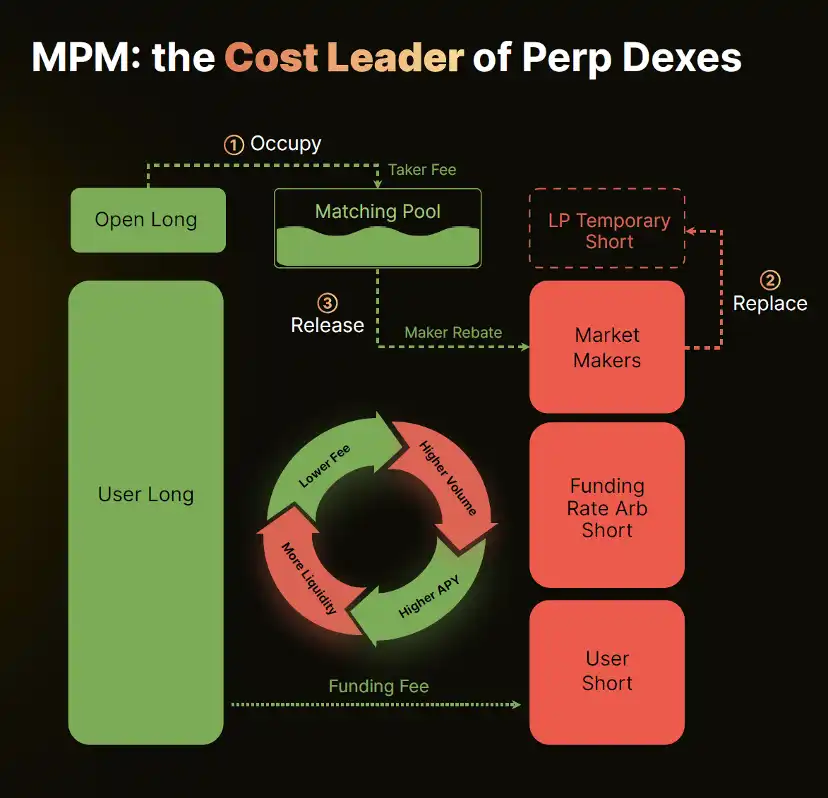
The innovation of MYX Finance’s market-making mechanism demonstrates higher capital efficiency than traditional P2Pool. In an environment where long and short positions grow alternately, MPM can use limited funds to support a position size that is dozens of times larger than its own, greatly improving the capital efficiency and returns of LPs. When the market is unbalanced, LPs on MYX Finance can clearly manage their own exposure, flexibly choose to hedge passive positions in other markets, or bear the profits and losses caused by position fluctuations, gaining greater strategic space and risk management flexibility.
The MPM mechanism is not only extremely friendly to LPs, but also brings traders a trading experience that surpasses CEX - strong liquidity not only brings a 0-slippage, seamless trading experience, but also reduces users' transaction costs to an extremely low level - whether compared with the top 3 CEXs or DEXs such as dYdX and Hyperliquid, MYX Finance's transaction fees are much lower. Combined with the recent VIP equity activities, high-frequency traders can save tens of thousands of dollars in fees every month.
(2) Product advantages: cross-chain scenarios
In cross-chain trading scenarios, MYX Finance uses chain abstraction architecture to solve the liquidation problems and composability limitations of CEX. With the help of account abstraction wallets, it greatly improves the utilization efficiency of single-chain assets, unpopular assets, and liquidity-depleted assets, releases the potential of various types of assets, and further optimizes the trading experience brought by the MPM mechanism.
Specifically, suppose we open a contract order for an unpopular asset/restaking token/low-liquidity asset on CEX, and this transaction is unfortunately liquidated. Due to the restrictions of specific on-chain rules/lack of liquidity/imperfect cross-chain technology, the liquidated assets may not be able to cover the debt owed. MYX Finance uses the chain abstraction architecture to open up asset liquidity between multiple chains. Whether you hold isolated single-chain assets or unpopular assets, you can make full use of them and place mortgage orders in MYX Finance - this greatly amplifies the utilization efficiency and liquidity of assets, and improves the user's LP and asset utilization efficiency by dozens of times.
Based on the MPM market-making mechanism and chain abstraction architecture, MYX Finance provides a smooth cross-chain trading experience with zero slippage, ultra-low fees, and multiple assets. This user experience, coupled with a series of airdrops and reward activities, has enabled MYX Finance to achieve an astonishing growth rate in user base and trading volume since the mainnet was launched in February - it took only 36 days for MYX's daily trading volume to reach 100 million US dollars. To achieve this number, dYdX took 184 days and GMX took 86 days. Since then, MYX Finance's average daily trading volume has remained as high as 100 million US dollars.
(3) Product advantages: social + trading
In order to further strengthen the horsepower of the "growth engine", MYX Finance launched the Telegram mini app last month. Currently, Telegram has a huge user base of 800 million, and 90% of crypto users use Telegram for socializing. By integrating "social + trading", MYX Finance's TG mini app has greatly reduced the "transaction path" of Telegram users. After entering the MYX mini app, users can log in through social media accounts such as Twitter and Facebook, or through mobile phones and emails, and a wallet will be automatically created for the user, greatly reducing the learning cost and usage cost of Web2 users on Telegram. According to the product plan to be announced later, MYX Finance will welcome a group of trading KOLs to settle in and launch the "copy order function", truly opening up "social + trading" on the chain. After users have finished chatting about the market, bragging, listening to analysis, or sharing trading strategies with KOLs, they can copy orders with one click and follow the operations of the big bulls.
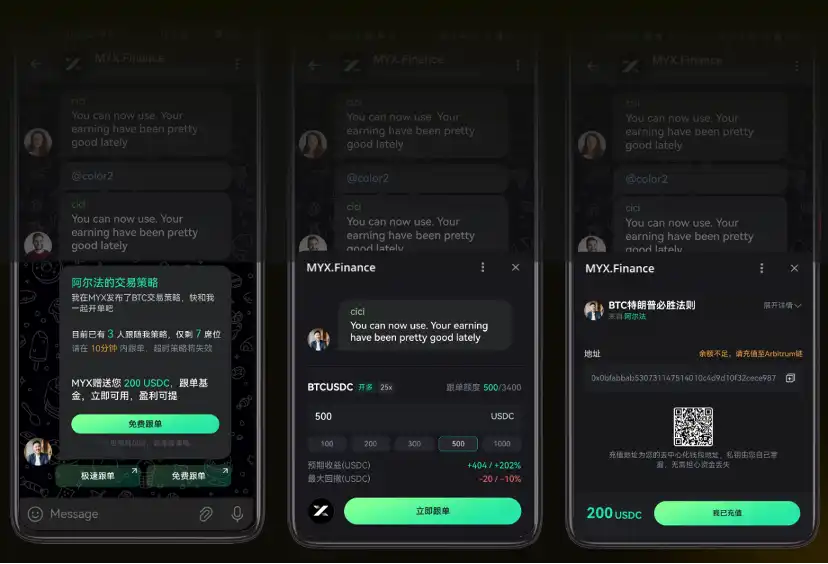
(4) Token Economics: Benefiting the Community and Users, Maximizing Expectations of Appreciation
It can be seen that compared with Hyperliquid, Synfures and derivatives protocols that have just been listed, MYX Finance is very competitive in terms of products. However, historical experience tells us that no matter how competitive the product is and how many users it has, if the token empowerment is not done well and users cannot be motivated to buy and hold tokens, the market performance of the token is usually not satisfactory.
The Tokenonomics announced by MYX Finance locks the secondary market after TGE by restricting the allocation and release of tokens for projects and institutional investors to protect the interests of retail investors and community airdrop recipients - the total amount of tokens for the project is fixed at 1,000,000,000 MYX, the team only retains 20% and the tokens are unlocked one year after the launch and distributed monthly within two years; 20% of the tokens are owned by institutional investors, locked at TGE, and distributed monthly in the 18 months after 6 months of TGE - by restricting the unlocking time for institutions and teams, MYX Finance has locked the selling pressure from private equity and teams after the tokens are listed to the greatest extent, and has made every effort to maintain the trading environment of the MYX token secondary market.
In addition to 10% of the tokens as initial liquidity and 5% of the tokens as reserve funds, MYX Finance will airdrop 45% of the total project tokens, or 450,000,000 MYX, to community users through various operational activities to encourage users to trade on MYX, provide liquidity and participate in various activities on the platform. Compared with projects such as Hyperliquid, MYX Finance has the lowest airdrop acquisition cost, and because the project itself is very "easy to use", beginners can complete a series of interactions without even any tutorials.
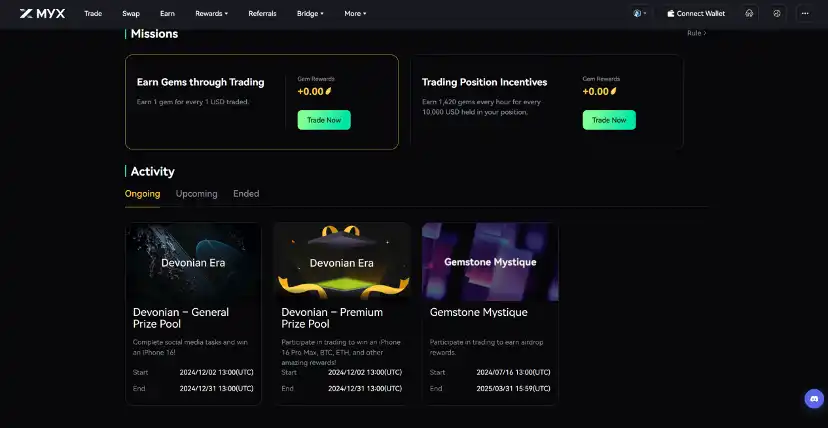
For example, MYX Finance's largest airdrop event, the "Origin Plan", airdrops 20% of the total MYX tokens to early participants. Users usually only need to complete social media tasks and trade normally (enjoying extremely low transaction fees during the period) to win the airdrop. Currently, nearly 10,000 users have participated in the "Cambrian", "Ordovician" and "Silurian" phases of the "Origin Plan". Although I am not sure, judging from the scale of the prizes, the ongoing "Devonian" event is the largest phase since the start of the "Origin Plan", and it is also very likely to be the last large-scale airdrop event before the project's TGE. If the wool party has not participated yet, you can complete the task first and leave an airdrop base.
(5) Market value management and investor background
From the perspective of the team and investors’ background, the MYX Finance team members themselves come from large firms, top VCs and established financial institutions, and are undoubtedly experts in currency value management. In the seed round of financing, it naturally received investment from Sequoia Capital, Consensys, Hack VC, OKX Ventures, and GSR, and later became one of the first projects to receive investment from the Linea Ecosystem Investment Alliance. With the support of top VCs and ecosystem, it can be seen that the resources behind MYX Finance are very substantial, and capital and ecosystems are also very optimistic about its subsequent growth space and performance in the secondary market.
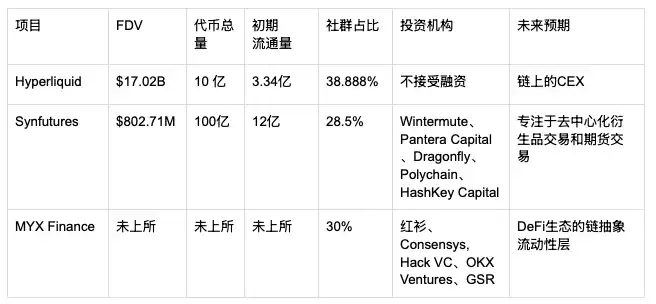
Among the derivatives protocols that have been listed this year, Hyperliquid’s market performance is the most outstanding. Synfutures’ market performance is not as good as expected, and it has not been able to take over the wave of “derivatives fever” ignited by Hyperliquid. According to internal information, MYX Finance is very likely to conduct TGE in Q1 next year. Considering the above-mentioned product strength, user base, capital strength, and future vision, MYX Finance is indeed the most promising one to take over among the derivatives protocols to be listed next year. It is understandable that we missed out on Hyperliquid, as we were indeed hit by a surprise attack; but as the derivatives market continues to heat up, it would be wrong to miss out on MYX again.
After the DeFi Summer of 2020 came to an end, the on-chain world fell into a "misfire"-like silence. Many developers and crypto players suddenly lost their way and entered the "crypto winter" - in 2024, driven by the nourishment of BTC, the crypto market returned to "spring" - with derivatives protocols such as Hyperliquid, Synfutures, and MYX Finance shining one after another, in the cold winter, developers are not "hibernating", but cultivating the on-chain ecology, broadening application scenarios, strengthening the degree of implementation, and improving the interactive experience - with this series of actions, the user base of the on-chain ecology is growing rapidly!
For investors, especially those who have experienced this long bear market, what they should do is to uphold the mentality of "all sails have passed", actively embrace the new round of bull market, and realize that "the world on the chain is the true form of encrypted products" - MYX Finance, Hyperliquid and other projects represent not only a new round of "wealth codes", but also represent the infinite possibilities and application value brought by the innovations behind them, such as "chain abstract liquidity layer", "unconscious transactions", and "MPM".
This article is from a contribution and does not represent the views of BlockBeats
You may also like

Token Cannot Compound, Where Is the Real Investment Opportunity?

February 6th Market Key Intelligence, How Much Did You Miss?

China's Central Bank and Eight Other Departments' Latest Regulatory Focus: Key Attention to RWA Tokenized Asset Risk
Foreword: Today, the People's Bank of China's website published the "Notice of the People's Bank of China, National Development and Reform Commission, Ministry of Industry and Information Technology, Ministry of Public Security, State Administration for Market Regulation, China Banking and Insurance Regulatory Commission, China Securities Regulatory Commission, State Administration of Foreign Exchange on Further Preventing and Dealing with Risks Related to Virtual Currency and Others (Yinfa [2026] No. 42)", the latest regulatory requirements from the eight departments including the central bank, which are basically consistent with the regulatory requirements of recent years. The main focus of the regulation is on speculative activities such as virtual currency trading, exchanges, ICOs, overseas platform services, and this time, regulatory oversight of RWA has been added, explicitly prohibiting RWA tokenization, stablecoins (especially those pegged to the RMB). The following is the full text:
To the people's governments of all provinces, autonomous regions, and municipalities directly under the Central Government, the Xinjiang Production and Construction Corps:
Recently, there have been speculative activities related to virtual currency and Real-World Assets (RWA) tokenization, disrupting the economic and financial order and jeopardizing the property security of the people. In order to further prevent and address the risks related to virtual currency and Real-World Assets tokenization, effectively safeguard national security and social stability, in accordance with the "Law of the People's Republic of China on the People's Bank of China," "Law of the People's Republic of China on Commercial Banks," "Securities Law of the People's Republic of China," "Law of the People's Republic of China on Securities Investment Funds," "Law of the People's Republic of China on Futures and Derivatives," "Cybersecurity Law of the People's Republic of China," "Regulations of the People's Republic of China on the Administration of Renminbi," "Regulations on Prevention and Disposal of Illegal Fundraising," "Regulations of the People's Republic of China on Foreign Exchange Administration," "Telecommunications Regulations of the People's Republic of China," and other provisions, after reaching consensus with the Cyberspace Administration of China, the Supreme People's Court, and the Supreme People's Procuratorate, and with the approval of the State Council, the relevant matters are notified as follows:
(I) Virtual currency does not possess the legal status equivalent to fiat currency. Virtual currencies such as Bitcoin, Ether, Tether, etc., have the main characteristics of being issued by non-monetary authorities, using encryption technology and distributed ledger or similar technology, existing in digital form, etc. They do not have legal tender status, should not and cannot be circulated and used as currency in the market.
The business activities related to virtual currency are classified as illegal financial activities. The exchange of fiat currency and virtual currency within the territory, exchange of virtual currencies, acting as a central counterparty in buying and selling virtual currencies, providing information intermediary and pricing services for virtual currency transactions, token issuance financing, and trading of virtual currency-related financial products, etc., fall under illegal financial activities, such as suspected illegal issuance of token vouchers, unauthorized public issuance of securities, illegal operation of securities and futures business, illegal fundraising, etc., are strictly prohibited across the board and resolutely banned in accordance with the law. Overseas entities and individuals are not allowed to provide virtual currency-related services to domestic entities in any form.
A stablecoin pegged to a fiat currency indirectly fulfills some functions of the fiat currency in circulation. Without the consent of relevant authorities in accordance with the law and regulations, any domestic or foreign entity or individual is not allowed to issue a RMB-pegged stablecoin overseas.
(II)Tokenization of Real-World Assets refers to the use of encryption technology and distributed ledger or similar technologies to transform ownership rights, income rights, etc., of assets into tokens (tokens) or other interests or bond certificates with token (token) characteristics, and carry out issuance and trading activities.
Engaging in the tokenization of real-world assets domestically, as well as providing related intermediary, information technology services, etc., which are suspected of illegal issuance of token vouchers, unauthorized public offering of securities, illegal operation of securities and futures business, illegal fundraising, and other illegal financial activities, shall be prohibited; except for relevant business activities carried out with the approval of the competent authorities in accordance with the law and regulations and relying on specific financial infrastructures. Overseas entities and individuals are not allowed to illegally provide services related to the tokenization of real-world assets to domestic entities in any form.
(III) Inter-agency Coordination. The People's Bank of China, together with the National Development and Reform Commission, the Ministry of Industry and Information Technology, the Ministry of Public Security, the State Administration for Market Regulation, the China Banking and Insurance Regulatory Commission, the China Securities Regulatory Commission, the State Administration of Foreign Exchange, and other departments, will improve the work mechanism, strengthen coordination with the Cyberspace Administration of China, the Supreme People's Court, and the Supreme People's Procuratorate, coordinate efforts, and overall guide regions to carry out risk prevention and disposal of virtual currency-related illegal financial activities.
The China Securities Regulatory Commission, together with the National Development and Reform Commission, the Ministry of Industry and Information Technology, the Ministry of Public Security, the People's Bank of China, the State Administration for Market Regulation, the China Banking and Insurance Regulatory Commission, the State Administration of Foreign Exchange, and other departments, will improve the work mechanism, strengthen coordination with the Cyberspace Administration of China, the Supreme People's Court, and the Supreme People's Procuratorate, coordinate efforts, and overall guide regions to carry out risk prevention and disposal of illegal financial activities related to the tokenization of real-world assets.
(IV) Strengthening Local Implementation. The people's governments at the provincial level are overall responsible for the prevention and disposal of risks related to virtual currencies and the tokenization of real-world assets in their respective administrative regions. The specific leading department is the local financial regulatory department, with participation from branches and dispatched institutions of the State Council's financial regulatory department, telecommunications regulators, public security, market supervision, and other departments, in coordination with cyberspace departments, courts, and procuratorates, to improve the normalization of the work mechanism, effectively connect with the relevant work mechanisms of central departments, form a cooperative and coordinated working pattern between central and local governments, effectively prevent and properly handle risks related to virtual currencies and the tokenization of real-world assets, and maintain economic and financial order and social stability.
(5) Enhanced Risk Monitoring. The People's Bank of China, China Securities Regulatory Commission, National Development and Reform Commission, Ministry of Industry and Information Technology, Ministry of Public Security, State Administration of Foreign Exchange, Cyberspace Administration of China, and other departments continue to improve monitoring techniques and system support, enhance cross-departmental data analysis and sharing, establish sound information sharing and cross-validation mechanisms, promptly grasp the risk situation of activities related to virtual currency and real-world asset tokenization. Local governments at all levels give full play to the role of local monitoring and early warning mechanisms. Local financial regulatory authorities, together with branches and agencies of the State Council's financial regulatory authorities, as well as departments of cyberspace and public security, ensure effective connection between online monitoring, offline investigation, and fund tracking, efficiently and accurately identify activities related to virtual currency and real-world asset tokenization, promptly share risk information, improve early warning information dissemination, verification, and rapid response mechanisms.
(6) Strengthened Oversight of Financial Institutions, Intermediaries, and Technology Service Providers. Financial institutions (including non-bank payment institutions) are prohibited from providing account opening, fund transfer, and clearing services for virtual currency-related business activities, issuing and selling financial products related to virtual currency, including virtual currency and related financial products in the scope of collateral, conducting insurance business related to virtual currency, or including virtual currency in the scope of insurance liability. Financial institutions (including non-bank payment institutions) are prohibited from providing custody, clearing, and settlement services for unauthorized real-world asset tokenization-related business and related financial products. Relevant intermediary institutions and information technology service providers are prohibited from providing intermediary, technical, or other services for unauthorized real-world asset tokenization-related businesses and related financial products.
(7) Enhanced Management of Internet Information Content and Access. Internet enterprises are prohibited from providing online business venues, commercial displays, marketing, advertising, or paid traffic diversion services for virtual currency and real-world asset tokenization-related business activities. Upon discovering clues of illegal activities, they should promptly report to relevant departments and provide technical support and assistance for related investigations and inquiries. Based on the clues transferred by the financial regulatory authorities, the cyberspace administration, telecommunications authorities, and public security departments should promptly close and deal with websites, mobile applications (including mini-programs), and public accounts engaged in virtual currency and real-world asset tokenization-related business activities in accordance with the law.
(8) Strengthened Entity Registration and Advertisement Management. Market supervision departments strengthen entity registration and management, and enterprise and individual business registrations must not contain terms such as "virtual currency," "virtual asset," "cryptocurrency," "crypto asset," "stablecoin," "real-world asset tokenization," or "RWA" in their names or business scopes. Market supervision departments, together with financial regulatory authorities, legally enhance the supervision of advertisements related to virtual currency and real-world asset tokenization, promptly investigating and handling relevant illegal advertisements.
(IX) Continued Rectification of Virtual Currency Mining Activities. The National Development and Reform Commission, together with relevant departments, strictly controls virtual currency mining activities, continuously promotes the rectification of virtual currency mining activities. The people's governments of various provinces take overall responsibility for the rectification of "mining" within their respective administrative regions. In accordance with the requirements of the National Development and Reform Commission and other departments in the "Notice on the Rectification of Virtual Currency Mining Activities" (NDRC Energy-saving Building [2021] No. 1283) and the provisions of the "Guidance Catalog for Industrial Structure Adjustment (2024 Edition)," a comprehensive review, investigation, and closure of existing virtual currency mining projects are conducted, new mining projects are strictly prohibited, and mining machine production enterprises are strictly prohibited from providing mining machine sales and other services within the country.
(X) Severe Crackdown on Related Illegal Financial Activities. Upon discovering clues to illegal financial activities related to virtual currency and the tokenization of real-world assets, local financial regulatory authorities, branches of the State Council's financial regulatory authorities, and other relevant departments promptly investigate, determine, and properly handle the issues in accordance with the law, and seriously hold the relevant entities and individuals legally responsible. Those suspected of crimes are transferred to the judicial authorities for processing according to the law.
(XI) Severe Crackdown on Related Illegal and Criminal Activities. The Ministry of Public Security, the People's Bank of China, the State Administration for Market Regulation, the China Banking and Insurance Regulatory Commission, the China Securities Regulatory Commission, as well as judicial and procuratorial organs, in accordance with their respective responsibilities, rigorously crack down on illegal and criminal activities related to virtual currency, the tokenization of real-world assets, such as fraud, money laundering, illegal business operations, pyramid schemes, illegal fundraising, and other illegal and criminal activities carried out under the guise of virtual currency, the tokenization of real-world assets, etc.
(XII) Strengthen Industry Self-discipline. Relevant industry associations should enhance membership management and policy advocacy, based on their own responsibilities, advocate and urge member units to resist illegal financial activities related to virtual currency and the tokenization of real-world assets. Member units that violate regulatory policies and industry self-discipline rules are to be disciplined in accordance with relevant self-regulatory management regulations. By leveraging various industry infrastructure, conduct risk monitoring related to virtual currency, the tokenization of real-world assets, and promptly transfer issue clues to relevant departments.
(XIII) Without the approval of relevant departments in accordance with the law and regulations, domestic entities and foreign entities controlled by them may not issue virtual currency overseas.
(XIV) Domestic entities engaging directly or indirectly in overseas external debt-based tokenization of real-world assets, or conducting asset securitization activities abroad based on domestic ownership rights, income rights, etc. (hereinafter referred to as domestic equity), should be strictly regulated in accordance with the principles of "same business, same risk, same rules." The National Development and Reform Commission, the China Securities Regulatory Commission, the State Administration of Foreign Exchange, and other relevant departments regulate it according to their respective responsibilities. For other forms of overseas real-world asset tokenization activities based on domestic equity by domestic entities, the China Securities Regulatory Commission, together with relevant departments, supervise according to their division of responsibilities. Without the consent and filing of relevant departments, no unit or individual may engage in the above-mentioned business.
(15) Overseas subsidiaries and branches of domestic financial institutions providing Real World Asset Tokenization-related services overseas shall do so legally and prudently. They shall have professional personnel and systems in place to effectively mitigate business risks, strictly implement customer onboarding, suitability management, anti-money laundering requirements, and incorporate them into the domestic financial institutions' compliance and risk management system. Intermediaries and information technology service providers offering Real World Asset Tokenization services abroad based on domestic equity or conducting Real World Asset Tokenization business in the form of overseas debt for domestic entities directly or indirectly venturing abroad must strictly comply with relevant laws and regulations. They should establish and improve relevant compliance and internal control systems in accordance with relevant normative requirements, strengthen business and risk control, and report the business developments to the relevant regulatory authorities for approval or filing.
(16) Strengthen organizational leadership and overall coordination. All departments and regions should attach great importance to the prevention of risks related to virtual currencies and Real World Asset Tokenization, strengthen organizational leadership, clarify work responsibilities, form a long-term effective working mechanism with centralized coordination, local implementation, and shared responsibilities, maintain high pressure, dynamically monitor risks, effectively prevent and mitigate risks in an orderly and efficient manner, legally protect the property security of the people, and make every effort to maintain economic and financial order and social stability.
(17) Widely carry out publicity and education. All departments, regions, and industry associations should make full use of various media and other communication channels to disseminate information through legal and policy interpretation, analysis of typical cases, and education on investment risks, etc. They should promote the illegality and harm of virtual currencies and Real World Asset Tokenization-related businesses and their manifestations, fully alert to potential risks and hidden dangers, and enhance public awareness and identification capabilities for risk prevention.
(18) Engaging in illegal financial activities related to virtual currencies and Real World Asset Tokenization in violation of this notice, as well as providing services for virtual currencies and Real World Asset Tokenization-related businesses, shall be punished in accordance with relevant regulations. If it constitutes a crime, criminal liability shall be pursued according to the law. For domestic entities and individuals who knowingly or should have known that overseas entities illegally provided virtual currency or Real World Asset Tokenization-related services to domestic entities and still assisted them, relevant responsibilities shall be pursued according to the law. If it constitutes a crime, criminal liability shall be pursued according to the law.
(19) If any unit or individual invests in virtual currencies, Real World Asset Tokens, and related financial products against public order and good customs, the relevant civil legal actions shall be invalid, and any resulting losses shall be borne by them. If there are suspicions of disrupting financial order and jeopardizing financial security, the relevant departments shall deal with them according to the law.
This notice shall enter into force upon the date of its issuance. The People's Bank of China and ten other departments' "Notice on Further Preventing and Dealing with the Risks of Virtual Currency Trading Speculation" (Yinfa [2021] No. 237) is hereby repealed.

Former Partner's Perspective on Multicoin: Kyle's Exit, But the Game He Left Behind Just Getting Started
Why Bitcoin Is Falling Now: The Real Reasons Behind BTC's Crash & WEEX's Smart Profit Playbook
Bitcoin's ongoing crash explained: Discover the 5 hidden triggers behind BTC's plunge & how WEEX's Auto Earn and Trade to Earn strategies help traders profit from crypto market volatility.

Wall Street's Hottest Trades See Exodus

Vitalik Discusses Ethereum Scaling Path, Circle Announces Partnership with Polymarket, What's the Overseas Crypto Community Talking About Today?

Believing in the Capital Markets - The Essence and Core Value of Cryptocurrency

Polymarket's 'Weatherman': Predict Temperature, Win Million-Dollar Payout

$15K+ Profits: The 4 AI Trading Secrets WEEX Hackathon Prelim Winners Used to Dominate Volatile Crypto Markets
How WEEX Hackathon's top AI trading strategies made $15K+ in crypto markets: 4 proven rules for ETH/BTC trading, market structure analysis, and risk management in volatile conditions.

A nearly 20% one-day plunge, how long has it been since you last saw a $60,000 Bitcoin?

Raoul Pal: I've seen every single panic, and they are never the end.

Key Market Information Discrepancy on February 6th - A Must-Read! | Alpha Morning Report

2026 Crypto Industry's First Snowfall
The Harsh Reality Behind the $26 Billion Crypto Liquidation: Liquidity Is Killing the Market
Why Is Gold, US Stocks, Bitcoin All Falling?

Key Market Intelligence for February 5th, how much did you miss out on?

Wintermute: By 2026, crypto had gradually become the settlement layer of the Internet economy
Token Cannot Compound, Where Is the Real Investment Opportunity?
February 6th Market Key Intelligence, How Much Did You Miss?
China's Central Bank and Eight Other Departments' Latest Regulatory Focus: Key Attention to RWA Tokenized Asset Risk
Foreword: Today, the People's Bank of China's website published the "Notice of the People's Bank of China, National Development and Reform Commission, Ministry of Industry and Information Technology, Ministry of Public Security, State Administration for Market Regulation, China Banking and Insurance Regulatory Commission, China Securities Regulatory Commission, State Administration of Foreign Exchange on Further Preventing and Dealing with Risks Related to Virtual Currency and Others (Yinfa [2026] No. 42)", the latest regulatory requirements from the eight departments including the central bank, which are basically consistent with the regulatory requirements of recent years. The main focus of the regulation is on speculative activities such as virtual currency trading, exchanges, ICOs, overseas platform services, and this time, regulatory oversight of RWA has been added, explicitly prohibiting RWA tokenization, stablecoins (especially those pegged to the RMB). The following is the full text:
To the people's governments of all provinces, autonomous regions, and municipalities directly under the Central Government, the Xinjiang Production and Construction Corps:
Recently, there have been speculative activities related to virtual currency and Real-World Assets (RWA) tokenization, disrupting the economic and financial order and jeopardizing the property security of the people. In order to further prevent and address the risks related to virtual currency and Real-World Assets tokenization, effectively safeguard national security and social stability, in accordance with the "Law of the People's Republic of China on the People's Bank of China," "Law of the People's Republic of China on Commercial Banks," "Securities Law of the People's Republic of China," "Law of the People's Republic of China on Securities Investment Funds," "Law of the People's Republic of China on Futures and Derivatives," "Cybersecurity Law of the People's Republic of China," "Regulations of the People's Republic of China on the Administration of Renminbi," "Regulations on Prevention and Disposal of Illegal Fundraising," "Regulations of the People's Republic of China on Foreign Exchange Administration," "Telecommunications Regulations of the People's Republic of China," and other provisions, after reaching consensus with the Cyberspace Administration of China, the Supreme People's Court, and the Supreme People's Procuratorate, and with the approval of the State Council, the relevant matters are notified as follows:
(I) Virtual currency does not possess the legal status equivalent to fiat currency. Virtual currencies such as Bitcoin, Ether, Tether, etc., have the main characteristics of being issued by non-monetary authorities, using encryption technology and distributed ledger or similar technology, existing in digital form, etc. They do not have legal tender status, should not and cannot be circulated and used as currency in the market.
The business activities related to virtual currency are classified as illegal financial activities. The exchange of fiat currency and virtual currency within the territory, exchange of virtual currencies, acting as a central counterparty in buying and selling virtual currencies, providing information intermediary and pricing services for virtual currency transactions, token issuance financing, and trading of virtual currency-related financial products, etc., fall under illegal financial activities, such as suspected illegal issuance of token vouchers, unauthorized public issuance of securities, illegal operation of securities and futures business, illegal fundraising, etc., are strictly prohibited across the board and resolutely banned in accordance with the law. Overseas entities and individuals are not allowed to provide virtual currency-related services to domestic entities in any form.
A stablecoin pegged to a fiat currency indirectly fulfills some functions of the fiat currency in circulation. Without the consent of relevant authorities in accordance with the law and regulations, any domestic or foreign entity or individual is not allowed to issue a RMB-pegged stablecoin overseas.
(II)Tokenization of Real-World Assets refers to the use of encryption technology and distributed ledger or similar technologies to transform ownership rights, income rights, etc., of assets into tokens (tokens) or other interests or bond certificates with token (token) characteristics, and carry out issuance and trading activities.
Engaging in the tokenization of real-world assets domestically, as well as providing related intermediary, information technology services, etc., which are suspected of illegal issuance of token vouchers, unauthorized public offering of securities, illegal operation of securities and futures business, illegal fundraising, and other illegal financial activities, shall be prohibited; except for relevant business activities carried out with the approval of the competent authorities in accordance with the law and regulations and relying on specific financial infrastructures. Overseas entities and individuals are not allowed to illegally provide services related to the tokenization of real-world assets to domestic entities in any form.
(III) Inter-agency Coordination. The People's Bank of China, together with the National Development and Reform Commission, the Ministry of Industry and Information Technology, the Ministry of Public Security, the State Administration for Market Regulation, the China Banking and Insurance Regulatory Commission, the China Securities Regulatory Commission, the State Administration of Foreign Exchange, and other departments, will improve the work mechanism, strengthen coordination with the Cyberspace Administration of China, the Supreme People's Court, and the Supreme People's Procuratorate, coordinate efforts, and overall guide regions to carry out risk prevention and disposal of virtual currency-related illegal financial activities.
The China Securities Regulatory Commission, together with the National Development and Reform Commission, the Ministry of Industry and Information Technology, the Ministry of Public Security, the People's Bank of China, the State Administration for Market Regulation, the China Banking and Insurance Regulatory Commission, the State Administration of Foreign Exchange, and other departments, will improve the work mechanism, strengthen coordination with the Cyberspace Administration of China, the Supreme People's Court, and the Supreme People's Procuratorate, coordinate efforts, and overall guide regions to carry out risk prevention and disposal of illegal financial activities related to the tokenization of real-world assets.
(IV) Strengthening Local Implementation. The people's governments at the provincial level are overall responsible for the prevention and disposal of risks related to virtual currencies and the tokenization of real-world assets in their respective administrative regions. The specific leading department is the local financial regulatory department, with participation from branches and dispatched institutions of the State Council's financial regulatory department, telecommunications regulators, public security, market supervision, and other departments, in coordination with cyberspace departments, courts, and procuratorates, to improve the normalization of the work mechanism, effectively connect with the relevant work mechanisms of central departments, form a cooperative and coordinated working pattern between central and local governments, effectively prevent and properly handle risks related to virtual currencies and the tokenization of real-world assets, and maintain economic and financial order and social stability.
(5) Enhanced Risk Monitoring. The People's Bank of China, China Securities Regulatory Commission, National Development and Reform Commission, Ministry of Industry and Information Technology, Ministry of Public Security, State Administration of Foreign Exchange, Cyberspace Administration of China, and other departments continue to improve monitoring techniques and system support, enhance cross-departmental data analysis and sharing, establish sound information sharing and cross-validation mechanisms, promptly grasp the risk situation of activities related to virtual currency and real-world asset tokenization. Local governments at all levels give full play to the role of local monitoring and early warning mechanisms. Local financial regulatory authorities, together with branches and agencies of the State Council's financial regulatory authorities, as well as departments of cyberspace and public security, ensure effective connection between online monitoring, offline investigation, and fund tracking, efficiently and accurately identify activities related to virtual currency and real-world asset tokenization, promptly share risk information, improve early warning information dissemination, verification, and rapid response mechanisms.
(6) Strengthened Oversight of Financial Institutions, Intermediaries, and Technology Service Providers. Financial institutions (including non-bank payment institutions) are prohibited from providing account opening, fund transfer, and clearing services for virtual currency-related business activities, issuing and selling financial products related to virtual currency, including virtual currency and related financial products in the scope of collateral, conducting insurance business related to virtual currency, or including virtual currency in the scope of insurance liability. Financial institutions (including non-bank payment institutions) are prohibited from providing custody, clearing, and settlement services for unauthorized real-world asset tokenization-related business and related financial products. Relevant intermediary institutions and information technology service providers are prohibited from providing intermediary, technical, or other services for unauthorized real-world asset tokenization-related businesses and related financial products.
(7) Enhanced Management of Internet Information Content and Access. Internet enterprises are prohibited from providing online business venues, commercial displays, marketing, advertising, or paid traffic diversion services for virtual currency and real-world asset tokenization-related business activities. Upon discovering clues of illegal activities, they should promptly report to relevant departments and provide technical support and assistance for related investigations and inquiries. Based on the clues transferred by the financial regulatory authorities, the cyberspace administration, telecommunications authorities, and public security departments should promptly close and deal with websites, mobile applications (including mini-programs), and public accounts engaged in virtual currency and real-world asset tokenization-related business activities in accordance with the law.
(8) Strengthened Entity Registration and Advertisement Management. Market supervision departments strengthen entity registration and management, and enterprise and individual business registrations must not contain terms such as "virtual currency," "virtual asset," "cryptocurrency," "crypto asset," "stablecoin," "real-world asset tokenization," or "RWA" in their names or business scopes. Market supervision departments, together with financial regulatory authorities, legally enhance the supervision of advertisements related to virtual currency and real-world asset tokenization, promptly investigating and handling relevant illegal advertisements.
(IX) Continued Rectification of Virtual Currency Mining Activities. The National Development and Reform Commission, together with relevant departments, strictly controls virtual currency mining activities, continuously promotes the rectification of virtual currency mining activities. The people's governments of various provinces take overall responsibility for the rectification of "mining" within their respective administrative regions. In accordance with the requirements of the National Development and Reform Commission and other departments in the "Notice on the Rectification of Virtual Currency Mining Activities" (NDRC Energy-saving Building [2021] No. 1283) and the provisions of the "Guidance Catalog for Industrial Structure Adjustment (2024 Edition)," a comprehensive review, investigation, and closure of existing virtual currency mining projects are conducted, new mining projects are strictly prohibited, and mining machine production enterprises are strictly prohibited from providing mining machine sales and other services within the country.
(X) Severe Crackdown on Related Illegal Financial Activities. Upon discovering clues to illegal financial activities related to virtual currency and the tokenization of real-world assets, local financial regulatory authorities, branches of the State Council's financial regulatory authorities, and other relevant departments promptly investigate, determine, and properly handle the issues in accordance with the law, and seriously hold the relevant entities and individuals legally responsible. Those suspected of crimes are transferred to the judicial authorities for processing according to the law.
(XI) Severe Crackdown on Related Illegal and Criminal Activities. The Ministry of Public Security, the People's Bank of China, the State Administration for Market Regulation, the China Banking and Insurance Regulatory Commission, the China Securities Regulatory Commission, as well as judicial and procuratorial organs, in accordance with their respective responsibilities, rigorously crack down on illegal and criminal activities related to virtual currency, the tokenization of real-world assets, such as fraud, money laundering, illegal business operations, pyramid schemes, illegal fundraising, and other illegal and criminal activities carried out under the guise of virtual currency, the tokenization of real-world assets, etc.
(XII) Strengthen Industry Self-discipline. Relevant industry associations should enhance membership management and policy advocacy, based on their own responsibilities, advocate and urge member units to resist illegal financial activities related to virtual currency and the tokenization of real-world assets. Member units that violate regulatory policies and industry self-discipline rules are to be disciplined in accordance with relevant self-regulatory management regulations. By leveraging various industry infrastructure, conduct risk monitoring related to virtual currency, the tokenization of real-world assets, and promptly transfer issue clues to relevant departments.
(XIII) Without the approval of relevant departments in accordance with the law and regulations, domestic entities and foreign entities controlled by them may not issue virtual currency overseas.
(XIV) Domestic entities engaging directly or indirectly in overseas external debt-based tokenization of real-world assets, or conducting asset securitization activities abroad based on domestic ownership rights, income rights, etc. (hereinafter referred to as domestic equity), should be strictly regulated in accordance with the principles of "same business, same risk, same rules." The National Development and Reform Commission, the China Securities Regulatory Commission, the State Administration of Foreign Exchange, and other relevant departments regulate it according to their respective responsibilities. For other forms of overseas real-world asset tokenization activities based on domestic equity by domestic entities, the China Securities Regulatory Commission, together with relevant departments, supervise according to their division of responsibilities. Without the consent and filing of relevant departments, no unit or individual may engage in the above-mentioned business.
(15) Overseas subsidiaries and branches of domestic financial institutions providing Real World Asset Tokenization-related services overseas shall do so legally and prudently. They shall have professional personnel and systems in place to effectively mitigate business risks, strictly implement customer onboarding, suitability management, anti-money laundering requirements, and incorporate them into the domestic financial institutions' compliance and risk management system. Intermediaries and information technology service providers offering Real World Asset Tokenization services abroad based on domestic equity or conducting Real World Asset Tokenization business in the form of overseas debt for domestic entities directly or indirectly venturing abroad must strictly comply with relevant laws and regulations. They should establish and improve relevant compliance and internal control systems in accordance with relevant normative requirements, strengthen business and risk control, and report the business developments to the relevant regulatory authorities for approval or filing.
(16) Strengthen organizational leadership and overall coordination. All departments and regions should attach great importance to the prevention of risks related to virtual currencies and Real World Asset Tokenization, strengthen organizational leadership, clarify work responsibilities, form a long-term effective working mechanism with centralized coordination, local implementation, and shared responsibilities, maintain high pressure, dynamically monitor risks, effectively prevent and mitigate risks in an orderly and efficient manner, legally protect the property security of the people, and make every effort to maintain economic and financial order and social stability.
(17) Widely carry out publicity and education. All departments, regions, and industry associations should make full use of various media and other communication channels to disseminate information through legal and policy interpretation, analysis of typical cases, and education on investment risks, etc. They should promote the illegality and harm of virtual currencies and Real World Asset Tokenization-related businesses and their manifestations, fully alert to potential risks and hidden dangers, and enhance public awareness and identification capabilities for risk prevention.
(18) Engaging in illegal financial activities related to virtual currencies and Real World Asset Tokenization in violation of this notice, as well as providing services for virtual currencies and Real World Asset Tokenization-related businesses, shall be punished in accordance with relevant regulations. If it constitutes a crime, criminal liability shall be pursued according to the law. For domestic entities and individuals who knowingly or should have known that overseas entities illegally provided virtual currency or Real World Asset Tokenization-related services to domestic entities and still assisted them, relevant responsibilities shall be pursued according to the law. If it constitutes a crime, criminal liability shall be pursued according to the law.
(19) If any unit or individual invests in virtual currencies, Real World Asset Tokens, and related financial products against public order and good customs, the relevant civil legal actions shall be invalid, and any resulting losses shall be borne by them. If there are suspicions of disrupting financial order and jeopardizing financial security, the relevant departments shall deal with them according to the law.
This notice shall enter into force upon the date of its issuance. The People's Bank of China and ten other departments' "Notice on Further Preventing and Dealing with the Risks of Virtual Currency Trading Speculation" (Yinfa [2021] No. 237) is hereby repealed.
Former Partner's Perspective on Multicoin: Kyle's Exit, But the Game He Left Behind Just Getting Started
Why Bitcoin Is Falling Now: The Real Reasons Behind BTC's Crash & WEEX's Smart Profit Playbook
Bitcoin's ongoing crash explained: Discover the 5 hidden triggers behind BTC's plunge & how WEEX's Auto Earn and Trade to Earn strategies help traders profit from crypto market volatility.


 App
App