
Successive Core Team "Heroes" Depart, Has Aave's DAO Dream Crumbled?

Original Title: "Key Contributors Successively Leaving, Has Aave's DAO Dream Been Shattered?"
Original Author: Bootly, BitpushNews
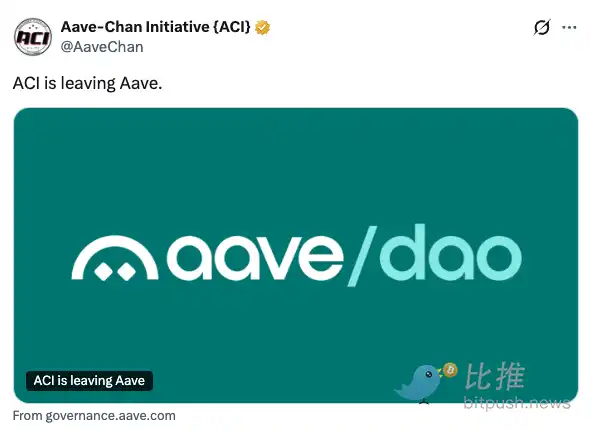
On March 3, the Aave protocol's core governance team Aave Chan Initiative (ACI) announced it would shut down operations and leave AAVE.
This is the second major contributor to leave within two weeks—previously on February 20, the development team behind the Aave V3 codebase, BGD Labs, announced their exit.
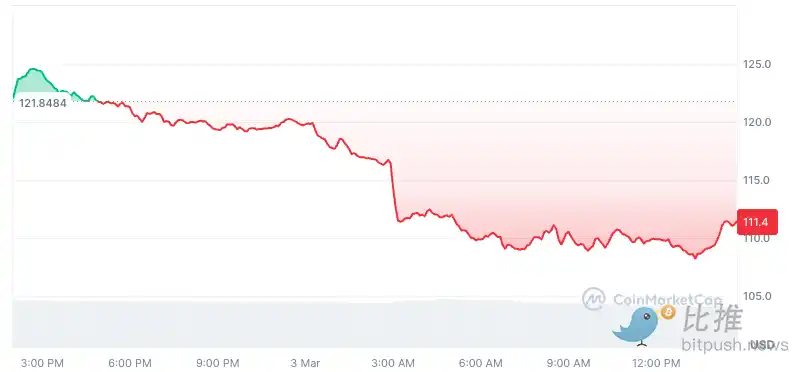
Following the announcement, the AAVE token price dropped over 11%.
As the most successful DAO (decentralized autonomous organization) in DeFi history, the flagship of DeFi with nearly $27 billion in TVL, is going through a profound internal turmoil.
From Revenue Attribution Dispute to Bundled Voting
The seeds of this crisis were sown as early as December last year.
At that time, Aave Labs, without governance discussion, switched the front-end interface's transaction aggregator from ParaSwap to CoW Swap. Fees that were supposed to go to the DAO treasury now flowed into Aave Labs' account.
Faced with criticism, Aave founder Stani Kulechov's response was: the front-end interface was built by Labs, so the revenue naturally belongs to Labs; only the smart contracts and liquidity pools belong to the DAO. This explanation may hold legally, but it sparked discontent within the community.
To quell the dispute, Aave Labs proposed a proposal called "Aave Will Win" in February this year. The proposal mainly includes: requesting DAO approval for around $51 million to be used for V4 development, in exchange for transferring all future revenue from Aave branded products to the DAO, and establishing Aave V4 as the sole technical foundation, gradually phasing out V3.
The issue is that these three matters were bundled together. Support revenue going to the DAO but think the fund size is too large? No choice. Believe V3 still holds value and should not be sidelined? Equally no choice. It's either all or nothing.
ACI's Grievance: Opaque Voting
In ACI's exit statement, the most crucial allegation is that a significant portion of the support for the proposal came from addresses associated with Aave Labs. The interim check vote only passed with a slim 52.58% majority, and ACI believes the outcome might have been different without these "self-votes."
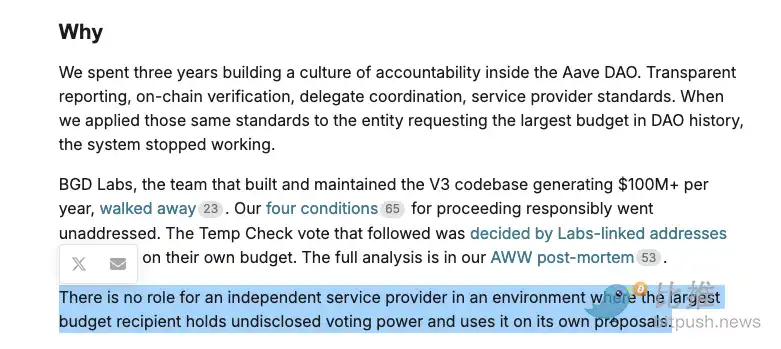
ACI founder Marc Zeller wrote, "If a major budget recipient can abuse their undisclosed voting power to push through their proposal forcefully, then independent service providers lose their purpose in the DAO."
ACI did not fail to attempt to address the issue. Before the vote, it laid out four conditions, including stricter on-chain milestone tracking, limiting self-voting by budget recipients, etc., but none were adopted.
This conflict reflects structural issues in DAO governance.
Aave Labs holds the codebase, brand domain, social media, and development narrative power. BGD Labs maintains the flagship V3 version—it contributed over 75% of the protocol's revenue and 97% of the total deposits. ACI is responsible for governing coordination and business development, claiming to have driven 61% of governance actions in the past three years, helping increase Aave's DeFi market share from less than 50% to over 65%.
These three teams were supposed to balance each other out. However, with BGD and ACI exiting successively, the remaining power center, no matter how it postures, is hard to trust completely.
In response to ACI's exit announcement, Stani Kulechov stated, "Thank Marc for his contributions over the years; the protocol will continue to operate as normal."
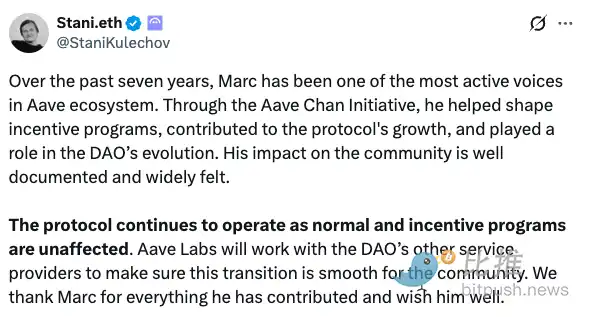
But this response did not address the core issue: when the person most capable of assessing V3's technical risks has exited, how can the DAO confidently bet its future on untested V4?
Another noteworthy detail is that institutional investor Blockchain Capital later revealed that, due to the custody platform not supporting snapshot voting, their held AAVE could not participate. This reveals another reality of DAO governance: while ostensibly decided collectively by token holders, voting power often tends to concentrate in the hands of a few.
DAO Governance Dilemma
ACI indicates that during the next four months of the transition period, governance dashboards, incentive frameworks, committee roles, and other tools and responsibilities will be transferred or open-sourced. However, some things are difficult to transfer: three years of accumulated governance experience, familiarity with protocol details, and the interpersonal network for coordinating different stakeholders.
Data shows that over the past three years, ACI has spent $4.6 million DAO on helping GHO stablecoin grow from $35 million to $527 million. Who will take over this work in the future remains unknown.
The recent turmoil at Aave is essentially a microcosm of the DAO governance dilemma.
In theory, a DAO is a community of token holders. However, in practice, governance is often dominated by the founding team, early investors, and core developers. These roles are both rule-makers and enforcers, and sometimes recipients of the budget. When conflicts of interest arise, whether "procedural justice" is sufficient becomes a contentious issue.
A DeFi practitioner commented, "This is not a matter of right or wrong, but when interests and positions are at odds, the existing governance mechanisms do not provide an effective way to resolve them."
What's next?
The revision of the "Aave Will Win" proposal during the ARFC phase will be the first window to observe the situation's direction. If Kulechov's promised "structural improvements" can be implemented, such as splitting the bundled proposal, clarifying voting behavior boundaries, it may bring this turmoil to a close.
If a consensus cannot be reached, the most extreme possibility is that BGD and ACI will start afresh and fork out a new protocol. Despite the high liquidity barrier, it is not impossible—core developers and governance teams simultaneously exiting provide the technical foundation and community basis for the fork.
For Aave, the immediate issue is how to fill the void left by the departure of two core teams. The longer-term issue is how to find a more sustainable balance between the founder's vision, core developers' interests, and community will. If the paradox of "centralization of power" cannot be resolved, even the strongest protocol may lose its first-mover advantage in endless infighting.
You may also like
BTC Challenges 64,000 After Breaking 63,000, Market Trading 'Manageable Risks'
As the Bubble Bursts, Who Dominates Attention in the AI Era? A 2026 Guide to Influential AI KOLs in China and the UK
Old Money in Crypto Shifts: Paradigm Raises $1.2 Billion, Half Bet on AI and Robotics
Bitdeer unveils $36M Nevada factory to shake up Bitcoin mining
Perplexity Fine-Tuned a Chinese AI Model to Match Claude Opus 4.8 at One-Third the Cost
Bank of Korea defends bank-first stablecoin plan amid bill deadlock
JPMorgan says bitcoin's main risk isn't Strategy, but blockchain adoption that doesn't benefit public chains and tokens
Fear & Greed Index Today: What Extreme Fear Means for Crypto, Stocks and Gold
Labour MPs Push to Make UK Crypto Donation Ban Permanent
Supreme Court ruling expanding Trump's authority over federal agencies raises questions for SEC, CFTC as crypto rulemaking advances
'Bottom building in progress': Analysts say bitcoin holder capitulation signals late-stage bear market
A Comprehensive Analysis: Starting from 1996, Who is Laying the Foundation for the Next Generation of Capital Markets
Luke Dashjr, the Biggest Anti-Spammer of Bitcoin, Inscribed Phrases on the Network in 2011
Whales bought 270,000 BTC while ETFs bled $7 billion. One side is wrong
The crypto IPO class of 2025-26 is down as much as 89%. Autopsy of a listing boom
Robinhood Chain Mining Guide: A Comprehensive Tutorial from Cross-Chain to Memecoin
BitGo CEO says single-digit percentages of bitcoin's supply are 'probably right' for large holders amid Strategy's sale
Beyond Private Keys: How to Safeguard the Security Boundaries of Web3 from Wallets, L2 to Supply Chains?
BTC Challenges 64,000 After Breaking 63,000, Market Trading 'Manageable Risks'
As the Bubble Bursts, Who Dominates Attention in the AI Era? A 2026 Guide to Influential AI KOLs in China and the UK
Old Money in Crypto Shifts: Paradigm Raises $1.2 Billion, Half Bet on AI and Robotics
Bitdeer unveils $36M Nevada factory to shake up Bitcoin mining
Perplexity Fine-Tuned a Chinese AI Model to Match Claude Opus 4.8 at One-Third the Cost
Bank of Korea defends bank-first stablecoin plan amid bill deadlock