Stablecoin Yields Discontinued, Circle Plunges 20% in One Day

Original Title: Circle Shares Fall Most Ever On Latest Stablecoin Rewards Move
Original Authors: Emily Mason, Monique Mulima and Lydia Beyoud, Bloomberg
Translation: Peggy, BlockBeats
Editor's Note: With the draft of the "Clarity Act" circulating, the stablecoin "rewards model" is explicitly included in the regulatory scope for the first time. This means that exchanges can no longer offer users holding stablecoins such as USDC yield rewards, and the attractiveness of its role as a "quasi-deposit" will be directly diminished.
This change quickly transmitted to market pricing. On March 25, Circle (CRCL) fell by 20.1%, intraday dropping as much as 22%, marking its largest single-day decline in history and leading the downturn among various crypto-related stocks.
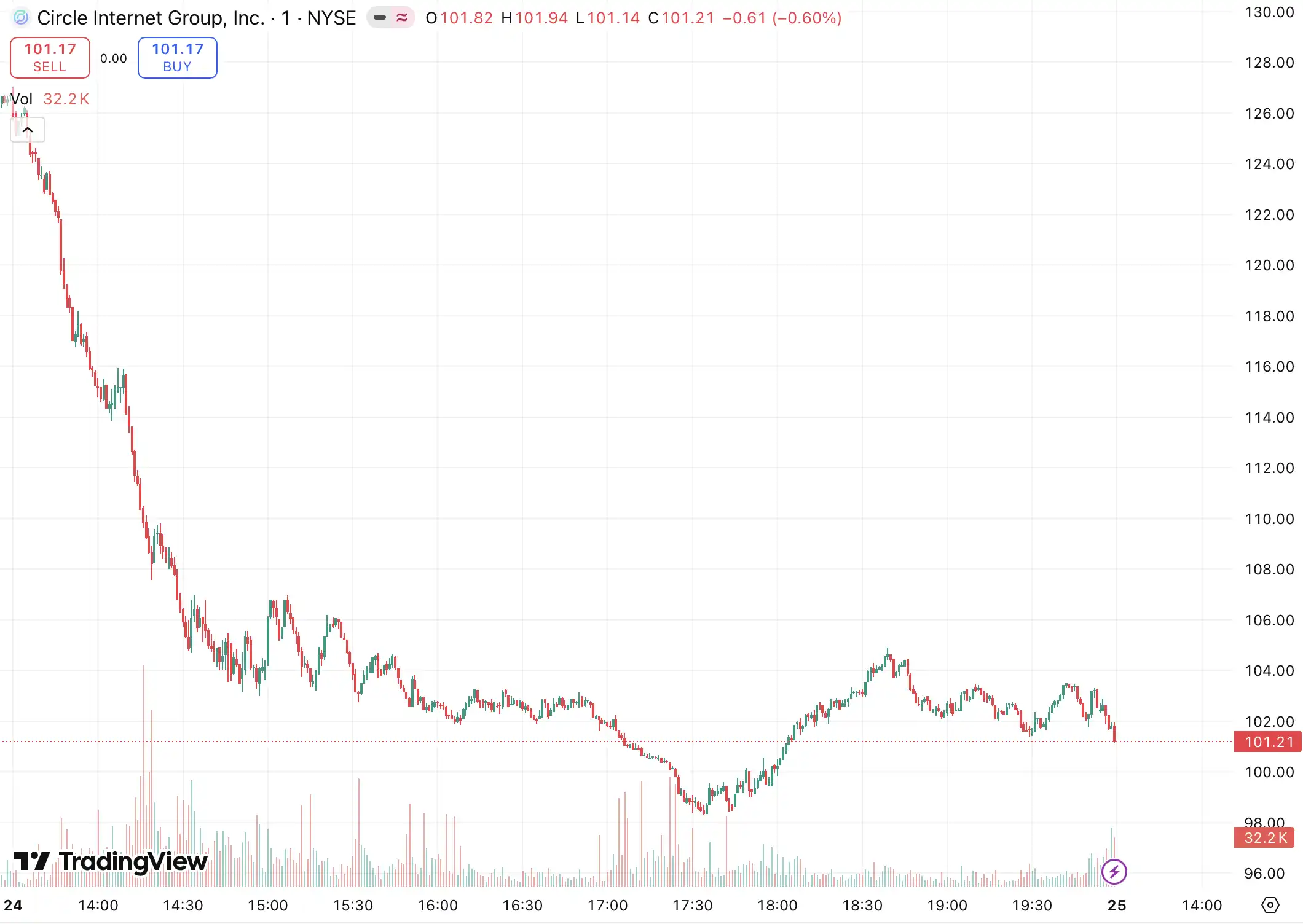
Previously, driven by expectations related to the "Genius Act," Circle's stock price had soared. Now, however, it has experienced a pullback due to the "Clarity Act." The trajectory of Circle fundamentally represents a positive collision between the stablecoin business model and regulatory boundaries.
The following is the original text:
Key Takeaways
·Circle Internet Group Inc.'s stock price hit its largest historical decline on Tuesday, as the market reassesses the potential impact of stablecoin regulatory changes and intensified industry competition.
·This decline comes as investors digest the potential effects of proposed U.S. legislation, including the "Clarity Act." This act may prohibit exchanges from offering yield rewards to users holding stablecoins like USDC.
·Previously, driven by market expectations related to the U.S. "Genius Act" (stablecoin-related legislation), Circle's stock price had surged by up to 750% above its IPO price. However, as expectations subside, its stock price has dropped over 60% from its peak.
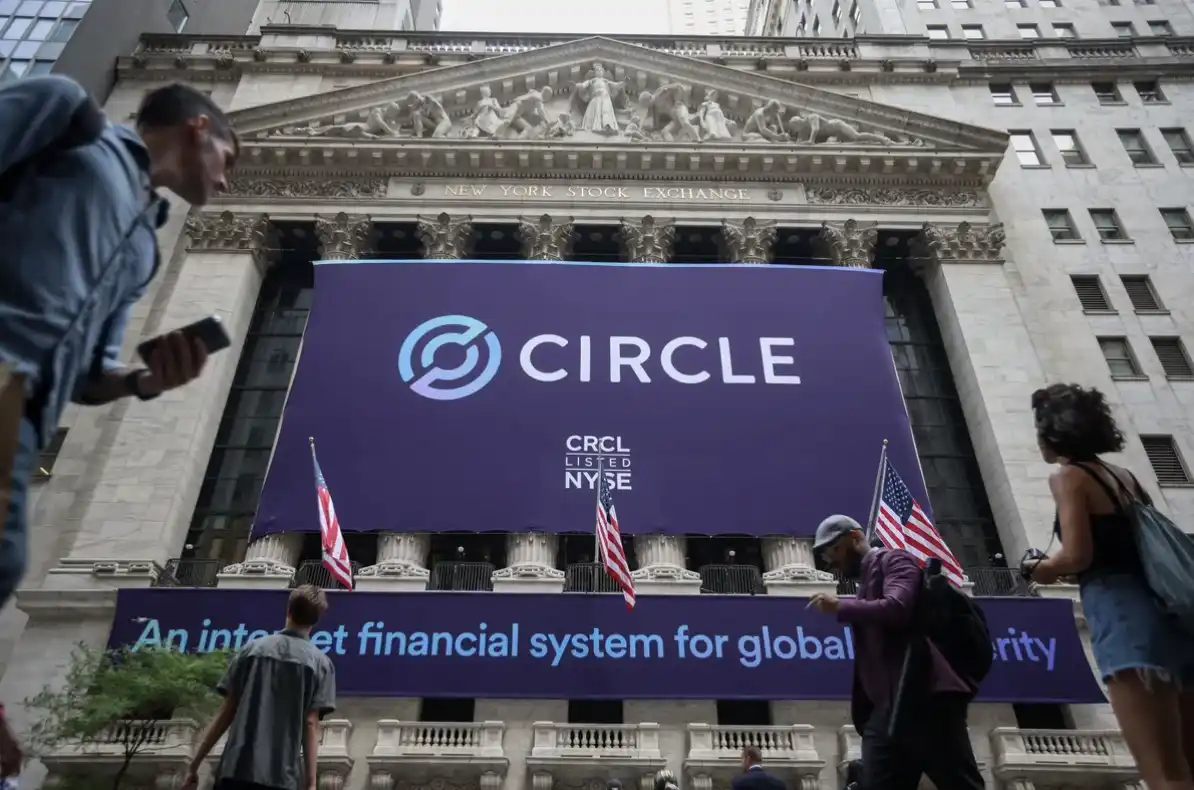
Circle Internet Financial Ltd.'s signage outside the New York Stock Exchange.
Original Text
Circle Internet Group Inc. (the issuer of USDC stablecoin) saw its stock price hit its largest historical decline on Tuesday as investors reassess the impact of stablecoin regulatory changes and intensified industry competition.
The stock once fell 22% intraday, marking the largest single-day drop in its history and leading the decline among various crypto-related stocks. Coinbase Global Inc. fell 11% at one point, while MARA Holdings Inc., Bullish, Galaxy Digital Holdings Ltd., and Robinhood Markets Inc. also dropped concurrently. Bitcoin fell 2.8% at one point to around $68,900, breaking below the $70,000 short-term support level traders had been watching.
The drop in Circle's stock price comes as the market digests the potential impact of proposed U.S. legislation on the stablecoin ecosystem. According to sources familiar with the matter, draft provisions of the "Clarity Act" may restrict platforms like Coinbase from offering interest rewards to users holding stablecoins such as USDC (a stablecoin issued by Circle pegged to the U.S. dollar).
The "Clarity Act" aims to establish a comprehensive regulatory framework for crypto assets and other tokens. However, the bill's progress has been slow, mainly due to the rift between the crypto industry and the banking sector — with a key dispute being whether stablecoins should provide interest-like returns similar to bank deposits.
Analysts point out that the revised version circulating in Washington currently may weaken incentives for users to hold stablecoins over bank deposits.
Needham & Co. analyst John Todaro said, "We believe today's market reaction is almost entirely driven by the latest disclosures around the Clarity Act." His firm expects that if the bill is finalized, it would directly limit Coinbase from offering the approximately 3.5% APY on USDC holdings to some users.
Meanwhile, competition among stablecoin issuers has heated up once again. On Tuesday, Tether announced it had reached a formal agreement with one of the "Big Four" accounting firms to complete its first full audit. Gus Gala, Senior Equity Research Analyst at Monness, Crespi, Hardt & Co., suggested that this move might signal the El Salvador-based company's readiness to enter the U.S. market, drawing high market interest. "In contrast, this is the more direct price-moving factor today," he said.
In the past, Circle's stock price surged significantly on expectations of the U.S. "Genius Act" (legislation related to stablecoins), rising as much as 750% from its IPO price last year. However, as the crypto market corrected, industry competition intensified, and the "Clarity Act" faced obstacles in Washington, this optimism quickly waned. Currently, Circle's stock price has retraced over 60% from its peak.
You may also like
Morning Report | Vitalik outlines Ethereum's long-term roadmap, Lean Ethereum will become the third major iteration; SK Hynix seeks to attract more AI investors by listing in the U.S
The impact of OUSD on Circle, Tether, and Paxos: not a single negative factor, but a more complex reshaping of competition
Li Feifei's latest long article: When video generation, robots, and NVIDIA all claim to be world models, we need a taxonomy
Blaming the desolation of the cryptocurrency world on the rise of AI is a form of intellectual laziness
Strategy Founder: The Next 10 Years of Bitcoin
Forbes Special Report: Stablecoin cross-border payments are faster now, but not cheaper yet
A valuation of 8 billion dollars, doubling in 8 months! What makes the crypto-friendly bank Erebor Bank stand out?
340 billion valuation: Li Yanhong's largest IPO, a seat in Kunlunxin's shares is hard to come by
Stablecoins are the "royalists" of the crypto world: Open USD brings the old currency system into play
Cape Verde 2-3 Argentina: The Underdog Team That Stunned the World in Defeat
Cape Verde's run ended in a 3-2 defeat to Argentina, but their journey — three unbeaten draws, one heroic goalkeeper, and a fight that pushed the defending champions to the brink — is the kind of story markets recognize too: small caps can rattle blue chips long before anyone expects it.
Semiconductor stocks plummet, yet Anthropic wants to create a 2nm chip
Where is Zhao Changpeng's billion-dollar investment going? YZi Labs' investment landscape fully revealed
Ethereum Foundation Report: A Basic Guide to Ethereum for Governments and Financial Institutions
A pre-announced harvesting case: After the cryptocurrency price dropped by 99%, the public chain Saga exited to transform into AI
When American giants collectively "defect" from Chinese AI models
BIS Report Compliance Observation: The Real Risks of Stablecoins, Not Just "Depegging"
Portugal 2-1 Croatia: Ronaldo's 20-Year Knockout-Stage Drought Ends With a Debt Finally Collected
Portugal beat Croatia 2-1 in the 2026 global football championship's knockout rounds as Ronaldo scored his first-ever knockout-stage goal, Gonçalo Ramos struck a stoppage-time winner, and VAR ruled out a late equalizer for offside.
Bitcoin Price Prediction July 2026: Will BTC Recover to $70K or Drop Below $55K?
Morning Report | Vitalik outlines Ethereum's long-term roadmap, Lean Ethereum will become the third major iteration; SK Hynix seeks to attract more AI investors by listing in the U.S
The impact of OUSD on Circle, Tether, and Paxos: not a single negative factor, but a more complex reshaping of competition
Li Feifei's latest long article: When video generation, robots, and NVIDIA all claim to be world models, we need a taxonomy
Blaming the desolation of the cryptocurrency world on the rise of AI is a form of intellectual laziness
Strategy Founder: The Next 10 Years of Bitcoin
Forbes Special Report: Stablecoin cross-border payments are faster now, but not cheaper yet