
- Buy Crypto
- Markets
 Futures
- Spot
- Copy Trade
- Earn
- More
On-Chain Data School (Part 6): A Brand New, Ark-Participated BTC Magical Pricing Methodology (I)

Original Title: "On-chain Data Academy (Part 6): A Brand New, Ark-Participated $BTC Magical Pricing Methodology (I)"
Original Author: Mr. Berg, On-chain Data Analyst
Cointime Price has advanced significantly compared to the previous five articles. If this is your first time reading this series of articles and you want to learn about on-chain knowledge, it is recommended to start by reading the first five articles.
Related Reading: "On-chain Data Academy (Part 5): How Many People Are Really Making Money? A Five-Minute Guide to the Objective Sentiment Index PSIP"
Reading a long article is not easy. Readers are advised to first select the content of interest based on the major headings.
If you want to directly understand the application part, you can read the second and third parts first.
TLDR
- The Cointime Price series consists of three articles, and this article is the first one.
- Introducing the basic principles and buy-the-dip application of Cointime Price
- Cointime Price is a new and efficient $BTC pricing method
- It is stricter than Realized Price and more sensitive than LTH-RP
1. Introduction to Cointime Price
The concept of Cointime Price originated on August 23, 2023, proposed by "Cointime Economics," a collaboration between Ark Invest and Glassnode.
The calculation logic of Cointime Price is relatively complex, and this article will try to explain the principle in a simple and clear manner.
Cointime Price = Pricing Model Designed for the Unique UTXO Structure of $BTC
In traditional pricing methods, when BTC, as a blockchain network, is involved in block creation or transaction transfers, it goes through a validation process. However, Cointime Price differs from traditional pricing methods by using a "time-weighted" calculation approach.
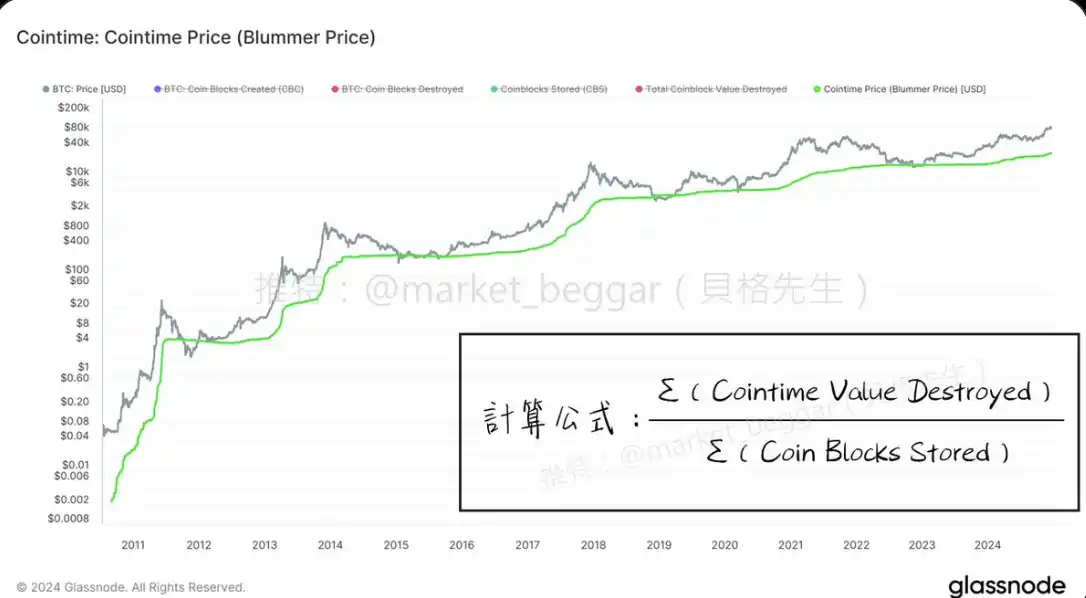
Cointime Price Calculation Logic (as shown in Figure 2, where the green line represents Cointime Price)
The Cointime Price calculation involves three key concepts:
· Coin Blocks Created (CBC):
CBC = The total circulating BTC supply when Block N is generated.
· Coin Blocks Destroyed (CBD):
When BTC is transferred, it is considered destroyed. The calculation is as follows: Transferred BTC amount × Holding time (number of blocks elapsed). This yields CBD (time-weighted BTC amount).
· Coin Blocks Stored (CBS):
CBS = CBC - CBD, which can be understood as the "total time-weighted BTC amount unspent."
In the formula calculation, the numerator's Cointime Value Destroyed is obtained by multiplying CBD by the BTC price at the time of transfer, resulting in the "BTC spent U-value at the time of transaction."
· Key Features of Cointime Price
· Time-weighted design: When long-term holders transfer large amounts of BTC (distribute), the Cointime Price change rate will accelerate.
· Buyer's perspective analysis: The numerator in the formula represents the "total time-weighted spending amount" in the market. Dividing it by CBS yields the market's time-weighted average cost of chips.
· Excluding lost chip impact: Since CBD calculates transfer behavior, BTC that has not been transferred is not counted, so it is not affected by ancient lost BTC.
II. Comparison with LTH-RP
In a previous article, I introduced LTH-RP (Long-Term Holder's Average Holding Cost). Readers interested in this topic can refer to the following post: [Introduction to LTH-RP](https://x.com/market_beggar/status/1864600434129948724)
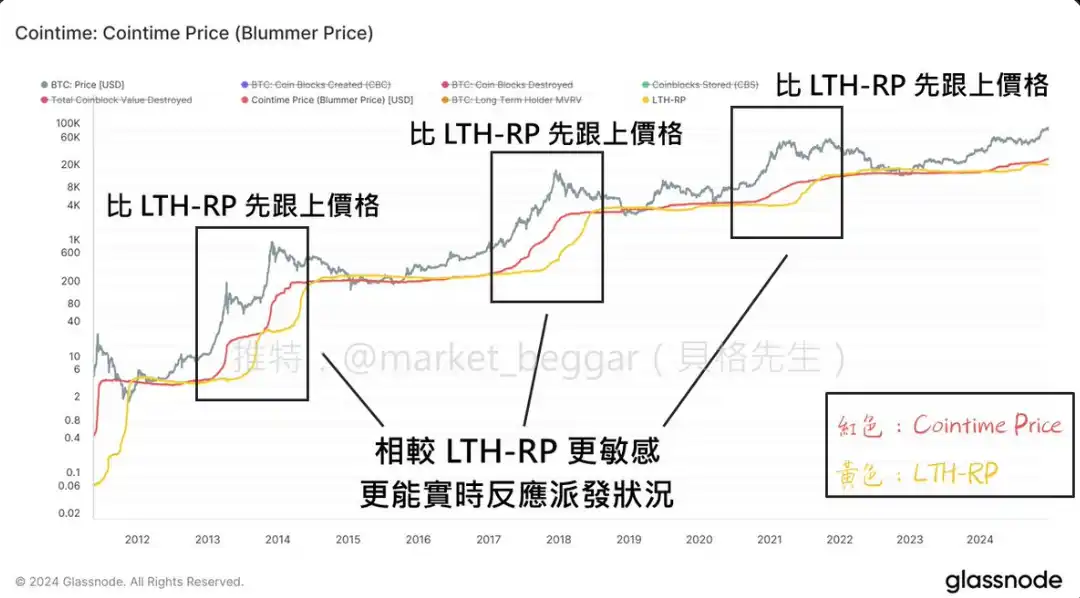
LTH-RP vs. Cointime Price
· Calculation Method of LTH-RP:
- Glassnode defines LTH as BTC held for>155 days
- LTH-RP = Average cost of these LTH BTC
- Limitation: Only for long-term holders, relatively rough definition.
· Calculation Method of Cointime Price:
- Considers the holding time each time BTC is transferred
- More precise and sensitive than LTH-RP
Performance of Cointime Price vs. LTH-RP in Market Trends
As shown in Chart Three, before each market uptrend, Cointime Price always reacts earlier than LTH-RP, better reflecting the real-time occurrence of supply distribution behavior.
Therefore, in my personal analysis, I tend to use Cointime Price for market judgment. The peak model I designed in my weekly market report also includes the Cointime Price indicator.
Application One: Bottom Fishing
Cointime Price = Time-weighted fair valuation of BTC, so when the market price falls below the Cointime Price, it means the market price is below the true value of BTC, usually a good bottom fishing opportunity.
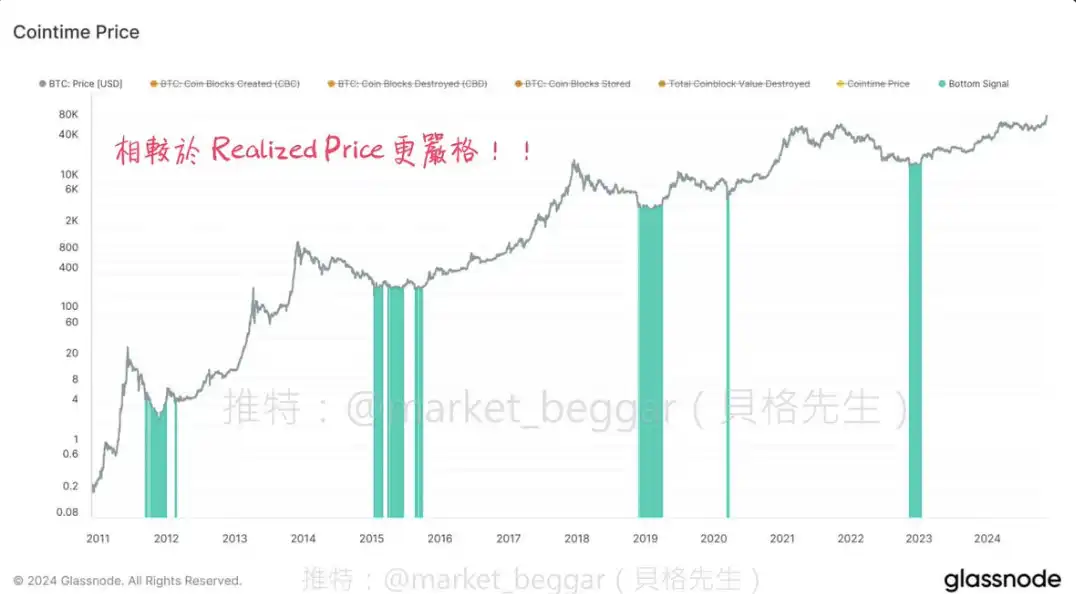
· Historical Data Validation
As shown in Chart Four, I marked the times when the BTC price was below the Cointime Price, and these moments were often good entry points.
Conclusion
This article is the first in the Cointime Price series, introducing the basic concept of Cointime Price and its bottom fishing application.
The next two articles will focus on the application of Cointime Price in Rug Pull scenarios, stay tuned
You may also like

Giannis Antetokounmpo's Investment in Kalshi Sparks Outrage: Idol Crossover or Insider Trading Scheme?

Mr. Beast Acquires Step: Top Streamer Enters Teen Finance Race?

Not Just Guessing Right or Wrong, Market Prediction Is Getting More and More “Fun”

$55,000 will be Bitcoin's make-or-break level

February 10th Key Market Information Gap, A Must-See! | Alpha Morning Report

About ERC-8004: Everything You Need to Know

ai.com's Debut Flop: After $70 Million Transaction, Did It Get a '504' Timeout?

FedNow versus The Clearing House: Who Will Win the Fed Payments Fray?

Recovering $70,000 in Lost Funds: The "Fragile Logic" Behind Bitcoin's Rebound

Mr. Beast acquires Step, Farcaster Founder Joins Tempo, what are the international crypto circles talking about today?
February 9th Market Key Intelligence, How Much Did You Miss?

After being questioned by Vitalik, L2s are collectively saying goodbye to the "cheap" era

WEEX AI Trading Hackathon Paris Workshop Reveals: How Retail Crypto Traders Can Outperform Hedge Funds
Witness how WEEX's Paris AI Trading Hackathon revealed AI's edge over human traders. Explore key strategies, live competition results & how to build your own AI trading bot.

U.S. Oil (USOR) Price Prediction 2026–2030
Key Takeaways U.S. Oil (USOR) is a speculative Solana-based crypto project that aims to index the United States…

USOR Surges on Meme Narrative Despite No Real-World Asset Backing
Key Takeaways: USOR, a Solana-based token, has seen a notable surge driven by speculative narratives rather than verifiable…

How to Buy U.S. Oil Reserve (USOR) Cryptocurrency
Key Takeaways U.S. Oil Reserve (USOR) is a Solana-based token primarily traded on decentralized exchanges (DEXs). Claims have…

USOR vs Oil ETFs: Understanding Why the ‘Oil Reserve’ Token Doesn’t Track Crude Prices
Key Takeaways The U.S. Oil Reserve (USOR) token has become noteworthy for its claims, yet it does not…

Trend Research Reduces Ether Holdings After Major Market Turbulence
Key Takeaways: Trend Research has significantly cut down its Ether holdings, moving over 404,000 ETH to exchanges recently.…


 App
App