
Market Downturn During Holiday Season; Possible Bull Run in Q1 Next Year





Original Title: "Observing Cryptocurrency Market Adjustment Under the Influence of Christmas Holiday | Frontier Lab Cryptocurrency Weekly Report"
Original Source: Frontier Lab
Market Overview
Overall Market Situation: This week, the cryptocurrency market showed a downward trend under the influence of the Christmas holiday. Although the market sentiment index rose slightly from 7% to 10%, it still remains in the extreme fear zone. It is worth noting that despite the overall market weakness, USDC, dominated by the US market, still achieved a 1.91% growth, indicating that institutional funds are still actively entering the market, injecting some confidence into the market.
DeFi Ecosystem Development: The DeFi sector saw a slight decrease in TVL by 0.37% to $527 billion this week. However, yield farming projects like "mechanism pools" performed well, and the overall supply of stablecoins has continued to grow, indicating that despite the market correction, fundamental liquidity continues to flow in. Yield farming projects like "mechanism pools" are highly sought after.
AI Agent Development: The AI Agent track continues to receive high market attention, with a total scale reaching $10.9 billion. Particularly, the AI Agent model combining TEE technology has become a new focus in the market, potentially becoming a new asset issuance method after "NFTs," demonstrating the trend of deep integration between AI and blockchain technology.
Meme Coin Trend: Under the influence of the holiday and the overall market decline, the Meme Coin track performed poorly this week, with significantly reduced investor participation and capital inflow. Market interest temporarily shifted to other tracks, highlighting the high volatility nature of this track.
Public Chain Performance Analysis: The public chain sector has shown strong resilience to declines, with Stacks achieving an important milestone with sBTC, BOB advancing BitVM Bridge development, Taiko launching a new round of ecosystem plans, etc., indicating that major public chains continue to focus on technical innovation and ecosystem development.
Future Market Outlook: Looking ahead, the market is expected to continue its bearish trend during the New Year holiday period. It is recommended that investors maintain a defensive allocation, increase the proportion of top assets, and consider moderately participating in high-yield farming pool projects. In the long term, the market generally expects a bullish trend in the first quarter of 2025, with a focus on AI Agent and DeFi yield farming pool projects.
Market Sentiment Index Analysis
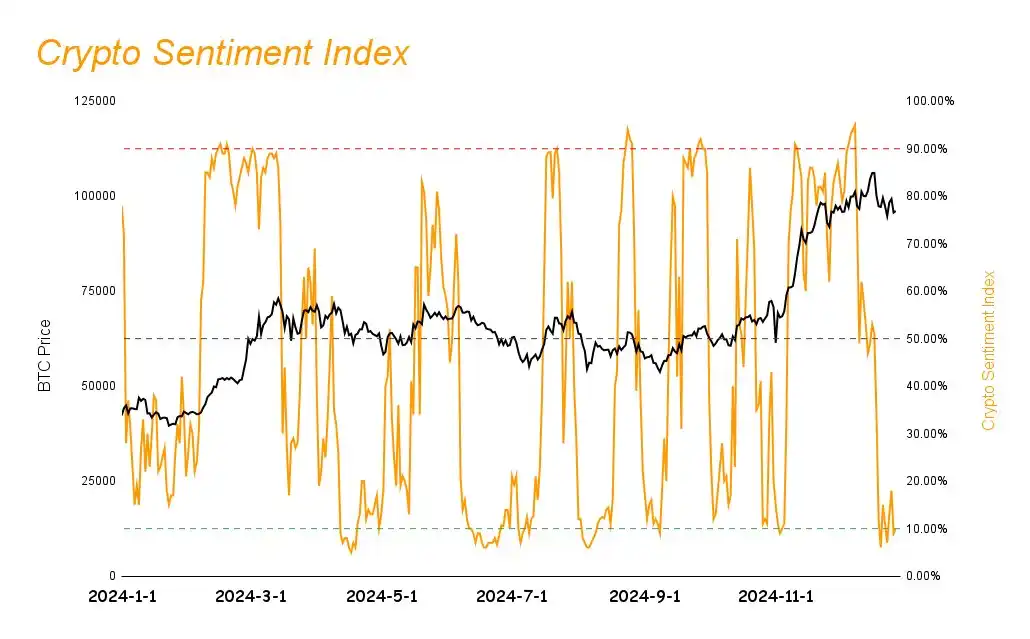
The market sentiment index has risen from 7% last week to 10%, still remaining in the extreme fear range.
This week, Altcoins performed weaker than the benchmark index, exhibiting a significant decline. Due to the Christmas holiday, liquidity sharply decreased, leading to increased market price volatility, making it prone to sharp fluctuations. As a result, market sentiment is not highly optimistic. Given the current market structure, it is expected that Altcoins will likely move in sync with the benchmark index in the short term, with a low probability of an independent trend.
When Altcoins are in the extreme fear zone, the market is often at a temporary bottom, poised for a potential upward reversal at any time.
Overall Market Trend Overview
· The cryptocurrency market was in a downtrend this week, with the sentiment index still in extreme fear.
· Defi-related crypto projects performed well, showing the market's continued focus on enhancing yield fundamentals.
· AI Agent track projects had high visibility this week, indicating that investors are actively seeking the next market breakout point.
Hot Track
AI Agent
This week, the overall market was in a downtrend, with all tracks experiencing a decline. While most AI Agent track token prices were also in a downtrend this week, the discussion about AI Agent was the most active in the market. This week, there was considerable discussion in the market about the AI Agent+TEE model, aipool, and its future impact on Crypto and Defi.
One booster for the Crypto market's cyclical surges is the introduction of new asset issuance models. For example, past asset issuance models like ICOs (Initial Coin Offerings), IEOs (Initial Exchange Offerings), INOs (Initial NFT Offerings), IDOs (Initial Decentralized Exchange Offerings), and minting methods have rapidly driven market development and cryptocurrency price increases. With AI rapidly merging with Crypto, aipool has become a highly popular asset issuance model at present, also continuing the trend of "Money Printing FI" in early 2024. If the market widely adopts this asset issuance model, we may soon see a wave of asset issuance frenzy brought by the aipool model. Therefore, we should pay close attention to projects utilizing the aipool model.
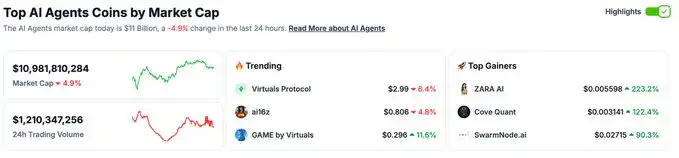
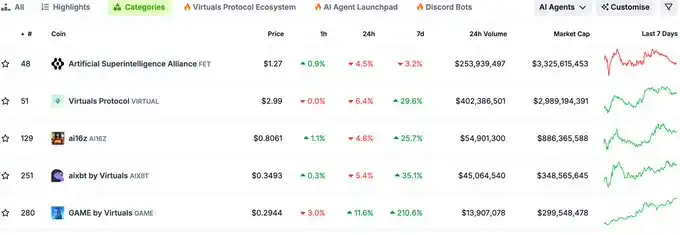
Top Five AI Agent Projects by Market Cap:
DeFi Track
TVL Growth Ranking
Top 5 Market Projects by TVL Growth in the past week (excluding small TVL projects, with a threshold of $30 million and above), data source: Defilama

Resolv (Unlaunched): (Recommendation Score: 3 Stars)
· Project Overview: Resolv is a Delta-neutral stablecoin project that tokenizes a market-neutral investment portfolio. The architecture is based on economically viable and fiat-independent revenue sources, allowing competitive returns to be distributed to the protocol's liquidity providers.
· Latest Developments: This week, Resolv completed a significant technical upgrade, successfully transitioning to an Omnichain project through the integration of LayerZero and Stargate technologies. The OFT standard it adopts has passed security audits by multiple institutions. Resolv demonstrated outstanding ecosystem development this week and attracted a second $100 million fund inflow. The ecosystem growth rate reached 84%, with the USDC Vault on Euler Finance offering up to 36.36% APY and attracting $5.67 million TVL this week. Resolv also launched the wstUSR pool on Pendle.fi and introduced a unified points system.
USDX Money (Unlaunched): (Recommendation Score: 3 Stars)
· Project Overview: USDX Money is an emerging synthetic USD stablecoin protocol that aims to provide a new encrypted native stablecoin solution through a multi-chain, multi-currency strategy. The core goal of the project is to build next-generation stablecoin infrastructure and maintain USDX's peg to the dollar through Delta-neutral hedging strategies.
· Latest Developments: USDX Money completed a fresh UI/UX upgrade this week to optimize user interaction. It also launched USDX/USDT and sUSDX/USDX liquidity pools on Curve Finance, with the ecosystem continuing to expand. The sUSDX reached a $170 million TVL through a partnership with Lista DAO. USDX Money also introduced an X-Points incentive program, including content creation and angel plans, and held a special Christmas event.
Usual (USUAL): (Recommendation Rating: 5 Stars)
· Project Overview: Usual is a Binance-backed stablecoin project aimed at providing a new stablecoin solution in a decentralized manner. The core mechanism of this project consists of three main tokens: the stablecoin USD0, the bond product USD0++, and the governance token USUAL.
· Latest Developments: Recently, Usual secured a $10 million Series A funding round led by Binance Labs and KrakenVentures. It also collaborated with the M^0 Foundation to launch the new product UsualM. Additionally, it became the largest USD0/USD0++ pool on Curve Finance, with Usual's TVL surpassing $1.5 billion, ranking it among the top five global stablecoins. The DAO treasury doubled to $17 million, and the Usual project introduced the USUALx staking yield of up to 18,000% APY, along with initiating a community airdrop event.
Hashnote (Not Yet Launched): (Recommendation Rating: 2 Stars)
· Project Overview: Hashnote is a project focusing on institutional cryptocurrency management solutions, aiming to provide transparency and optimize asset management through blockchain technology. Hashnote combines digital assets and traditional finance to offer users innovative yield-enhancing solutions such as USYC.
· Latest Developments: This week, Hashnote entered into a strategic partnership with CoreDAO and participated in its ecosystem working group panel discussion. It highlighted the introduction of an innovative Bitcoin dual-staking model that combines BTC and Core Token to provide users with a sustainable yield solution. Additionally, the project's CEO shared new strategies during the meeting, garnering over 14,000 views and demonstrating the market's strong interest in this innovative approach.
Spectra (SPECTRA): (Recommendation Rating: 2 Stars)
· Project Overview: Spectra is a protocol for tokenizing future yields. DeFi users can deposit interest-bearing tokens from other protocols for a specified future period and trade the future yield generated by that asset in advance. Spectra operates by placing interest-bearing tokens (IBT) or any fixed-term yield asset in a smart contract and issuing Future Yield Tokens (FYT) as a reward.
· Latest Developments: This week, Spectra successfully deployed a new governance contract on the Base mainnet and introduced Gauges and ncentivize pages in the Spectra App. Additionally, they optimized the multi-locking feature for veSPECTRA holders to allow more efficient participation in the Gauge voting mechanism. Spectra also completed the APW emission adjustment, with the new emission mechanism being executed at a 1:20 ratio.
In summary, we can see that projects with significant TVL growth this week are mainly concentrated in the stablecoin yield sector (Gauge Pools).
Overall Performance
· Stablecoin Market Cap Growth: USDT decreased from 1.451 trillion USD last week to 1.447 trillion USD, a decrease of 0.27%, while USDC increased from 421 billion USD last week to 429 billion USD, marking a growth of 1.91%. Despite the market being in a downtrend this week, the USDC-dominated market still saw growth, indicating that the market's main buyers continue to enter with sustained funds.
· Liquidity Gradual Increase: While the risk-free arbitrage rates in traditional markets continue to decline due to continuous interest rate cuts, the arbitrage rates of on-chain DeFi projects have been increasing steadily along with the rising value of cryptocurrency assets. Returning to DeFi will be a very good option.
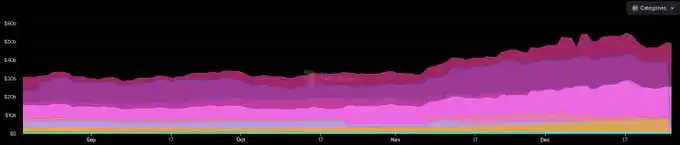
DeFi TVL by Track (Data Source: https://defillama.com/categories)
· Funding Situation: The TVL of DeFi projects has risen from 52.9 billion USD last week to the current 52.7 billion USD. Although there has been negative growth for two consecutive weeks, the magnitude of the decline is relatively small, at 0.37%. The main reason is that this week, the Western markets led by the U.S. are in the Christmas holiday season, leading to a decline in both token trading volumes and on-chain activities. Moreover, next week is the New Year's Day holiday, and there is not expected to be a significant improvement. Therefore, the focus should be on the overall TVL changes in the market in January, paying attention to whether the downward trend continues.
Deep Dive
Upward Momentum:
The core driving factors of this upward trend can be summarized as follows:
Due to the recent downward trend in the market, the APY of various DeFi protocols has decreased. Stablecoin yield projects have increased the yield rate through token/point rewards, giving a significant advantage to yield farming projects in the overall market. Specifically:
· Market Environment: Despite being in a bull market cycle, the recent market has been in a downward trend, leading to a significant decrease in the market's base interest rate.
· Rate Side: The basic lending rate has increased, reflecting the market's pricing expectations for funds.
· Yield Side: The yield rate of stablecoin yield projects has expanded compared to other projects, attracting more users to participate in this transmission mechanism. This has strengthened the value support of stablecoin yield projects, forming a benign growth momentum.
Potential Risks: Due to the recent upward trend in the market, market investors have focused more on yield and leverage, overlooking the downside risk. This week, due to the Christmas holiday, there has been a sharp decrease in market liquidity. This lack of liquidity has led to sell pressure in the market without sufficient liquidity to absorb it, resulting in continuous price declines. This, in turn, triggered liquidations in the market's long positions, causing losses to investors. The risk of cascading liquidations from these liquidations has significantly increased, further driving down the price and liquidating more assets.
Other Track Performance
Public Chains
The top 5 weekly market public chain TVL increases (excluding smaller TVL chains), data source: Defilama
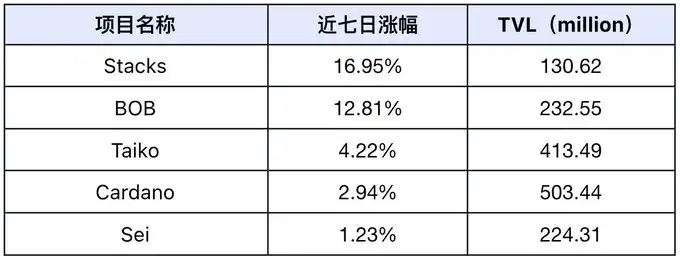
Stacks: This week, 922 BTC were transferred to the Stacks network, reaching the deposit cap of 1000 BTC in the first phase of sBTC. In terms of DeFi applications, 35% of sBTC has generated revenue on Zest Protocol. The ALEX community voted to allocate 12 million ALEX tokens to the Surge program. Stacks also implemented L1/L2 asset exchange functionality through Bitflow Finance and AI Console. Additionally, Stacks incentivized developers through the "Stackies" community reward program.
BOB: This week, BOB collaborated with Fiamma Labs to develop and release a prototype of the BitVM Bridge based on zero-knowledge technology, planning to launch the testnet in early 2025. It also partnered with Lombard Finance to successfully deploy Lombard Finance on the BOB chain. BOB engaged in initial governance discussions with Aave, planning to introduce its protocol to the BOB network. Moreover, BOB launched a 6-week DeFi incentive program, incentivizing LST holders to participate through Babylon Points. The project also conducted various community education tasks and Spaces events.
Taiko: This week, Taiko launched the Trailblazers Season 3 plan, established a reward pool of 6 million TAIKO tokens, and introduced the Liquidity Royale event, offering a reward of 12,000 TAIKO tokens to the top 100 liquidity providers; the number of projects in Taiko's on-chain ecosystem has grown to 130, with Symmetric being added as a key DEX partner. Taiko also held its first community meetup in Turkey with ITU Blockchain and Node 101, strengthening community development through holiday gift events and a Meme contest.
Cardano: This week, Cardano emphasized the slashing mechanism's technical advantages in safeguarding user ADA assets and launched convenient web application development tools. Cardano deepened its collaboration with hardware wallet provider Ledger and advanced decentralized community governance through the DReps (Delegates) voting decision-making model.
Sei: This week, Sei announced a major technological breakthrough named "Giga," successfully extending the EVM to process 5 gigagas per second, resulting in a 50x performance improvement. Sei also released the Giga Roadmap through Developer Office Hours to establish a clear roadmap for future technological development, introduced the EVM Wrapped feature to allow users to view their activity across multiple EVM chains, enhancing cross-chain interoperability. Sei also conducted the "12 Days of Christmas" holiday event and partnered with PythNetwork, Silo, and Nansen.
Gainers Overview
Top 5 gainers in market token prices over the past week (excluding tokens with very low trading volume and meme coins). Data Source: Coinmarketcap
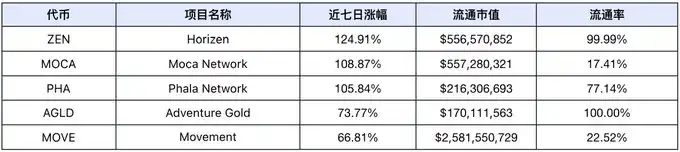
ZEN: This week, Horizen successfully deployed the Horizen 2.0 Devnet testnet, introduced an optimized zero-knowledge proof (ZK) solution to reduce technical complexity and costs, and established a strategic partnership with Automata Network to advance Web3 development. Horizen received institutional investor recognition through Grayscale's Horizen Trust, completed the final ZEN halving this week, and listed on the Bitvavo exchange. Horizen is also actively preparing the token distribution plan for the zkVerify project.
MOCA: This week, Moca Network successfully integrated with SK Planet's OK Cashbag app, bringing significant user growth, including 1.5 million page views and 800,000 wheel spin interactions. Moca Network has remained active in community operations, enhancing user stickiness through a Christmas marketing campaign (#MocaFam), and placing special emphasis on user security education by issuing multiple anti-fraud reminders.
PHA: This week, Phala Network officially launched Phala 2.0, integrating GPU TEE technology and Ethereum Layer 2 scaling features. The network also collaborated with NVIDIA to test TEE efficiency on H100/H200, achieving nearly 99% efficiency. Additionally, they announced the decision to migrate the Khala chain to the Ethereum mainnet. Phala Network's TEE-as-a-Service has been adopted by multiple projects such as Flashbots, with yearly data showing a significant increase in AI Agent contract executions to 4,500 times and active TEE Workers reaching 37,650, demonstrating Phala Network's leading position in decentralized AI infrastructure.
AGLD: This week, Adventure Gold engaged with the community through a Christmas-themed marketing campaign. Their Christmas blessing tweet received high community engagement (27 likes, 14 retweets). Adventure Gold also partnered with BladeGamesHQ in the AI Agent-driven on-chain economy, showcasing the project's exploration of the gaming ecosystem and AI technology integration.
MOVE: This week, Movement launched several innovative products based on its tech stack, including Puffpaw Vape with multi-chain support (featuring usage tracking data and reward functionality), Vomeus smart Vape with a high-definition screen, and Sentimint, allowing users to tag emotions and memories to items. Movement improved performance through Block-STM parallelization optimization and Rollup architecture, expanding its on-chain DeFi scene through cross-chain integration with WBTC.
Meme Token Price Surge Ranking
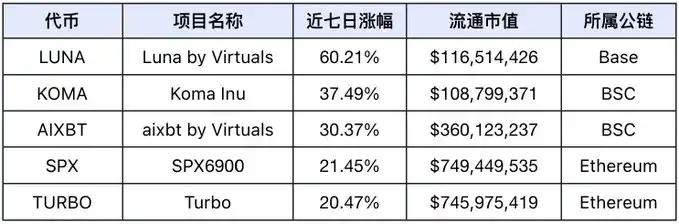
Data Source: coinmarketcap.com
This week, the Meme projects were significantly affected by the overall market downturn. Due to the Christmas holiday this week, there were fewer users participating in market trading, and funds in the market were withdrawn, leading to a notable decrease in investors participating in Meme coin projects this week. As a result, the current market focus and funds are not in the Meme coin sector at the moment.
Social Media Highlights
Based on the data of the top five daily growths on LunarCrush and the top five AI scores on Scopechat, the statistics for this week (12.21-12.27) are as follows:
The most frequently mentioned theme was L1s, and the tokens listed are as follows (tokens with extremely low trading volume and meme coins are not included):
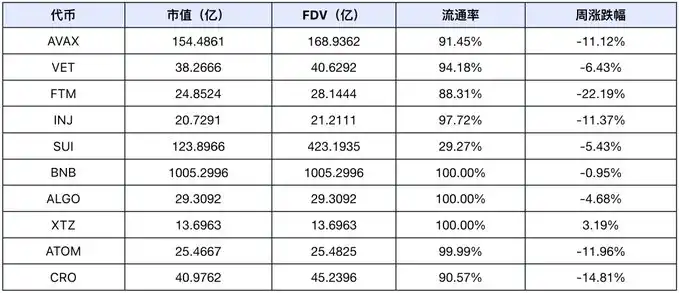
Data Source: Lunarcrush and Scopechat
According to data analysis, the highest social media attention this week was on the L1s project. As this week coincided with the Christmas holiday, the U.S.-dominant market entered the holiday period, causing market makers and institutions to be on vacation. This led to a significant decline in market liquidity and reduced on-chain investment activities by most retail investors, accompanied by selling pressure, resulting in a substantial market downturn. However, various public blockchains experienced relatively smaller price drops. During a general market downturn, public blockchains typically outperform other sectors. Apart from hedging by buying BTC and ETH, most market investors primarily allocated funds to various public blockchains. When the downturn ended and an uptrend began, public blockchains generally saw an increase before other projects.
Overall Market Theme Overview
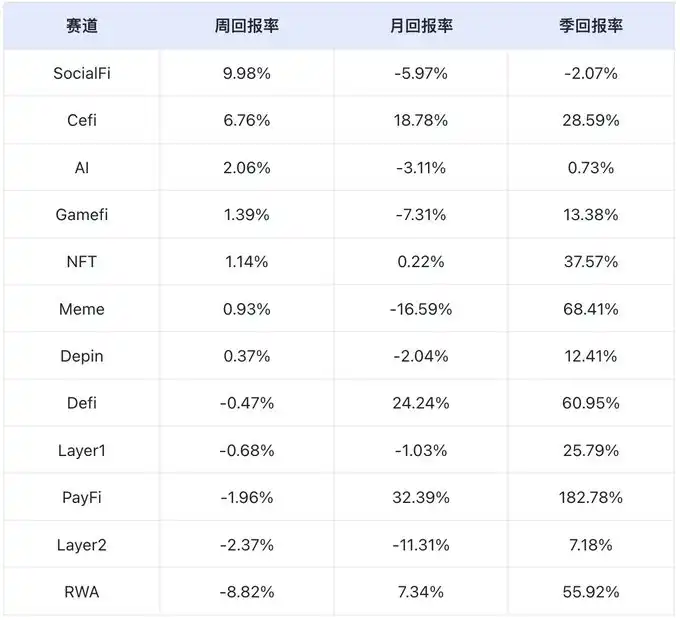
Data Source: SoSoValue
Based on the weekly return rate statistics, the SocialFi sector performed the best, while the RWA sector performed the worst.
· SocialFi Sector: The absolute leader in the SocialFi sector remains TON, accounting for 91.07% of the SocialFi sector's market value. This week, TON did not follow the overall market decline and instead rose against the trend by 6.3%, making the SocialFi sector the best performer. This week, Toncoin partnered with GMX to drive the development of high-frequency DeFi trading in the SocialFi sector.
· RWA Track: In the RWA track, OM, ONDO, and MKR account for a large proportion, with percentages of 44.28%, 23.85%, and 18.36%, totaling 86.49%. This week, OM, ONDO, and MKR each dropped by 10.76%, 19.86%, and 8.28%, respectively. Their significant declines compared to other track projects caused the RWA track to perform the worst this week.
Next Week's Crypto Major Events Preview
Monday (December 30): European Securities and Markets Authority to release MiCA crypto regulation implementation
Thursday (January 2): US Initial Jobless Claims for the week
Friday (January 3): Court approves FTX's Chapter 11 reorganization plan to take effect
Next Week Outlook
· Macro Factors Analysis
Entering the New Year holiday week, there will be few macroeconomic data releases. In previous years during the New Year holiday week, markets primarily led by the United States usually continue the subdued buying power seen during the Christmas period, leading to increased market volatility.
· Sector Rotation Trend
Although the DeFi track is currently struggling in the market, investors generally expect a market-wide upturn in the first quarter of next year. Therefore, most investors are still unwilling to sell their tokens. Meanwhile, to increase holdings income, many are participating in yield farming projects to boost returns. The AI sector's AI Agent track continues to attract market attention, with the market size reaching $10.9 billion. The asset issuance model of aipool based on AI Agent + TEE has gained widespread market attention.
· Investment Strategy Suggestions Maintain a defensive allocation, increase exposure to top assets BTC and ETH to enhance asset hedging attributes and hedge risks. Investors can also participate in high-yield yield farming DeFi projects. It is recommended for investors to exercise caution, control positions, and practice effective risk management.
You may also like

Galaxy Deep Research Report: How Hyperliquid's HIP-4 Upgrade Changes the Landscape of Prediction Markets?

ZachXBT: Humanity private key leak and abnormal surge in H token should be viewed separately
On June 9, according to related disclosures, on-chain investigator ZachXBT posted an update on Humanity’s roughly $31 million security incident, saying that after further analyzing fund flows, he currently tends to believe the project team was not involved in an “inside job” or a self-staged attack. According to him, the official explanation about the private key leak was broadly accurate, but before the token unlock, the price of H had been artificially pushed higher, and the hacker later took advantage of that market environment; therefore, the private key leak and the earlier abnormal price pumping should be regarded as two separate and independent events. This reframing has shifted the market’s understanding of the nature of the incident. Earlier discussion around Humanity had focused on whether the team directly participated in the attack or used the security incident to cover up internal operations. ZachXBT’s latest remarks shift the focus from “whether it was self-theft” to “whether there were pre-unlock market structure issues.” He also questioned whether the team may have.

Morning Report | OpenAI has submitted an S-1 registration statement draft to the U.S. SEC; Morpho completes $175 million financing

Morning Report | BitMine increased its holdings by 126,971 ETH last week; trader Eugene announced his exit from the crypto market

Wang Chuan: How can one not feel anxious after the neighbor Old Wang made thirty times profit by investing in storage stocks? (Seven) - A quarter-century cycle

Cryptocurrency CEXs are flocking to sell US stocks, and traditional brokerages are facing an "uninvited guest."
$75 billion in foreign capital has fled, and South Korean retail investors have absorbed it all using leverage

Japan’s Three Megabanks Plan Joint Stablecoin Issuance in Fiscal 2026
MUFG, SMBC, and Mizuho reportedly plan to jointly issue fiat-pegged stablecoins in fiscal 2026, signaling Japan’s growing push into bank-led digital payment infrastructure.

Humanity Discloses H Token Dual-Chain Attack Details, With Losses on Ethereum and BSC Exceeding $36 Million
Humanity said the H token attack across Ethereum and BSC caused more than $36 million in losses after leaked ProxyAdmin keys enabled malicious contract upgrades and token minting.
White House Discusses CLARITY Act With Law Enforcement Ahead of Senate Vote
The White House discussed the CLARITY Act with law enforcement ahead of a Senate vote, focusing on illicit finance risks and developer protections.

Bitcoin Trading Guide 2026: Strategies for Experienced Traders

What Is XAUT and PAXG? Why Tokenized Gold Is Booming in 2026

Will the SpaceX IPO Hurt Bitcoin? Here's What Traders Are Watching

Foreign selling in the South Korean stock market accelerates, with cumulative net sales reportedly reaching $75 billion this year
On June 9, The Kobeissi Letter, citing Goldman Sachs data, reported that global investors are selling South Korean stocks at an unusually rapid pace. In the latest trading session, foreign investors sold about $801 million worth of Kospi constituent stocks again; total foreign outflows last week reached about $10 billion, and the market has been in net foreign selling on nearly every trading day over the past month. According to the data cited in the report, foreign investors have sold about $75 billion worth of South Korean stocks so far this year. Meanwhile, South Korean retail and institutional investors together recorded roughly $69 billion in net buying over the same period, suggesting that the market’s main buying support has come from domestic capital rather than returning overseas funds. The information currently disclosed still mainly comes from The Kobeissi Letter’s retelling and Goldman Sachs data summaries, while public details on the statistical period and the specific definition of “selling” remain relatively limited.

Fortune Warns of Strategy’s Financing Structure Risks as Bitcoin Premium Narrows
Fortune warned that Strategy’s Bitcoin treasury model faces growing financing risks as MSTR’s net asset premium narrows and preferred stock dividend pressure increases.

Ferrari Challenge Le Mans: Carl Moon to Dominate in WEEX Livery

Sahara AI Responds to SAHARA’s Sharp Drop: No Contract or Product Security Issues Found, Internal Investigation Underway
Sahara AI responded to SAHARA’s 60% price drop, saying no token contract or product security issues have been found and an internal investigation is underway.

WEEX Deposit/Withdrawal Dynamic Island: Your Asset Status, Always in Sight
Galaxy Deep Research Report: How Hyperliquid's HIP-4 Upgrade Changes the Landscape of Prediction Markets?
ZachXBT: Humanity private key leak and abnormal surge in H token should be viewed separately
On June 9, according to related disclosures, on-chain investigator ZachXBT posted an update on Humanity’s roughly $31 million security incident, saying that after further analyzing fund flows, he currently tends to believe the project team was not involved in an “inside job” or a self-staged attack. According to him, the official explanation about the private key leak was broadly accurate, but before the token unlock, the price of H had been artificially pushed higher, and the hacker later took advantage of that market environment; therefore, the private key leak and the earlier abnormal price pumping should be regarded as two separate and independent events. This reframing has shifted the market’s understanding of the nature of the incident. Earlier discussion around Humanity had focused on whether the team directly participated in the attack or used the security incident to cover up internal operations. ZachXBT’s latest remarks shift the focus from “whether it was self-theft” to “whether there were pre-unlock market structure issues.” He also questioned whether the team may have.
Morning Report | OpenAI has submitted an S-1 registration statement draft to the U.S. SEC; Morpho completes $175 million financing
Morning Report | BitMine increased its holdings by 126,971 ETH last week; trader Eugene announced his exit from the crypto market
Wang Chuan: How can one not feel anxious after the neighbor Old Wang made thirty times profit by investing in storage stocks? (Seven) - A quarter-century cycle
Cryptocurrency CEXs are flocking to sell US stocks, and traditional brokerages are facing an "uninvited guest."


