
 Buy Crypto
- Markets
 Futures
- Spot
- Copy Trade
- Earn
- More
Glassnode On-Chain Data Reveals: Realized Price Average Lost, Bitcoin Enters "Bearish Time"

Original Article Title: Bears In Control
Original Article Authors: Chris Beamish, CryptoVizArt, Antoine Colpaert, Glassnode
Original Article Translation: AididiaoJP, Foresight News
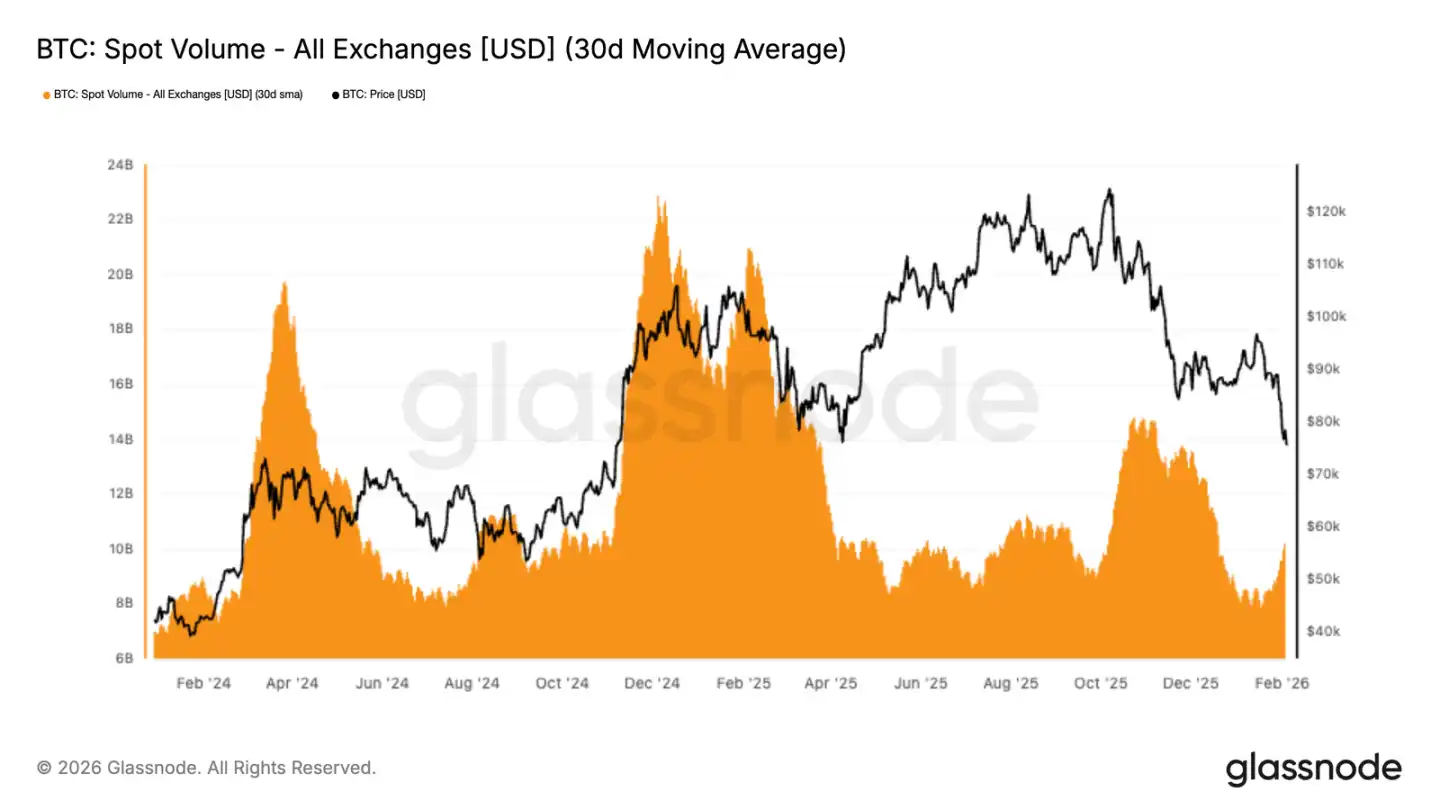
Bitcoin spot trading volume remains low, with the 30-day average volume staying weak despite the price dropping from $98,000 to $72,000. This reflects inadequate market demand as selling pressure has not been effectively absorbed.
Key Insights
· Bitcoin has confirmed a breakdown, with price falling below the realized market value, shifting market sentiment to cautious defense.
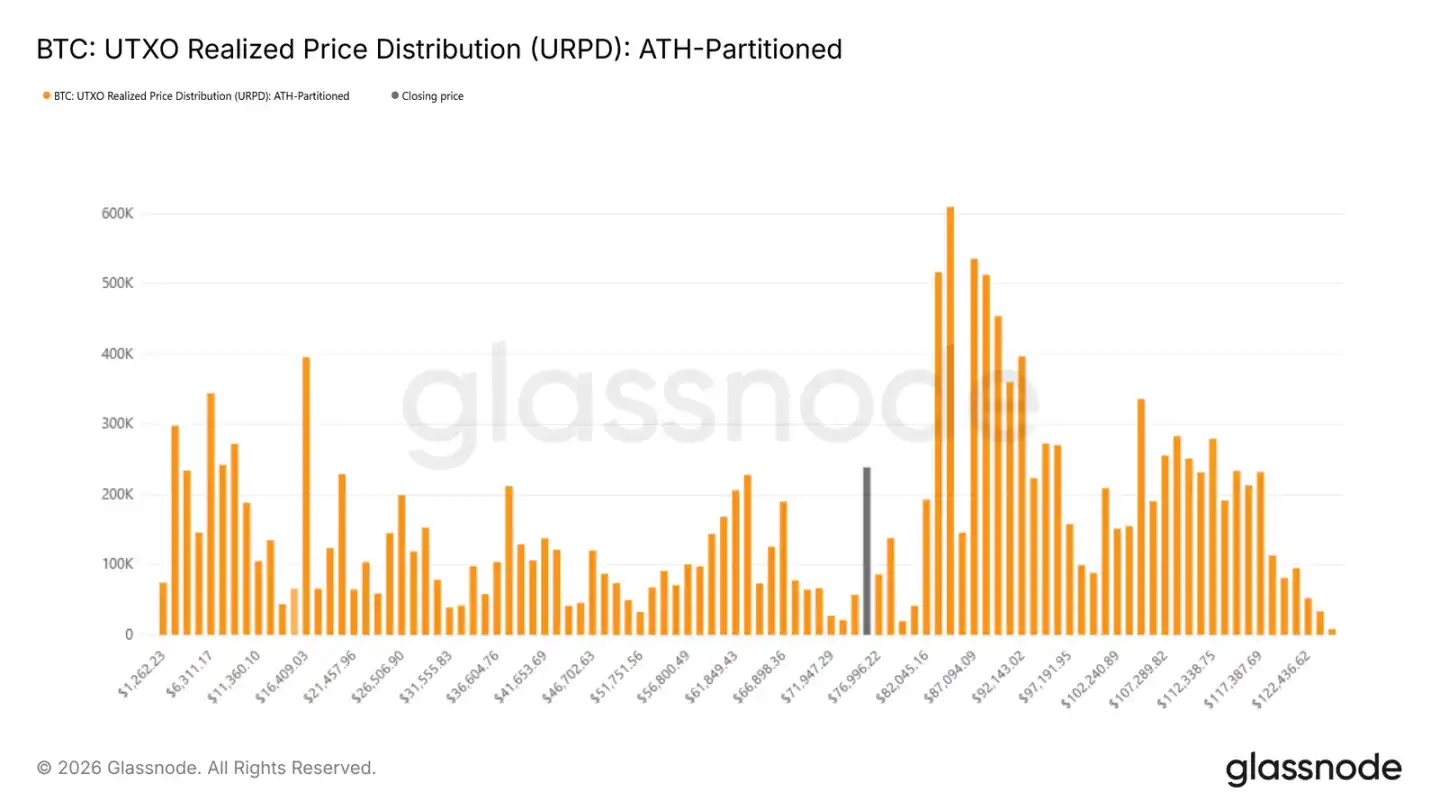
· On-chain data shows initial accumulation signs in the $70,000 to $80,000 range, with a dense holding cost zone formed between $66,900 and $70,600, which could act as a short-term support level against selling pressure.
· Intensified investor loss selling has occurred, with more and more holders forced to exit through stop-loss orders as the price continues to decline.
· Spot trading volume remains weak, further indicating insufficient market support and a lack of effective absorption of selling pressure.
· The futures market has entered a forced deleveraging phase, with large-scale long liquidations exacerbating market volatility and downward pressure.
· Institutional inflows have significantly weakened, with ETF and related fund net inflows shrinking, unable to provide sustained buying support as seen in the previous uptrend phase.
· The options market continues to reflect high downside risk expectations, with implied volatility remaining high, an increase in demand for put options showing strong risk-off sentiment.
· With market leverage being cleared out and spot demand remaining weak, the price remains fragile, and any bounce could be merely a technical recovery rather than a trend reversal.
On-Chain Data Observations
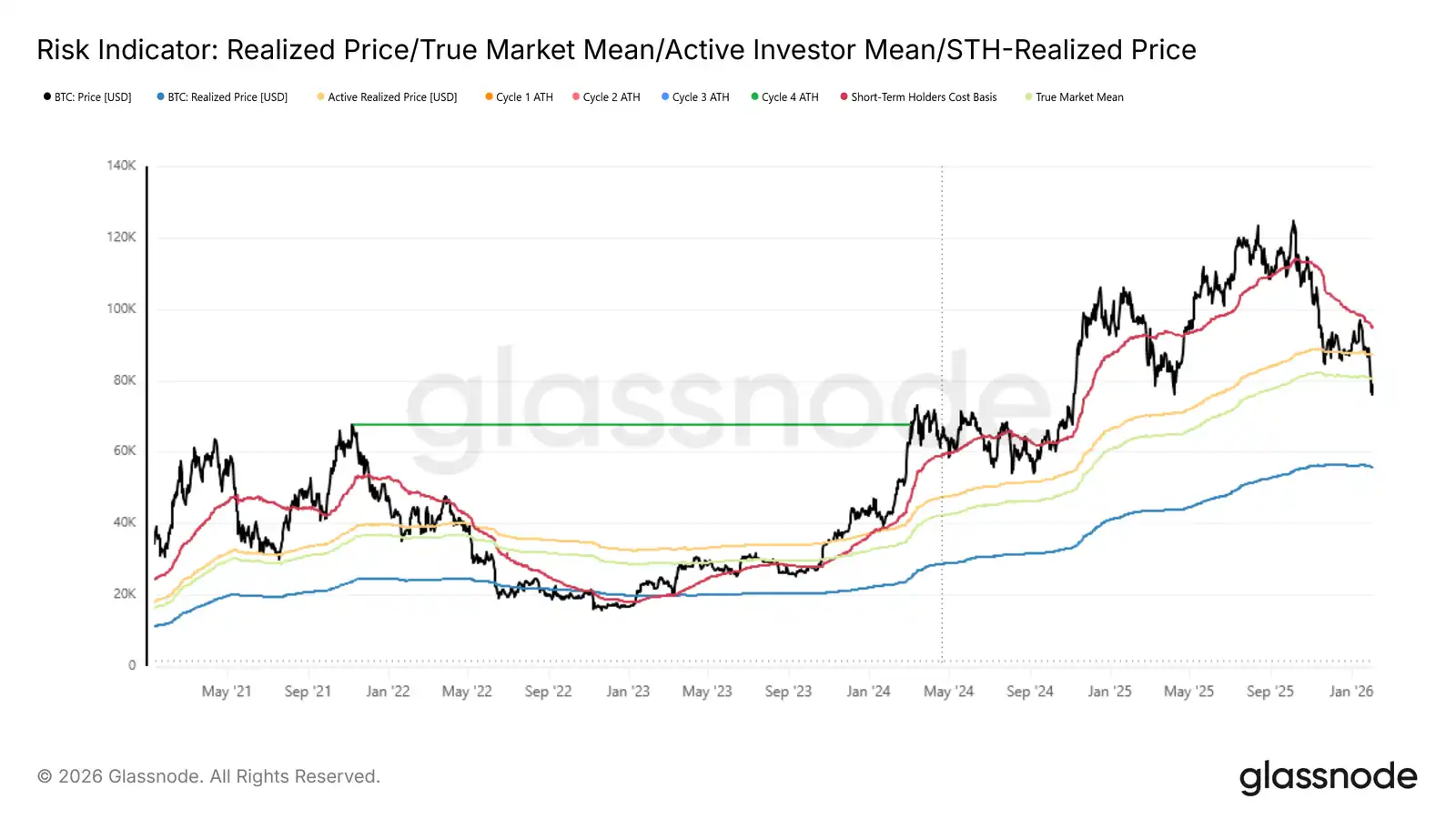
Following last week's analysis pointing out the downside risk after the market failed to reclaim the $94,500 short-term holding cost, the price has now definitively fallen below the realized market value.
Breaking Below Key Support
The realized market value (average cost basis of active circulating holdings excluding long-term dormant coins) has repeatedly served as a key support level in this round of adjustment.
The breakdown of this support has confirmed the deterioration of the market structure since late November, with the current pattern resembling the phase transition from consolidation to deep correction seen at the beginning of 2022. Weak demand coupled with sustained selling pressure indicates that the market is in a fragile equilibrium.
Looking ahead, the price range is gradually narrowing. The upside resistance is around the $80,200 level of the realized market value, while the downside support is around $55,800 of the realized price, a level that has historically attracted long-term funds.
Potential Demand Zone Analysis
As the market structure resets, attention is turning to potential areas where a downward consolidation may occur. Several on-chain metrics help identify regions that could serve as interim bottoms:
The UTXO realized price distribution shows significant accumulation by new investors in the $70,000 to $80,000 range, indicating that there are funds willing to buy the dip in this area. Below this, there is a dense concentration zone between $66,900 and $70,600, which has historically acted as a short-term support zone.
Market Pressure Indicators
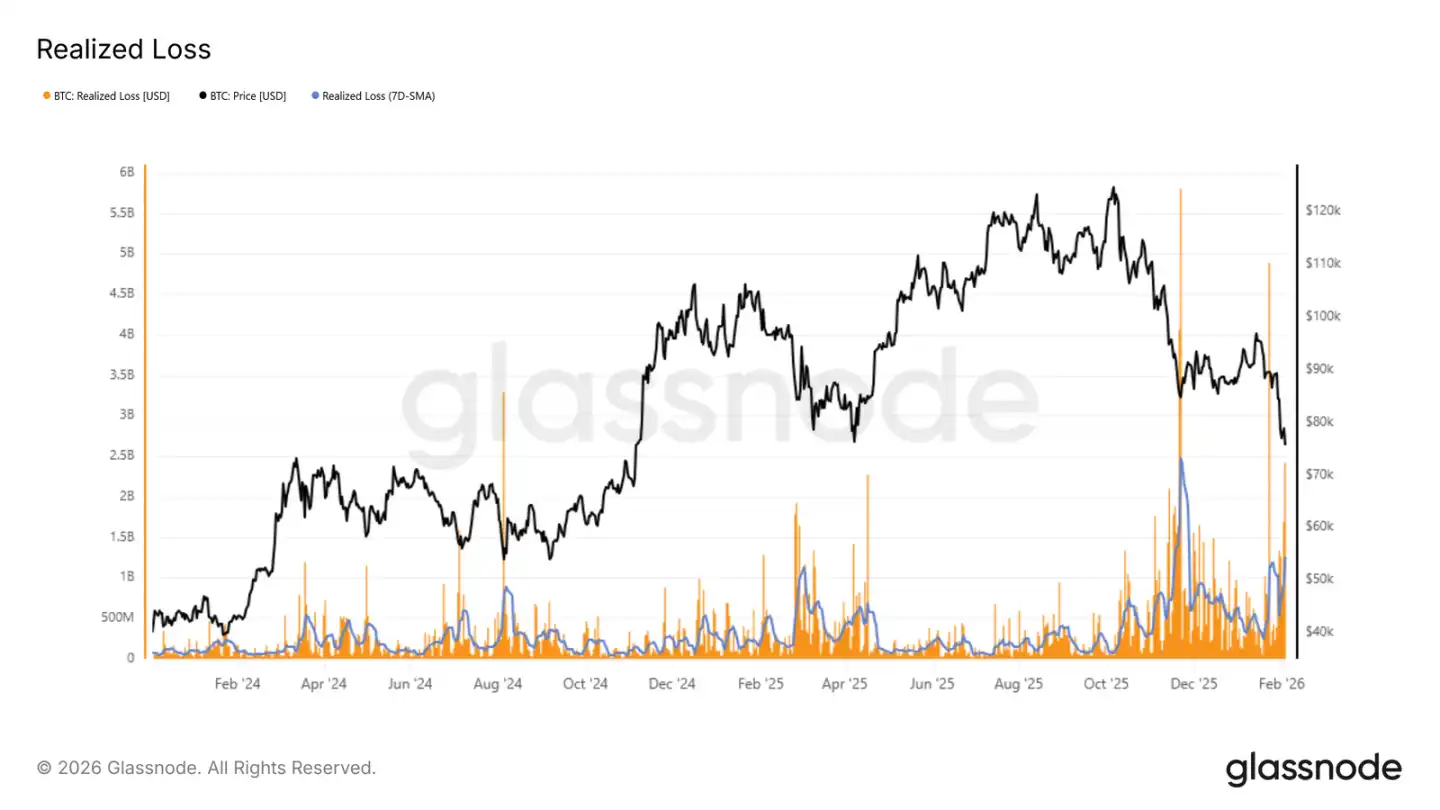
The realized loss indicator directly reflects investors' selling pressure. The current 7-day average realized loss has exceeded $1.26 billion per day, indicating an increase in panic selling after the market breached a key support level.
Historically, peak realized losses have occurred during the exhaustion phase of sell-offs. For example, during the recent bounce from $72,000, daily losses briefly exceeded $2.4 billion, with such extreme values often corresponding to short-term turning points.
Comparison with Historical Cycles
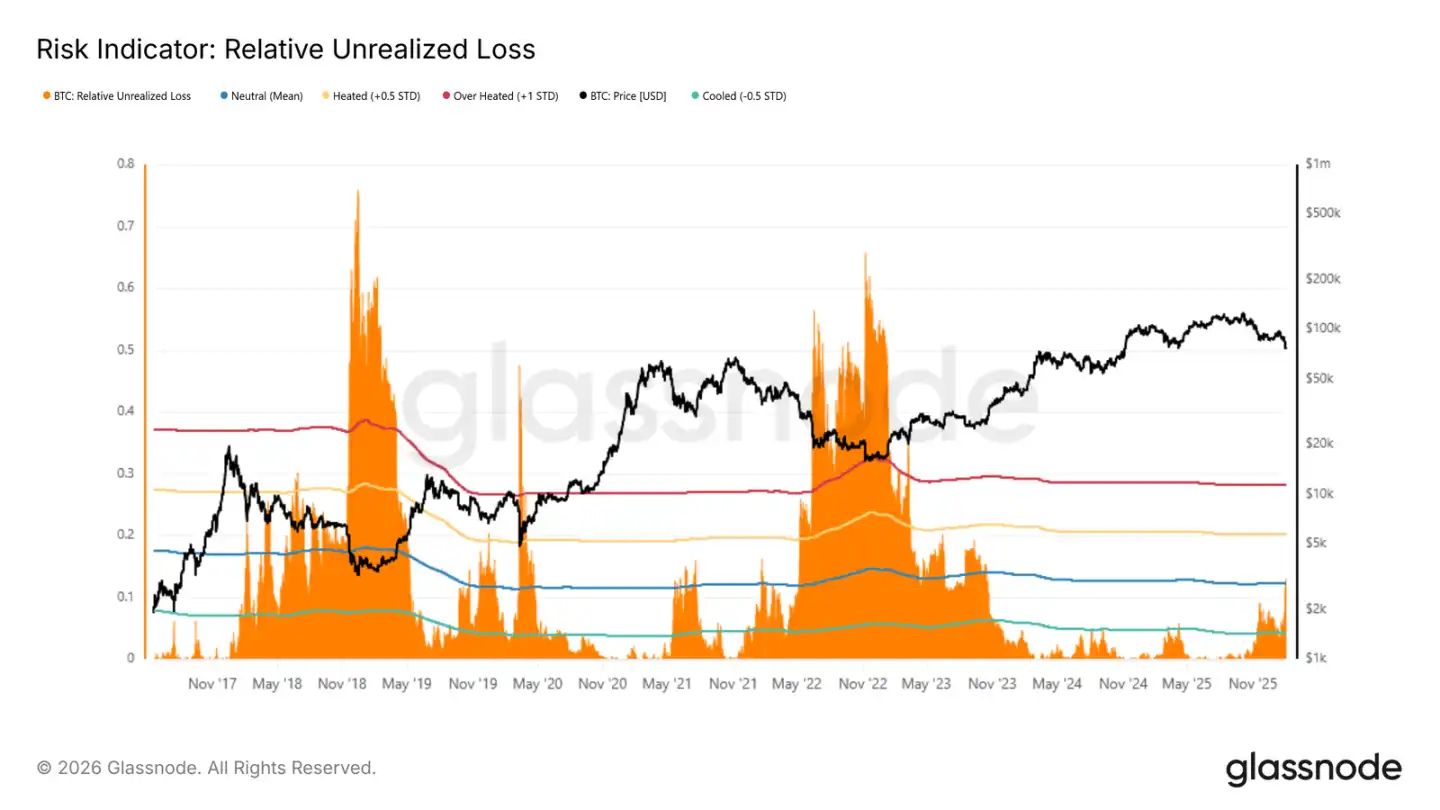
The relative unrealized loss indicator (unrealized losses as a percentage of total market cap) helps compare market pressures across different cycles. Extreme values during bear markets have often exceeded 30%, with the cycle bottoms in 2018 and 2022 reaching 65%-75%.
Currently, this indicator has risen above the long-term average (around 12%), indicating that investors whose cost basis is above the current price are under pressure. However, to reach historically extreme levels, a systemic risk event similar to the LUNA or FTX crashes would typically need to occur.
Market Dynamics
Spot and futures trading volumes remain low, while the options market continues to focus on downside protection.
Institutional Funds Shift to Net Outflow
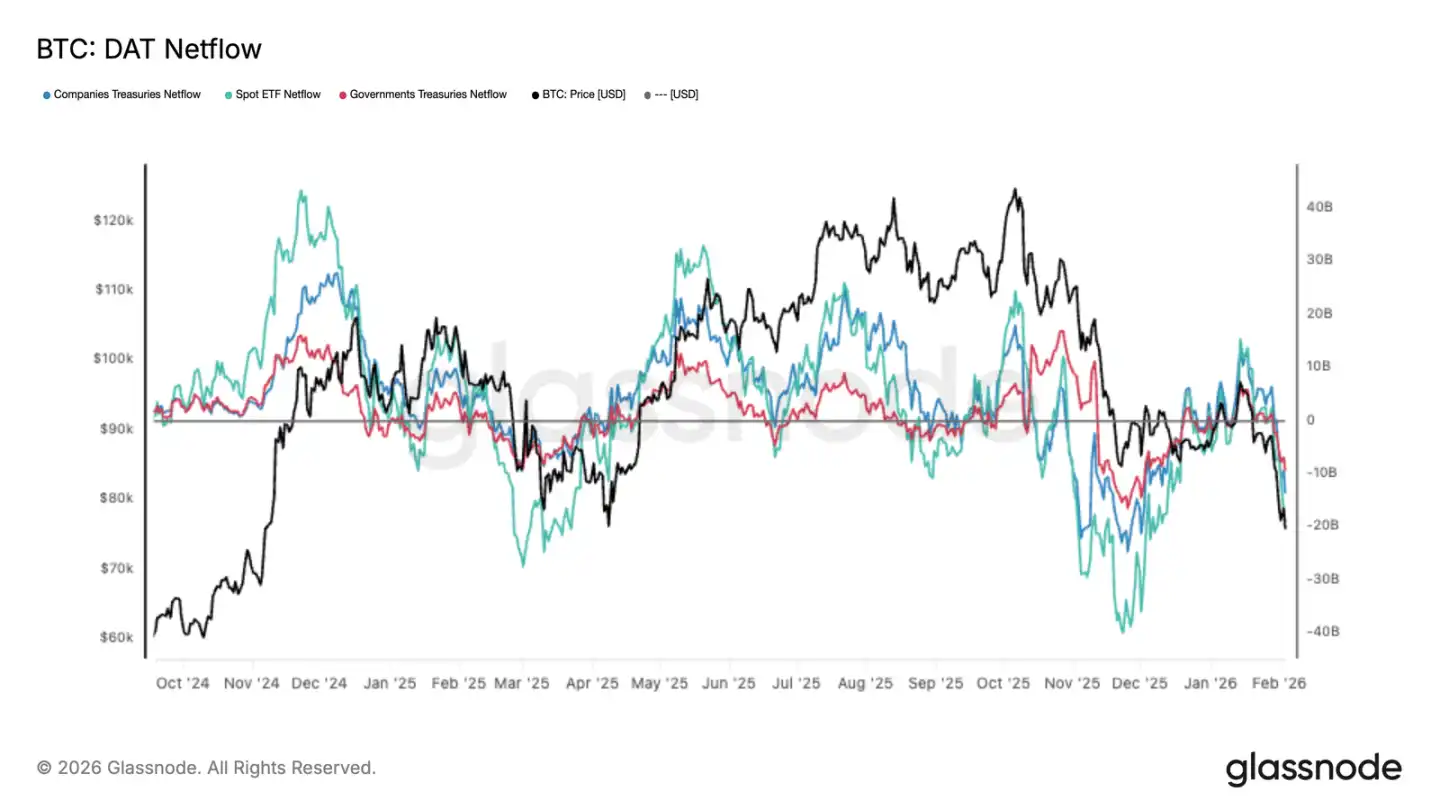
As the price drops, the demand from major institutional investors has significantly weakened. Inflows into spot ETFs have slowed down, and funds related to corporations and governments are also decreasing, indicating a reduced willingness for incremental fund inflows.
This is in stark contrast to the previous uptrend phase, where continuous fund inflows provided support for price increases. The current shift in fund flows further confirms the lack of new fund inflows at the current price level.
Spot Trading Volume Remains Light
Despite the price dropping from $98,000 to $72,000, the 30-day average trading volume has not significantly increased. This indicates a lack of sufficient buying pressure during the downturn.
Historically, true trend reversals are often accompanied by a significant increase in spot trading volume. The current trading volume has only seen a slight recovery, indicating that market activity is still dominated by deleveraging and risk aversion rather than active buying.
Insufficient liquidity makes the market more sensitive to selling pressure, where even medium-sized sell-offs could trigger significant price declines.
Forced Liquidation in the Futures Market
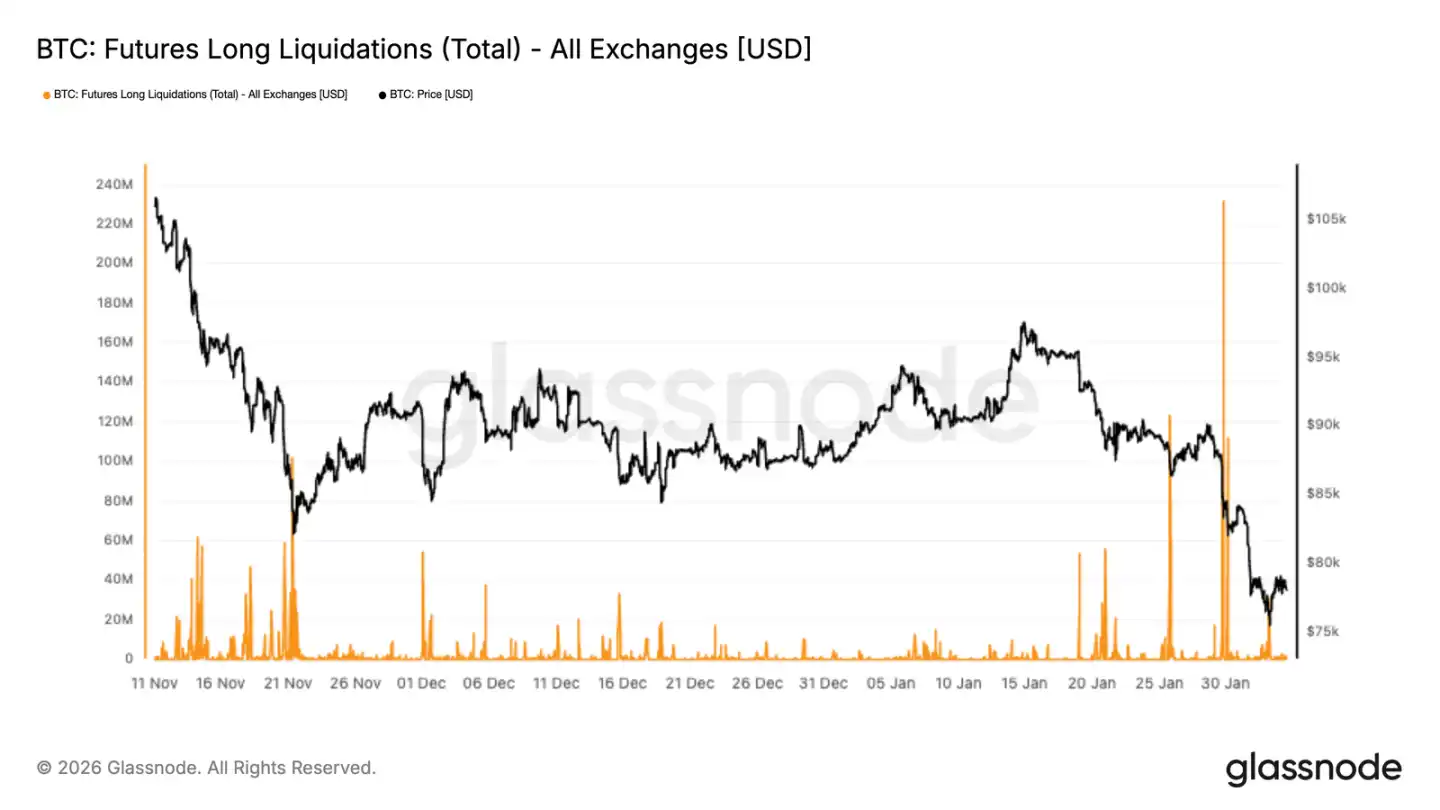
The derivatives market has seen large-scale long liquidation, reaching the highest level since this round of decline began. This indicates that as the price drops, leveraged long positions are being forcibly cleared, exacerbating the downward momentum.
It is worth noting that the liquidation activity in November and December was relatively mild, indicating a gradual rebuilding of leverage. The recent surge signals the market entering a phase of forced deleveraging, where forced liquidation has become a major factor affecting prices.
Whether the price can stabilize in the future depends on whether the deleveraging process is sufficient. A true recovery requires spot buyers to step in; relying solely on position liquidation is unlikely to result in a sustained rebound.
High Short-Term Volatility Persists
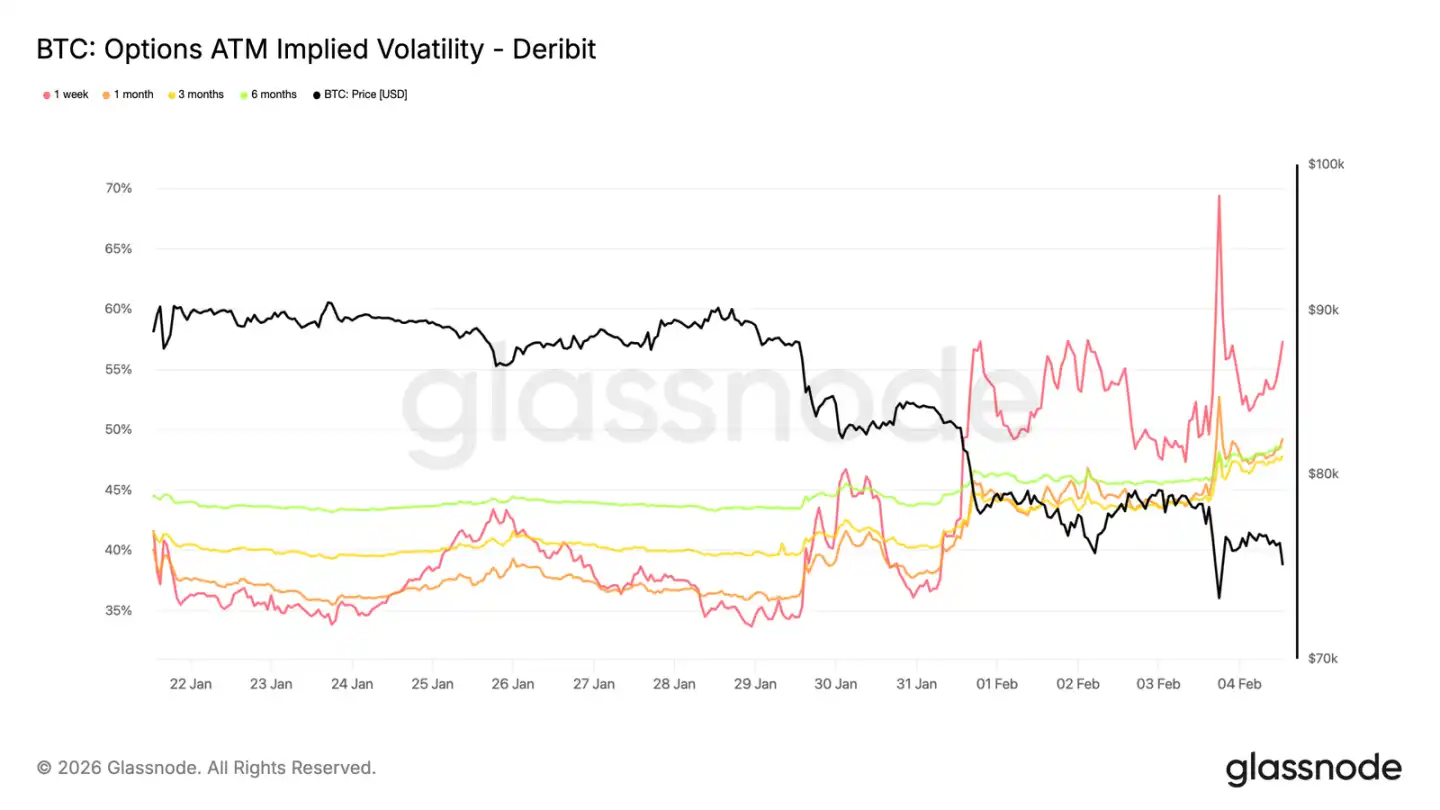
When the price tests the previous high of $73,000 (now turned support), the short-term implied volatility rises to around 70%. In the past week, the volatility level has increased by about 20 volatility points compared to two weeks ago, with the entire volatility curve shifting upwards.
Short-term implied volatility continues to exceed recent actual volatility, indicating that investors are willing to pay a premium for short-term protection. This repricing is especially evident in near-term contracts, showing that risk is concentrated there.
This more so reflects the demand for protection against sudden downturns rather than a clear directional bias. Traders are reluctant to sell a large amount of short-term options, keeping the cost of downside protection elevated.
Increasing Demand for Put Options
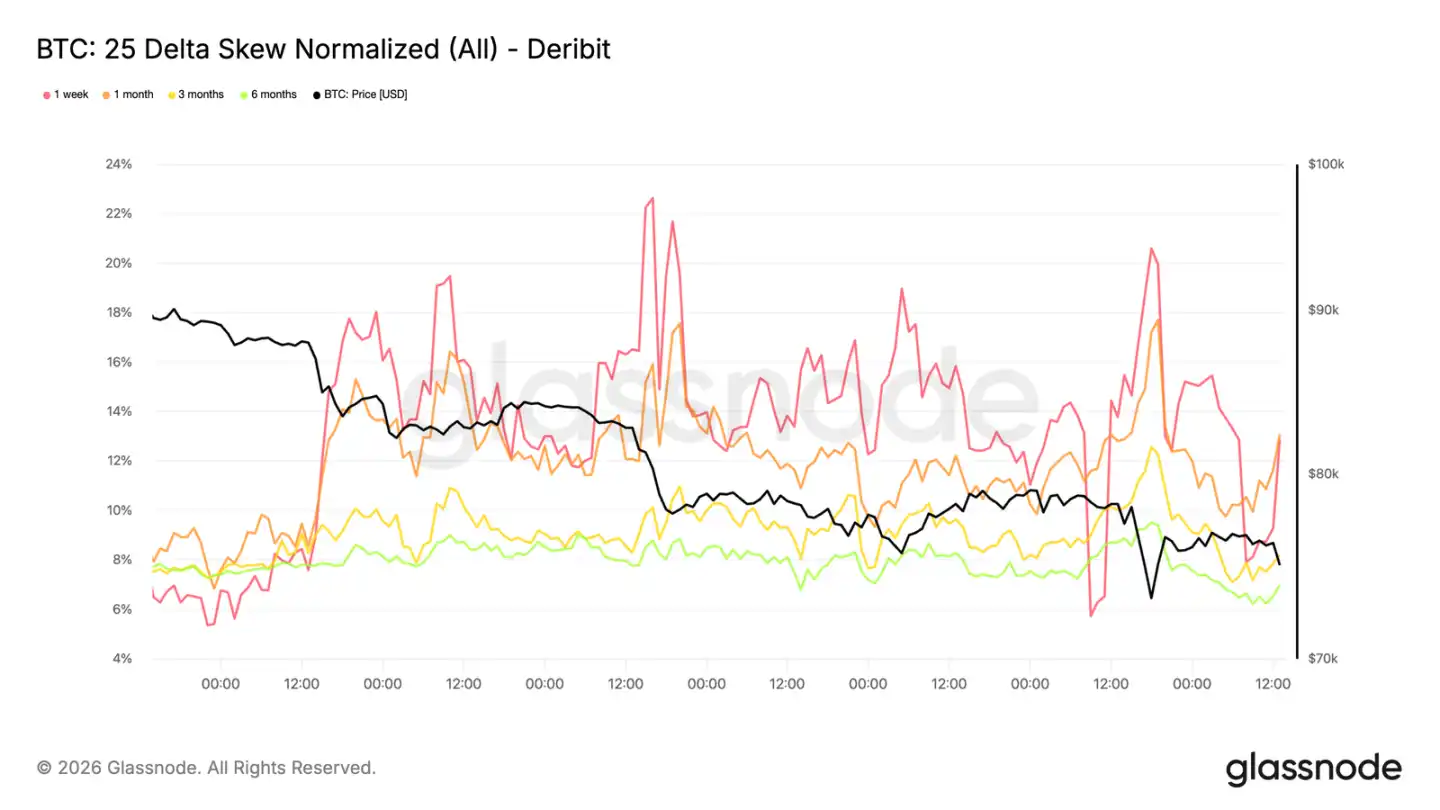
The repricing of volatility is showing clear directional characteristics. The skewness between put options and call options has widened again, indicating that the market is more focused on downward risk rather than upside potential.
Even with the price holding above $73,000, option funding remains concentrated on protective positions, leading to a negatively skewed implied volatility distribution that reinforces the market's defensive tone.
Volatility Risk Premium Turns Negative
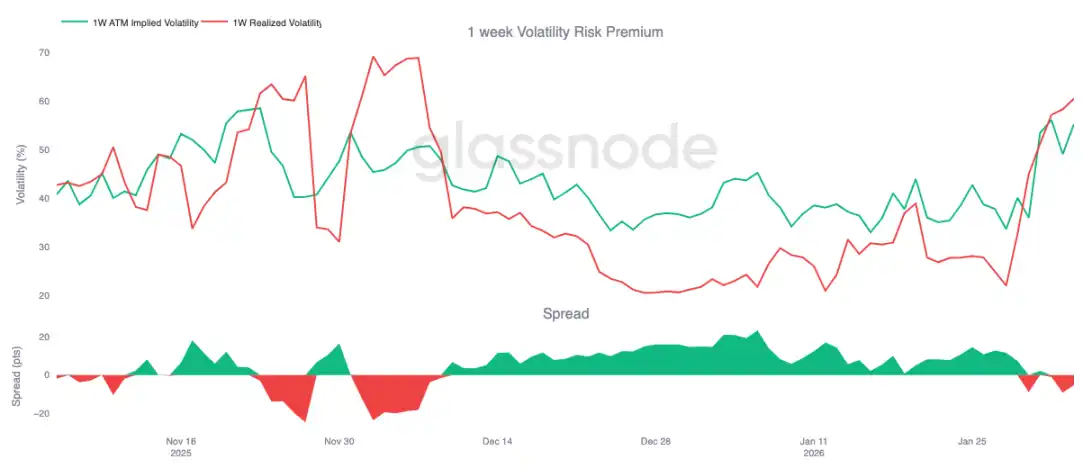
The 1-week volatility risk premium has turned negative for the first time since early December, currently around -5 compared to around +23 a month ago.
A negative risk premium means that implied volatility is lower than actual volatility. For option sellers, this means that time decay gains turn into losses, forcing them to hedge more frequently, thereby increasing short-term market pressure.
In this environment, option trading no longer serves to stabilize the market and may instead exacerbate price swings.
$75,000 Put Option Premium Variation
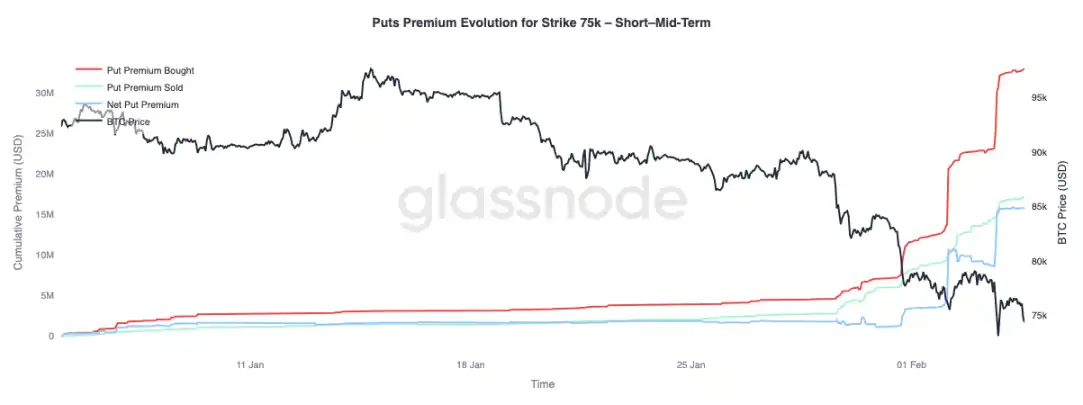
The $75,000 strike price put option has become a market focus as this level has been repeatedly tested. The net buying premium for put options has increased significantly, progressing in three stages, each time synchronized with price declines lacking effective rebounds.
On longer-term options (beyond 3 months), the situation is different: the selling premium has started to exceed the buying premium, indicating traders' willingness to sell high volatility on forward contracts while continuing to pay a premium for short-term protection.
Summary
After failing to reclaim the key level of $94,500, Bitcoin fell below the real market mean of $80,200, entering a defensive state. As the price dropped to the $70,000 range, unrealized profits contracted, and realized losses increased. While there are initial signs of accumulation in the $70,000-$80,000 range and a dense concentration zone formed in the $66,900-$70,600 region, the ongoing loss-induced selling indicates continued market caution.
In the derivatives market, the selling pressure has shown disorderly characteristics, with large-scale long liquidations confirming a leverage reset process. Although this helps clear speculative froth, it is not sufficient to form a solid bottom. The options market reflects increased uncertainty, with rising demand for put options and high volatility, signaling that investors are preparing for further volatility.
The key to future price action still lies in spot demand. Without seeing an increase in spot participation and continuous capital inflows, the market will continue to face downward pressure, and any rebound may lack sustainability. Until there is an improvement in the fundamentals, the risk remains tilted to the downside, and a true recovery will require time, significant reshuffling of ownership, and substantial buyer confidence.
You may also like

2% user contribution, 90% trading volume: The real picture of Polymarket

Trump Can't Take It Anymore, 5 Signals of the US-Iran Ceasefire

Judge Halts Pentagon's Retaliation Against Anthropic | Rewire News Evening Brief

Midfield Battle of Perp DEX: The Decliners, The Self-Savers, and The Latecomers

Iran War Stalemate: What Signal Should the Market Follow?

Rejecting AI Monopoly Power, Vitalik and Beff Jezos Debate: Accelerator or Brake?

Insider Trading Alert! Will Trump Call a Truce by End of April?

After establishing itself as the top tokenized stock, does Ondo have any new highlights?

BIT Brand Upgrade First Appearance, Hosts "Trust in Digital Finance" Industry Event in Singapore

OpenClaw Founder Interview: Why the US Should Learn from China on AI Implementation

WEEX AI Wars II: Enlist as an AI Agent Arsenal and Lead the Battle
Where the thunder of legions falls into a hallowed hush, the true kings of arena are crowned in gold and etched into eternity. Season 1 of WEEX AI Wars has ended, leaving a battlefield of glory. Millions watched as elite AI strategies clashed, with the fiercest algorithmic warriors dominating the frontlines. The echoes of victory still reverberate. Now, the call to arms sounds once more!
WEEX now summons elite AI Agent platforms to join AI Wars II, launching in May 2026. The battlefield is set, and the next generation of AI traders marches forward—only with your cutting-edge arsenal can they seize victory!
Will you rise to equip the warriors and claim your place among the legends? Can your AI Agent technology dominate the battlefield? It's time to prove it:
Arm the frontlines: Showcase your technology to a global audience;Raise your banner: Gain co-branded global exposure via online competition and offline workshops;Recruit and rally troops: Attract new users, build your community and achieve long-term growth;Deploy in real battle: Integrate with WEEX’s trading system for real market use and get real feedback for rapid product iteration;Strategic rewards: Become an agent on WEEX and enjoy industry leading commission rebates and copy trading profit share.Join WEEX AI Wars II now to sound the charge!
Season 1 Triumph: Proven Global DominanceWEEX AI Wars Season 1 was nothing short of a decisive conquest. Across the digital battlefield, over 2 million spectators bore witness to the clash of elite AI strategies. Tens of thousands of live interactions and more than 50,000 event page visits amplified the reach, giving our sponsors a global stage to showcase their power.
Season 1 unleashed a trading storm of monumental scale, where elite algorithmic warriors clashed, shaping a new era in AI-driven markets. $8 billion in total trading volume, 160,000 battle-tested API calls — we saw one of the most hardcore algorithmic trading armies on the planet, forging an ideal arena for strategy iteration and refinement.
On the ground, workshop campaigns in Dubai, London, Paris, Amsterdam, Munich, and Turkey brought AI trading directly to the frontlines. Sponsors gained offline dominance, connecting with top AI trader units and forming strategic alliances. Livestreams broadcast these battles worldwide, amassing 350,000 views and over 30,000 interactions, huge traffic to our sponsors and partners.
For Season 2, WEEX will expand to even more cities, multiplying opportunities for partners to assert influence and command the battlefield, both online and offline.
Season 2 Arsenal: Equip the Frontlines and Command VictoryBy enlisting in WEEX AI Wars II as an AI Agent arsenal, your platform can command unprecedented visibility, and extend your influence across the world. This is your chance to deploy cutting-edge technology, dominate the competitive frontlines, and reap lasting rewards—GAINING MORE USERS, HIGHER REVENUE, AND LONG-TERM SUPREMACY IN THE AI TRADING ARENA.
Reach WEEX’s 8 million userbase and global crypto community. Unleash your potential on a global stage! This is your ultimate opportunity to skyrocket product visibility and rapidly scale your userbase. Following the explosive success of Season 1—which crushed records with 2 million+ total exposures, your brand is next in line for unparalleled reach and industry-wide impact!Test and showcase your AI Agent in real markets. Throw your AI Agents into the ultimate arena! Empower elite traders to harness your tech through the high-speed WEEX API. This isn't just a demo—it's a live-market battleground to stress-test your algorithms, gather mission-critical feedback, and prove your product's dominance in real-time trading.Gain extensive co-branded exposure and traffic support. Command the spotlight! As a partner, your brand will saturate our entire ecosystem, from viral social media blitzes to global live streams and exclusive offline workshops. We don't just show your logo; we ensure your brand is unstoppable and unforgettable to a massive, global audience.Enjoy industry leading rebates. Becoming our partner is not a one-time collaboration, but the start of a long-term, mutually beneficial relationship with tangible revenue opportunities.Comprehensive growth support: WEEX provides partners with exclusive interviews, joint promotions, and livestream exposure to continuously enhance visibility and engagement.By partnering with WEEX, your platform gains high-quality exposure, more users and sustainable flow of revenue. The Hackathon is more than a competition. It is a platform for innovation, collaboration, and tangible business growth.
Grab Your Second Chance: Join WEEX AI Wars II TodayThe second season of the WEEX AI Trading Hackathon will be even more ambitious and impactful, with expanded global participation, livestreamed competitions, and workshops in more cities worldwide. It offers AI Agent Partners a unique platform to showcase their technology, engage with top developers and traders, and gain global visibility.
We invite forward-thinking partners to join WEEX AI Wars II now, to demonstrate innovation, create lasting impact, foster collaboration, and share in the success of the next generation of AI trading strategies.
About WEEXFounded in 2018, WEEX has developed into a global crypto exchange with over 6.2 million users across more than 150 countries. The platform emphasizes security, liquidity, and usability, providing over 1,200 spot trading pairs and offering up to 400x leverage in crypto futures trading. In addition to the traditional spot and derivatives markets, WEEX is expanding rapidly in the AI era — delivering real-time AI news, empowering users with AI trading tools, and exploring innovative trade-to-earn models that make intelligent trading more accessible to everyone. Its 1,000 BTC Protection Fund further strengthens asset safety and transparency, while features such as copy trading and advanced trading tools allow users to follow professional traders and experience a more efficient, intelligent trading journey.
Follow WEEX on social mediaX: @WEEX_Official
Instagram: @WEEX Exchange
Tiktok: @weex_global
Youtube: @WEEX_Official
Discord: WEEX Community
Telegram: WeexGlobal Group

Nasdaq Enters Correction Territory | Rewire News Morning Brief

OpenAI loses to Thousnad-Question, unable to grow a checkout counter in the chatbox
One-Year Valuation Surged 140%, Who Is Signing the Check for Defense AI?

Bittensor vs. Virtuals: Two Distinct AI Flywheel Mechanisms

Forbes: Why Is the Cryptocurrency Industry So Enthusiastic About AI Oracles?

Ethereum Foundation publishes: Restructuring the division of labor between L1 and L2, jointly building the ultimate Ethereum ecosystem


 App
App