

Glassnode: BTC Rebound a "Fakeout," Bottom Fragile and Yet to Be Built

By: blockbeats|2026/01/22 18:00:01
0
Share
copy
Original Title: Failed Breakout
Original Authors: CryptoVizArt, Chris Beamish, Antoine Colpaert, Glassnode
Original Translation: AididiaoJP, Foresight News

Entering early January 2026, the market showed signs of seller exhaustion, creating an opportunity for a rebound towards the upper boundary of the current trading range. However, this rebound came with higher risk as the price was approaching the ~$98,000 area where recently bought-in investors had active "break-even" selling pressure.

Key Takeaways

· On-chain structure remains fragile: Price hovering around key cost basis levels lacks continuous confirmation of long-term holder conviction.

· Overhang in the supply persists: Recently bought-in investors face overhead resistance limiting upside momentum, making any rebound prone to sell-offs.

· Spot funding trend turns positive: Seller pressure on major exchanges has eased, but buying behavior remains selective rather than broad-based.

· Treasury flows remain scattered: Treasury activity exhibits sporadic, event-driven characteristics, yet to form a coordinated buying trend, with limited impact on overall demand.

· Derivatives market participation low: Futures volume contracting, leverage usage cautious, market in a low participation state.

· Options market under short-term pressure only: Short-term implied volatility responding to risk events, while medium to long-term volatility remains stable.

· Hedge demand briefly spikes then reverts to norm: Surge in put/call volume ratio has subsided, indicating risk aversion is tactical.

· Dealer gamma positioning leans bearish: This weakens mechanical support for price stability, increasing market sensitivity to liquidity shocks.

On-chain Deep Dive

Over the past two weeks, the anticipated technical rebound has largely materialized, with the price stagnating below short-term holder cost basis after encountering resistance, once again confirming substantive selling pressure overhead. This report will focus on analyzing the structure and behavior of this "overhead" supply, revealing emerging seller dynamics.

Technical Rebound Meets Resistance

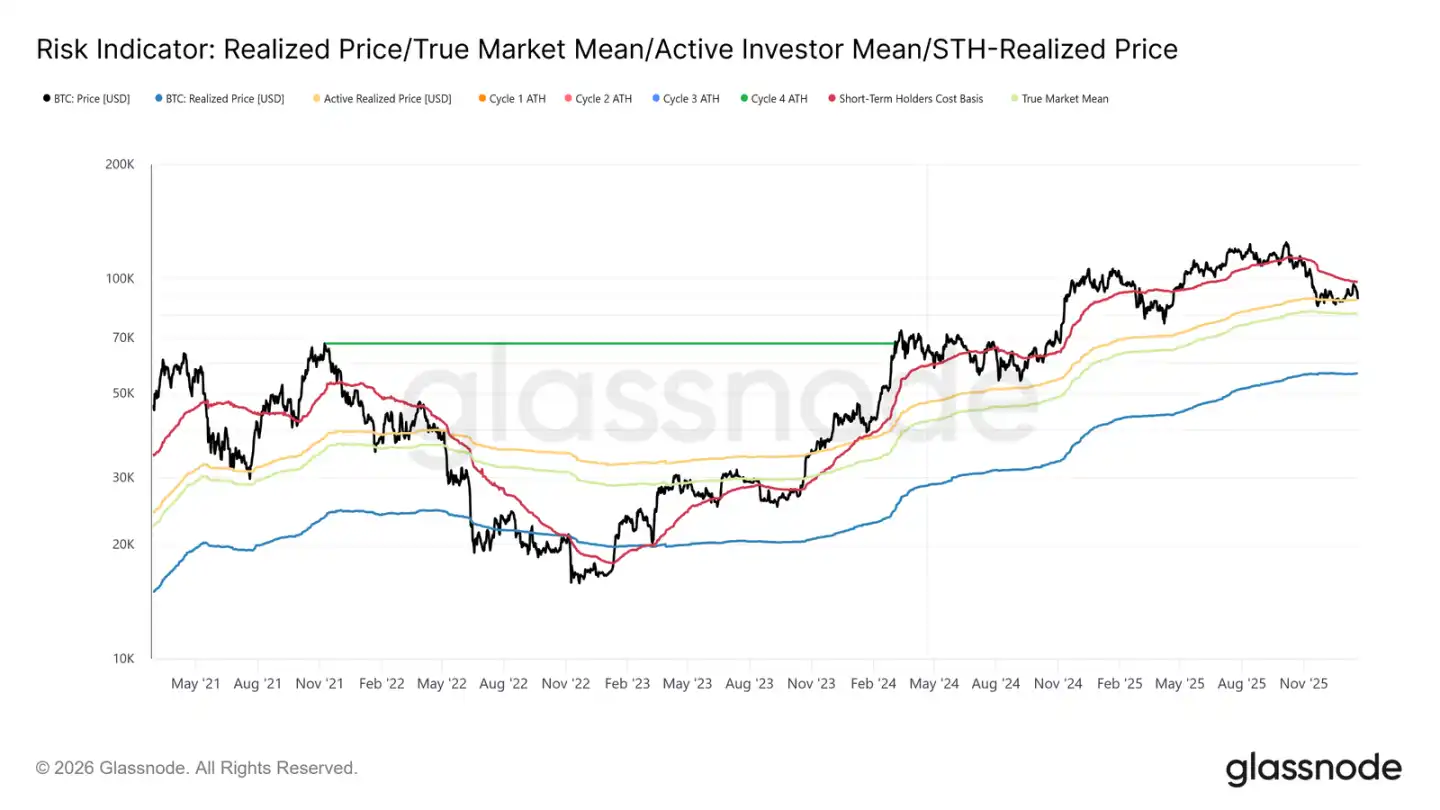
A clear narrative has emerged: the market has been in a mild bearish phase. Its downward bottom is supported by a true market value of $81,000, while the upward top is constrained by the average cost of short-term holders. This range has formed a fragile equilibrium where selling pressure is absorbed, but upward attempts have been repeatedly met with selling from investors who bought in during the first to third quarters of 2025.

Entering early January 2026, the weakening of selling pressure has opened a window for a rebound towards the upper range. However, as the price approaches the $98,000 region, the willingness to sell near the cost price of recent buyers has intensified, exacerbating the risk of this rebound.

The recent price being capped around $98,400 (short-term holder cost basis) mirrors the market structure of the first quarter of 2022. Back then, the market repeatedly failed to decisively break through the recent buyers' cost zone, leading to a prolonged consolidation phase. This similarity highlights the fragile nature of the current recovery attempt.
Glassnode: BTC Rebound a

Supply "Overhead" Pressure Persists

Based on the observation of price being resisted at key cost levels, further examination of on-chain supply distribution can better explain why upward momentum has been repeatedly thwarted.

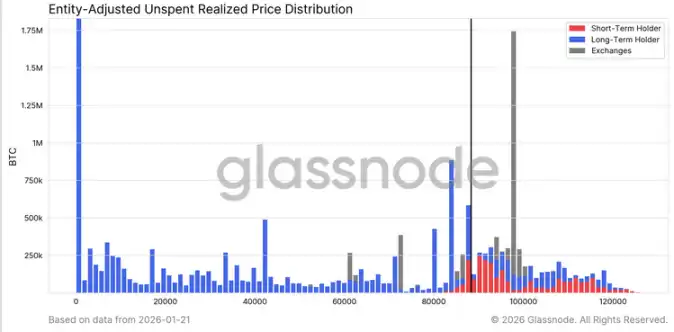
The URPD (Unrealized Profit/Loss Distribution) chart clearly reveals why the excess supply above $98,000 remains a key force suppressing mid-term rebounds. The recent rebound partly filled the "air pocket" between $93,000 and $98,000, mainly driven by early buyers transferring to new entrants, creating a new cluster of short-term holder supply.

However, the supply distribution above $100,000 shows a broad and dense supply zone, with this portion of tokens gradually transitioning to long-term holder positions. This undigested "overhead" supply is a persistent source of selling pressure, likely to keep the price suppressed below $98,400 (short-term holder cost line) and the psychological $100,000 mark. Therefore, a significant and sustained acceleration in demand momentum is needed to achieve an effective breakthrough.
Long-Term Holders Also Pose Resistance

Expanding the view from short-term holders to long-term positions, we find the same structural constraints still exist.

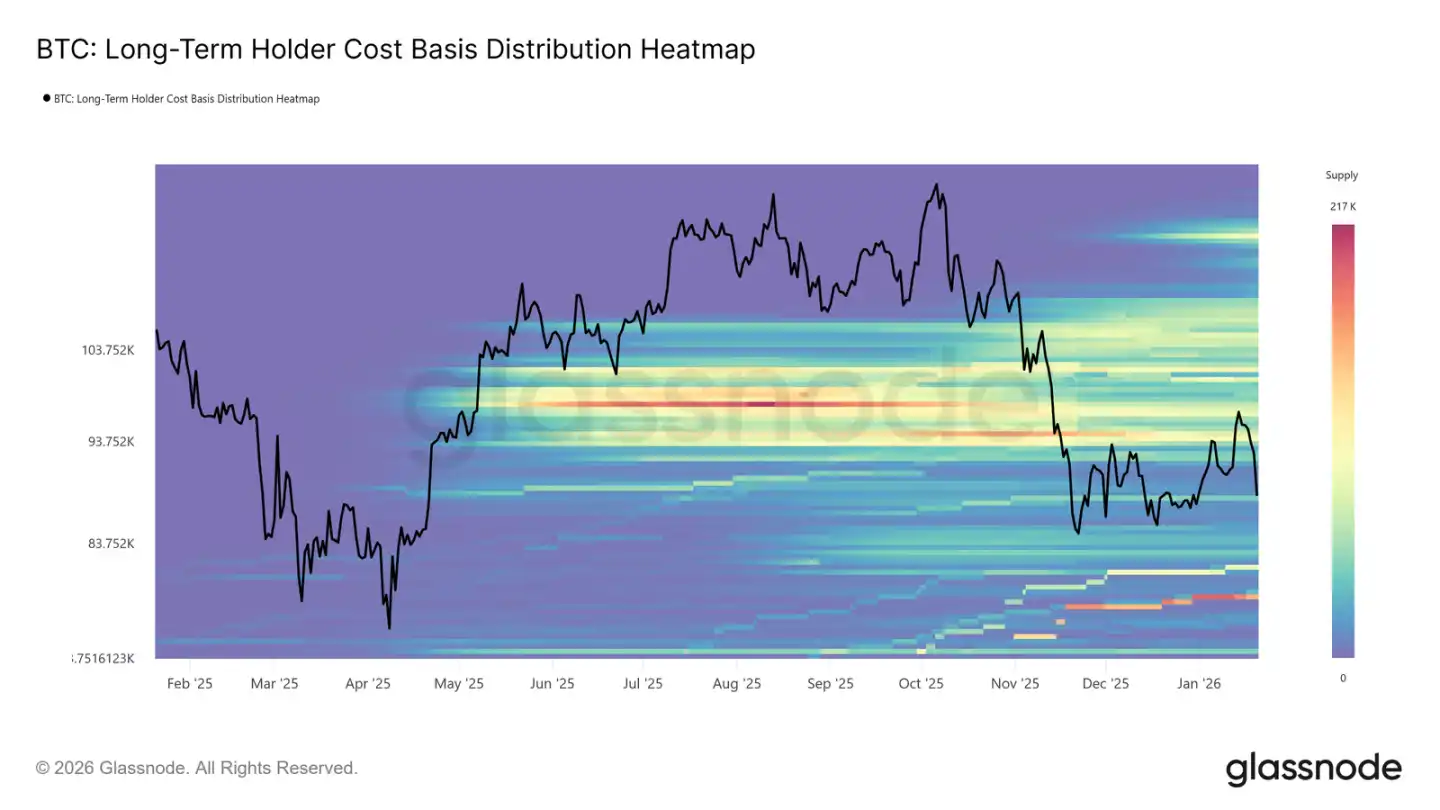
The long-term holder cost basis distribution heatmap shows a dense area of long-term coin holding costs above the current spot price. When the price rebounds to these historical buy-in levels, this area represents significant potential selling liquidity.

Before new, strong-enough demand emerges and absorbs the overhanging supply, long-term holders will always be a potential source of resistance. Therefore, unless this part of the "overhang" supply is completely absorbed, upside potential may remain limited, and any rebound is likely to face new selling pressure.
Rebound Encounters Profit-Taking and Stop-Loss Selling

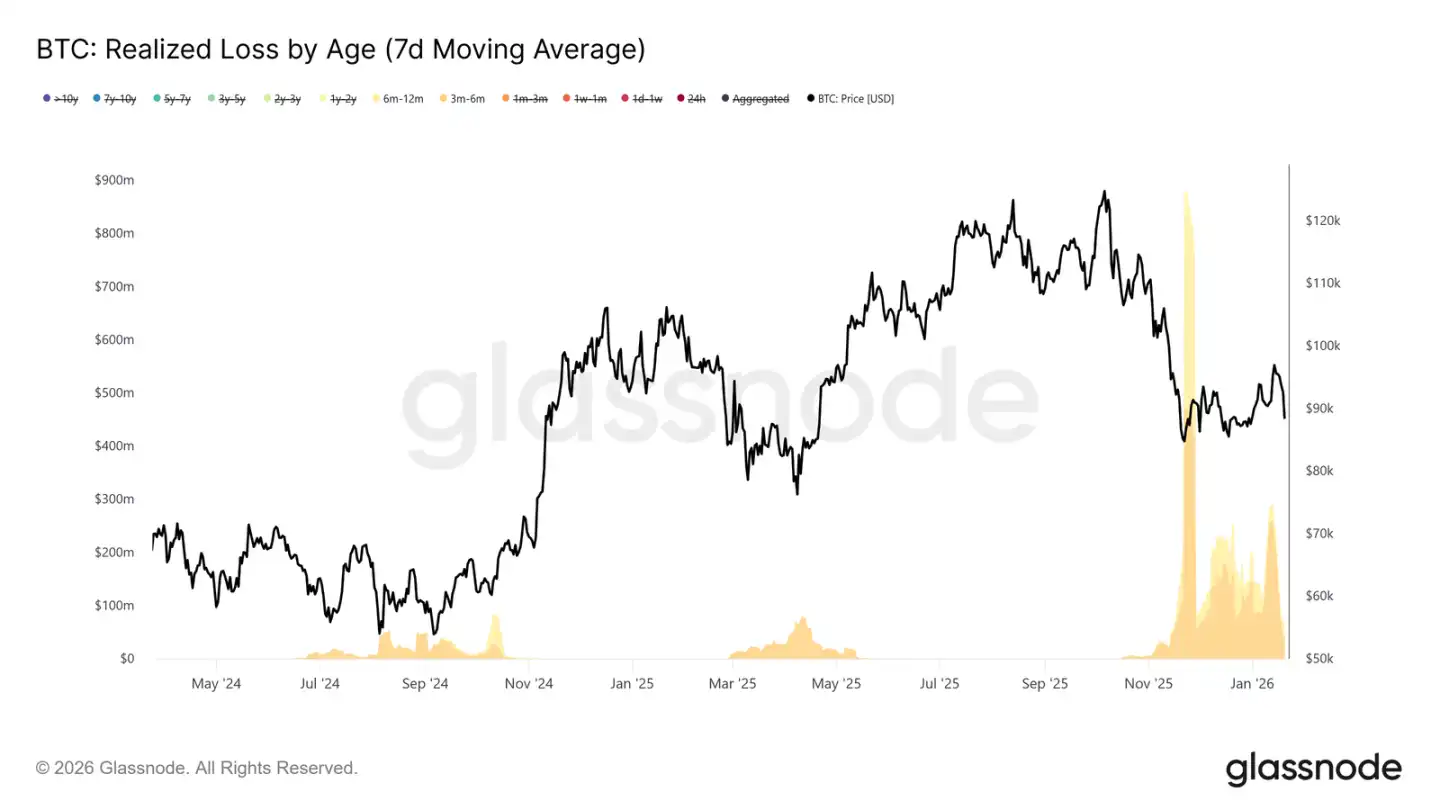
Furthermore, we can identify which investor groups actively took profits (or stopped losses) during the recent rally towards around $98,000, thus suppressing the price.

Realized loss data segmented by holding period shows that loss-selling mainly came from the 3-6 month holder group, followed by 6-12 month holders. This pattern is a typical characteristic of "painful selling," especially common among those who bought above the $110,000 price level and are now choosing to exit near their cost basis. This behavior reinforces selling pressure around key recovery levels.
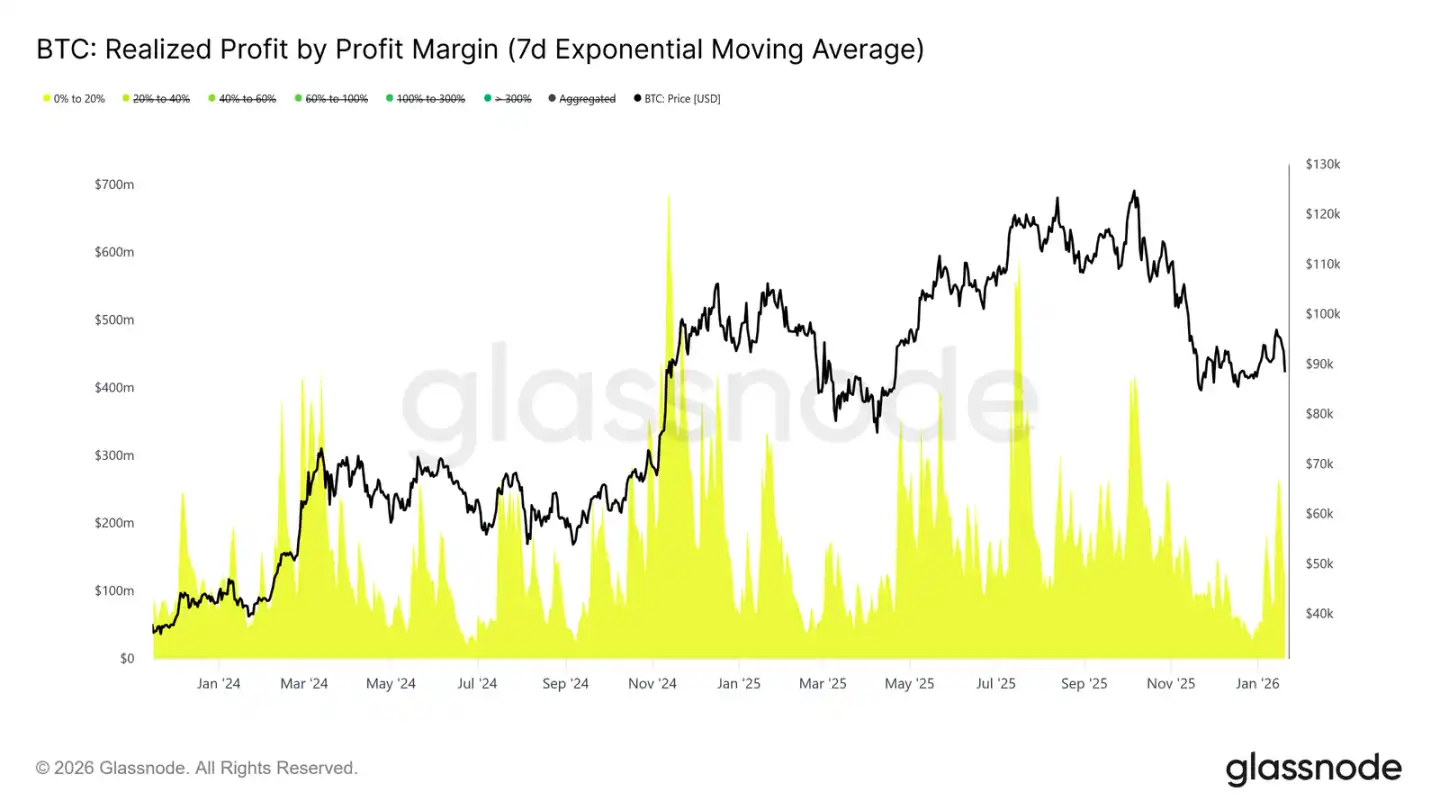
At the same time, realized profit data segmented by profit margin indicates a significant increase in profit-taking in the 0% to 20% profit margin range. This highlights the influence of "break-even sellers" and short-term swing traders, who tend to take small profits and exit rather than wait for the trend to continue.

This behavior is common during market transition periods when investor confidence is fragile, focusing more on capital preservation and tactical profit-taking. The increase in low-profit selling pressure is steadily undermining upward momentum as supply continues to be released near cost basis.
On-Chain Market Observations

Spot Funds Flow Turns Positive

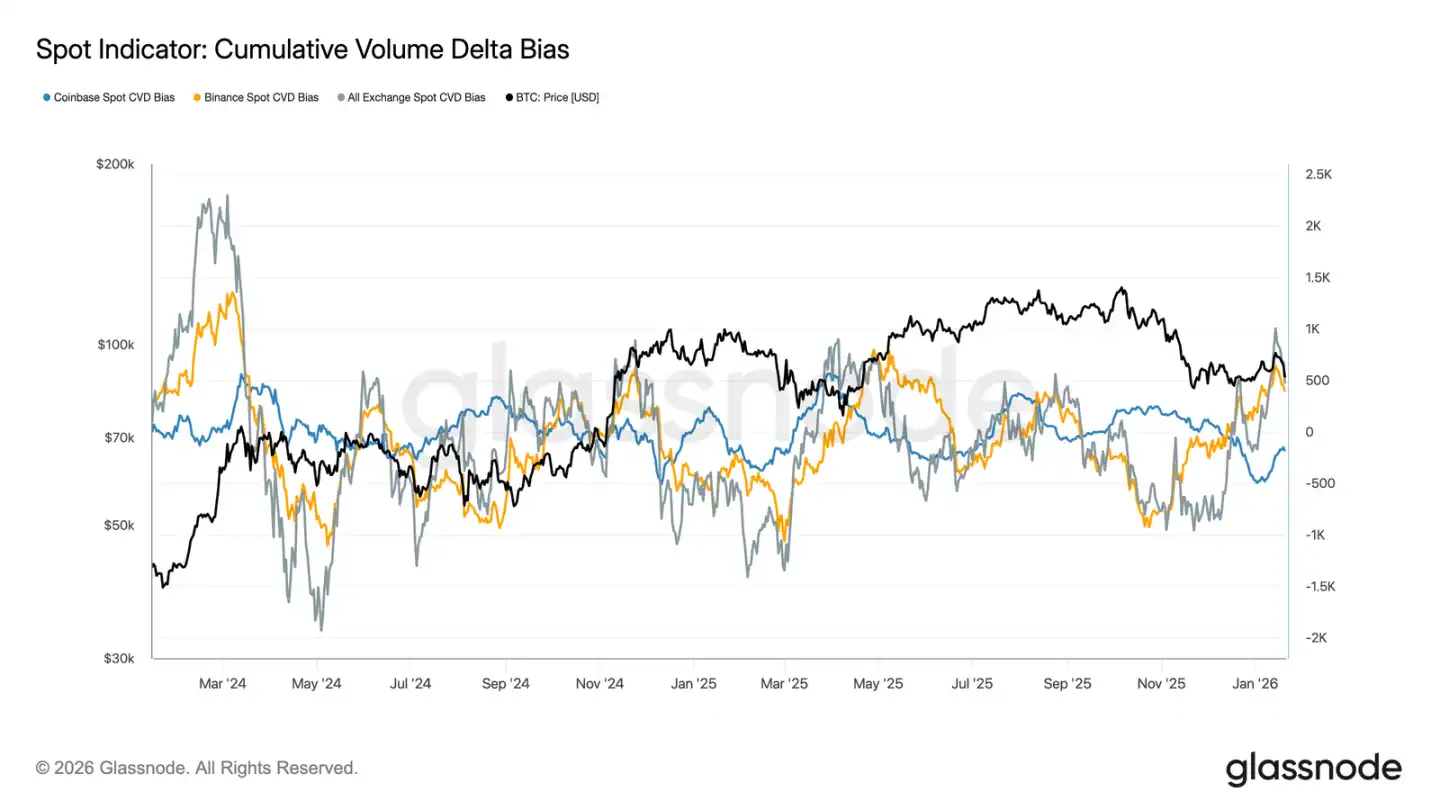
Spot market behavior has improved somewhat after the recent decline. Binance and exchange platform composite CVD (Cumulative Volume Diff) indicator has turned back to net buy status, indicating that spot participants are starting to reabsorb chips rather than sell on rallies, contrasting with the sustained selling pressure during the previous consolidation phase.

Coinbase, which has been a major source of selling pressure during the range-bound trading, has also significantly slowed its net selling speed. The reduction in selling pressure from Coinbase helps reduce overhead supply, stabilize price action, and support the recent rebound.

Although spot participants have not yet shown the continuous, aggressive buying typical of a trending expansion phase, the major platforms returning to net buying signal a positive improvement in the underlying spot market structure.
Intermittent Inflow of Funds into Digital Asset Treasury

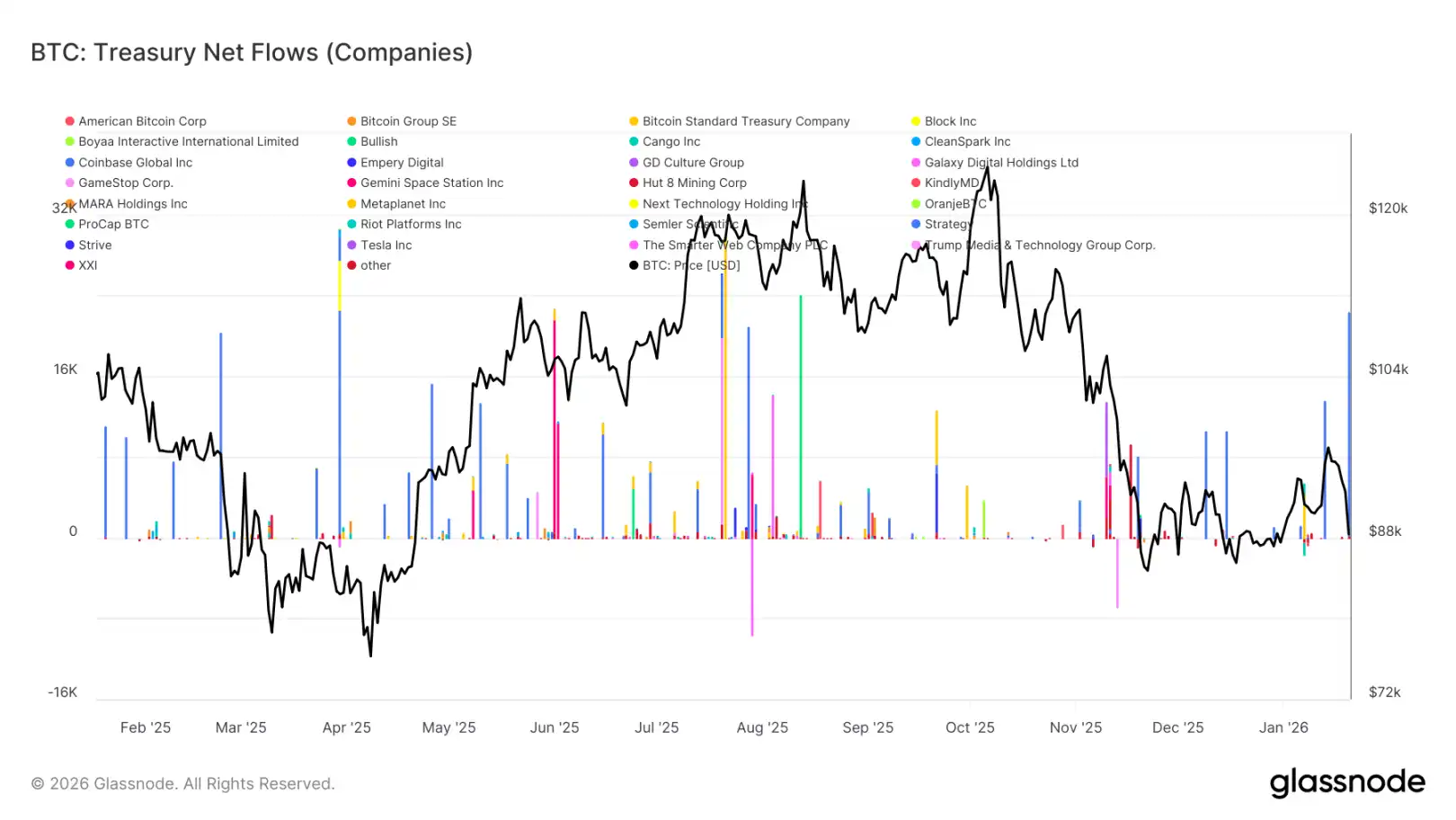
The recent net fund flow into digital asset treasuries continues to exhibit a scattered and uneven pattern, with activities mostly driven by isolated events rather than broad trend-buying. Although there have been significant individual buying spikes by some companies in the past few weeks, overall corporate demand has not transitioned into a sustained accumulation mode.

Overall, the fund flow into digital asset treasuries has been fluctuating narrowly around the zero line, indicating that the majority of corporate treasuries are currently in a state of watchful waiting or opportunistic operations rather than systematic accumulation. This is in sharp contrast to the earlier phase where multiple companies collectively bought in, driving the trend acceleration.

Generally speaking, the latest data indicates that corporate treasuries are only a marginal, selective source of demand, with their impact being intermittent and not yet exerting a decisive influence on the overall price dynamics.
Lackluster Derivatives Market

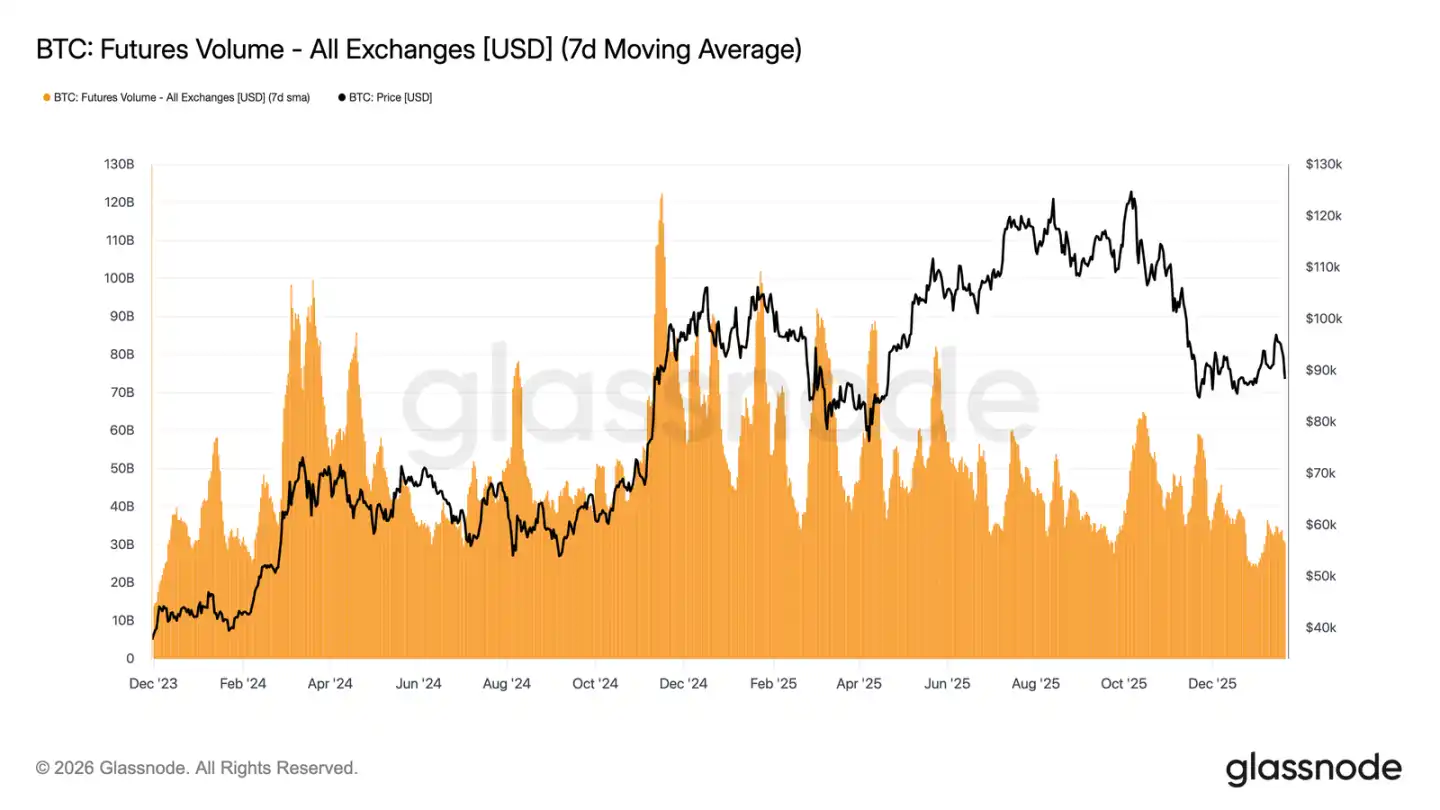
The 7-day moving average trading volume of Bitcoin futures continues to decline, far below the levels usually associated with a trending market. Recent price fluctuations have not been accompanied by effective volume amplification, highlighting the low participation and lack of confidence in the derivatives market.

The current market structure indicates that recent price actions are more driven by sparse liquidity rather than aggressive positioning. The adjustment of open interest has not been accompanied by a synchronous increase in trading volume, reflecting more of a repositioning of existing positions and risk rebalancing rather than fresh leveraged inputs.

In summary, the derivatives market is currently in a state of low participation and "quietness," with muted speculative interest. This "ghost market" characteristic means that the market could be very sensitive to any resurgence in trading volume, but currently, its impact on price discovery is limited.
Implied Volatility Spikes Only in the Short Term

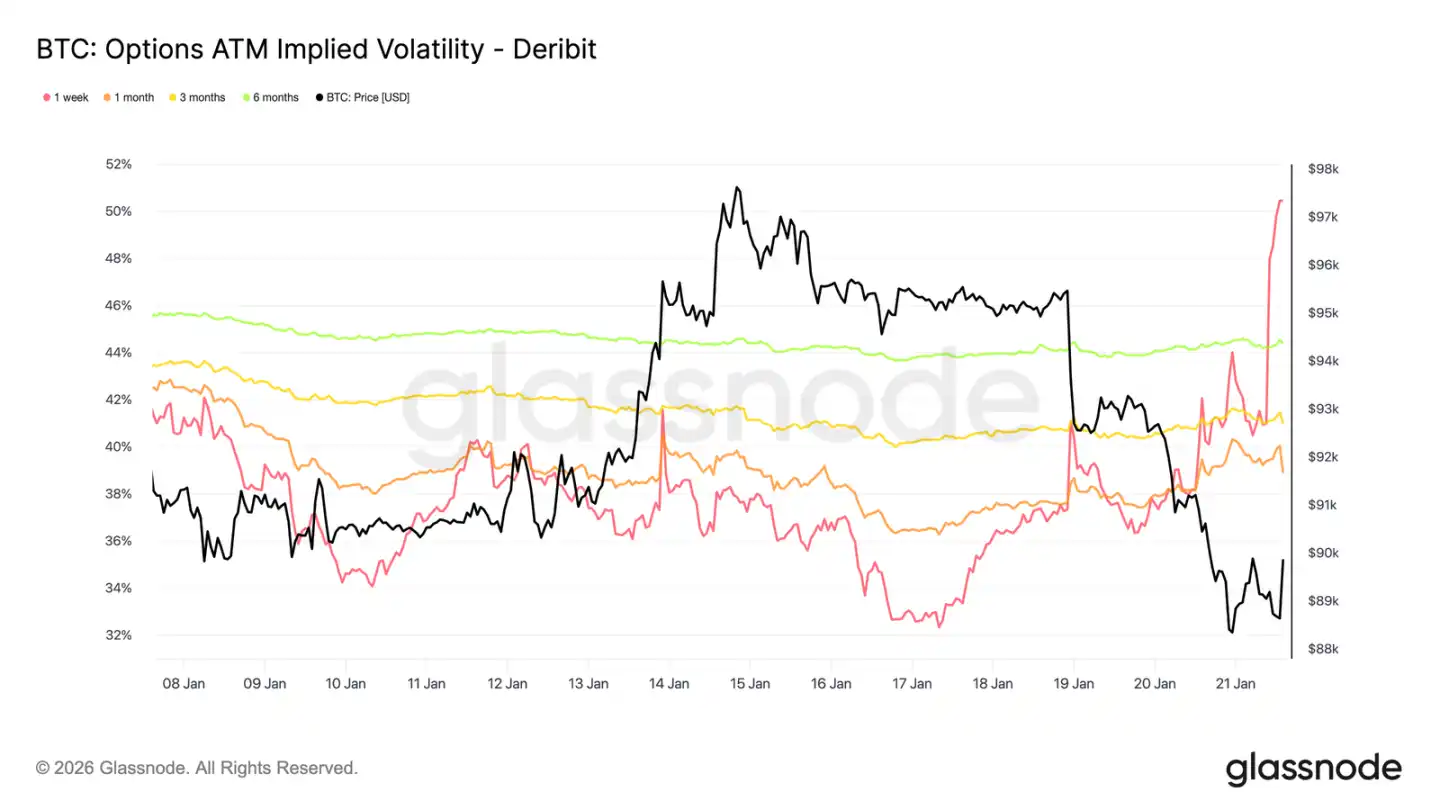
A spot sell-off triggered by macro and geopolitical news has only led to a short-term surge in volatility. Since the Sunday drop, the one-week implied volatility has risen by over 13 volatility points, while the three-month implied volatility has only increased by about 2 points, and the six-month implied volatility has remained almost unchanged.

The sharp steepening at the very front end of the volatility curve indicates that traders are engaging in tactical operations rather than reassessing the mid-term risk structure. Only the short-term volatility adjustment reflects event-driven uncertainty, rather than a transformation of the entire volatility regime.

The market is pricing in short-lived risks, not enduring turmoil.
Short-Term Option Skew Spike

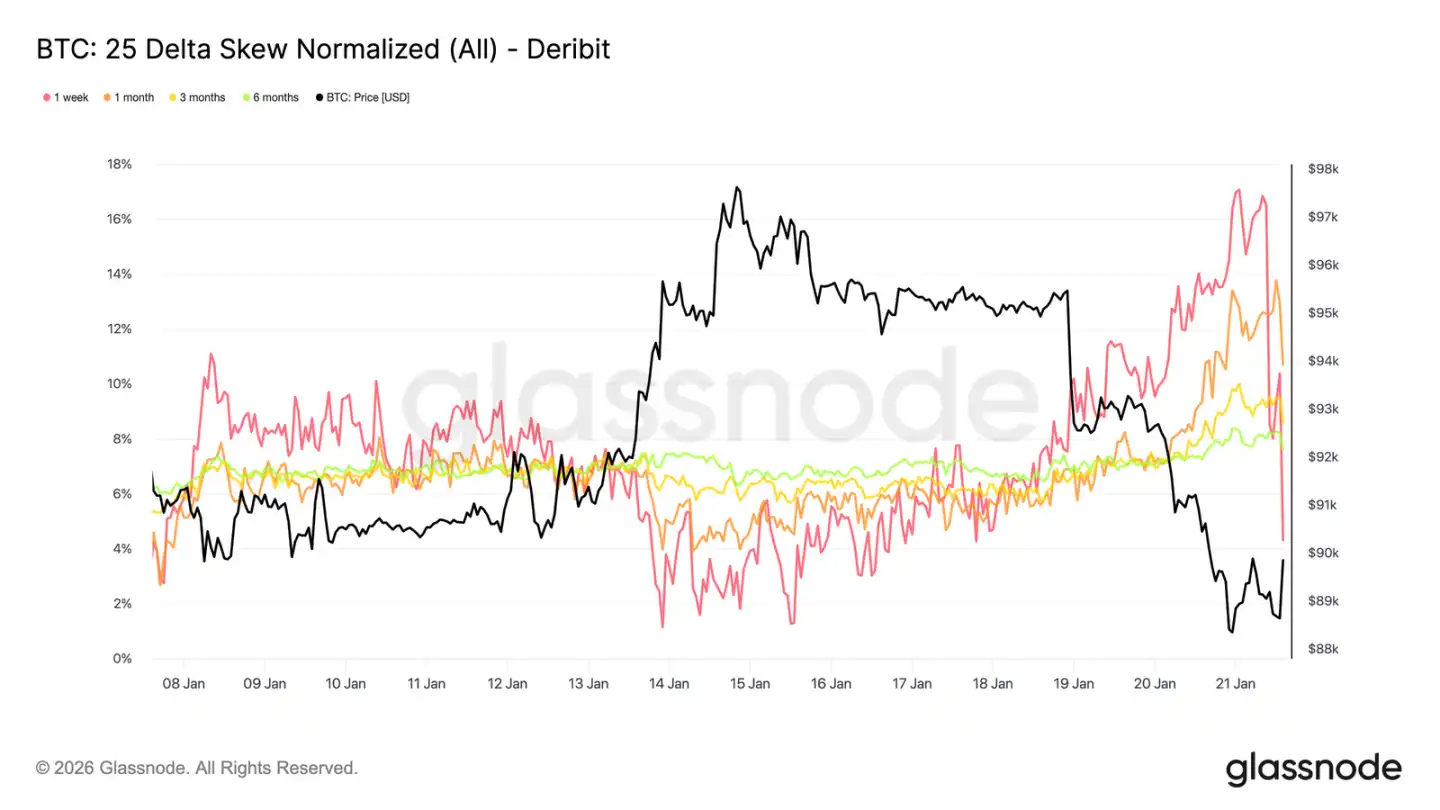
Similar to the at-the-money volatility, short-term skew dominated this adjustment. After nearing equilibrium about a week ago, the one-period 25 delta skew has dramatically shifted towards a "more expensive put option" state.

Since last week, this skew indicator has moved about 16 volatility points towards the put side, reaching an almost 17% put premium. The one-month skew has also reacted, while the skew for longer maturities, already in put territory, only slightly deepened this time.

Such a pronounced skew tilt typically accompanies a localized extreme market condition, where positions are crowded, making it difficult to sustain the original trend. After the market had digested the impact of Davos Forum-related comments, some profit-taking on the downside premium occurred, and the skew swiftly started to pull back.
Volatility Risk Premium Remains Elevated

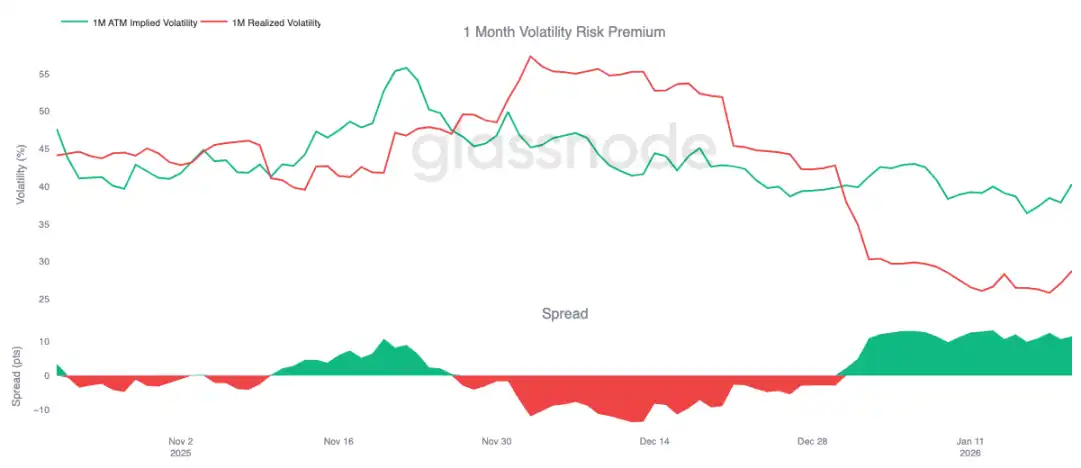
The one-month volatility risk premium has stayed positive since the beginning of the year. Despite the implied volatility being at historically absolute low levels, its pricing continues to be higher than the actual realized volatility. In other words, options are still relatively "overpriced" compared to actual price movements.

The volatility risk premium reflects the difference between implied and realized volatility. A positive premium means option sellers are compensated for bearing the volatility risk. This creates a favorable arbitrage environment for "shorting volatility" strategies—holding a short gamma position can generate profits as long as actual volatility remains within a limited range.

This dynamic is self-reinforcing, suppressing volatility increases. As long as selling volatility is profitable, more participants will join in, thus keeping implied volatility at lower levels. As of January 20, the one-month period volatility spread is around 11.5 volatility points, favoring the sellers, which clearly demonstrates that the current environment is still conducive to selling volatility.
Traders' Positions Shift to Net Short

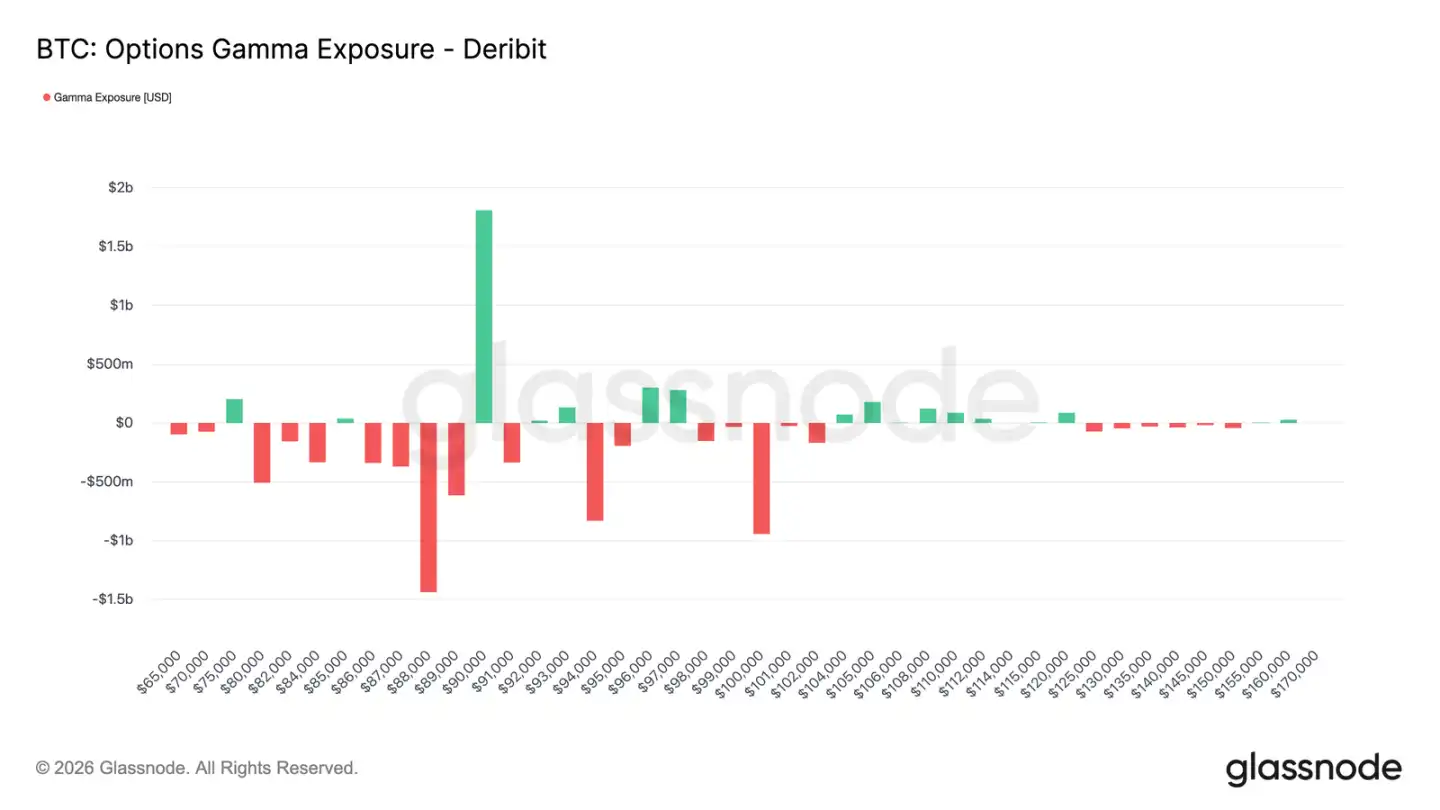
Traders' gamma positions are a key structural force influencing short-term price action. Recent fund flows indicate investors actively buying downside protection, leading to traders holding gamma short positions below $90,000. Meanwhile, some investors have funded this by selling upside options, causing traders to hold gamma long positions above $90,000.

This has created an asymmetric pattern: below $90,000, traders hold gamma short positions, meaning a price drop could self-accelerate due to their hedging actions (selling futures or spot). Above $90,000, traders' gamma long positions act as stabilizers, as an upward movement triggers their hedge buying, thus dampening the rally.

Therefore, the price action below $90,000 may still be fragile, with $90,000 itself becoming a key friction point. To effectively and sustainably break through this level, sufficient market momentum and confidence are needed to absorb trader hedging flows and push their gamma risk exposure to higher price levels.
Summary

The Bitcoin market is still in a low-participation state, with the current price trend more driven by "easing selling pressure" rather than "active buying pressure." On-chain data continues to reveal issues of supply overhang and fragile structural support. While spot funding rates have improved, they have not yet translated into a sustained buying trend.

Institutional demand remains cautious, with stablecoin inflows stabilizing near the zero line, and activity dominated by sporadic trading. Trading activity in the derivatives market is light, with futures volumes shrinking, leverage usage constrained, collectively creating a low-liquidity environment where prices are exceptionally sensitive to minor positional changes.

The options market also reflects this restraint. Volatility repricing is limited to the short term, hedging demand has returned to normal, and the high volatility risk premium continues to anchor the overall volatility level.

Overall, the market seems to be quietly building a bottom. The current consolidation is not due to overheated participation but rather a temporary pause in investor conviction as they await the next catalyst that can spark broad participation.

Original Article Link

You may also like

Token Cannot Compound, Where Is the Real Investment Opportunity?

The next chapter in the crypto industry will undoubtedly be written by Crypto-empowered Stocks.

February 6th Market Key Intelligence, How Much Did You Miss?

1. On-chain Flows: $508.2M USD inflow to Ethereum today; $390.8M USD outflow from Arbitrum 2. Biggest Gainers/Losers: $HBTC, $AIO 3. Top News: Current Bitcoin weekly RSI oversold signal comparable to June 2022

China's Central Bank and Eight Other Departments' Latest Regulatory Focus: Key Attention to RWA Tokenized Asset Risk


Foreword: Today, the People's Bank of China's website published the "Notice of the People's Bank of China, National Development and Reform Commission, Ministry of Industry and Information Technology, Ministry of Public Security, State Administration for Market Regulation, China Banking and Insurance Regulatory Commission, China Securities Regulatory Commission, State Administration of Foreign Exchange on Further Preventing and Dealing with Risks Related to Virtual Currency and Others (Yinfa [2026] No. 42)", the latest regulatory requirements from the eight departments including the central bank, which are basically consistent with the regulatory requirements of recent years. The main focus of the regulation is on speculative activities such as virtual currency trading, exchanges, ICOs, overseas platform services, and this time, regulatory oversight of RWA has been added, explicitly prohibiting RWA tokenization, stablecoins (especially those pegged to the RMB). The following is the full text:


To the people's governments of all provinces, autonomous regions, and municipalities directly under the Central Government, the Xinjiang Production and Construction Corps:


  Recently, there have been speculative activities related to virtual currency and Real-World Assets (RWA) tokenization, disrupting the economic and financial order and jeopardizing the property security of the people. In order to further prevent and address the risks related to virtual currency and Real-World Assets tokenization, effectively safeguard national security and social stability, in accordance with the "Law of the People's Republic of China on the People's Bank of China," "Law of the People's Republic of China on Commercial Banks," "Securities Law of the People's Republic of China," "Law of the People's Republic of China on Securities Investment Funds," "Law of the People's Republic of China on Futures and Derivatives," "Cybersecurity Law of the People's Republic of China," "Regulations of the People's Republic of China on the Administration of Renminbi," "Regulations on Prevention and Disposal of Illegal Fundraising," "Regulations of the People's Republic of China on Foreign Exchange Administration," "Telecommunications Regulations of the People's Republic of China," and other provisions, after reaching consensus with the Cyberspace Administration of China, the Supreme People's Court, and the Supreme People's Procuratorate, and with the approval of the State Council, the relevant matters are notified as follows:


  I. Clarify the essential attributes of virtual currency, Real-World Assets tokenization, and related business activities


  (I) Virtual currency does not possess the legal status equivalent to fiat currency. Virtual currencies such as Bitcoin, Ether, Tether, etc., have the main characteristics of being issued by non-monetary authorities, using encryption technology and distributed ledger or similar technology, existing in digital form, etc. They do not have legal tender status, should not and cannot be circulated and used as currency in the market.


  The business activities related to virtual currency are classified as illegal financial activities. The exchange of fiat currency and virtual currency within the territory, exchange of virtual currencies, acting as a central counterparty in buying and selling virtual currencies, providing information intermediary and pricing services for virtual currency transactions, token issuance financing, and trading of virtual currency-related financial products, etc., fall under illegal financial activities, such as suspected illegal issuance of token vouchers, unauthorized public issuance of securities, illegal operation of securities and futures business, illegal fundraising, etc., are strictly prohibited across the board and resolutely banned in accordance with the law. Overseas entities and individuals are not allowed to provide virtual currency-related services to domestic entities in any form.


  A stablecoin pegged to a fiat currency indirectly fulfills some functions of the fiat currency in circulation. Without the consent of relevant authorities in accordance with the law and regulations, any domestic or foreign entity or individual is not allowed to issue a RMB-pegged stablecoin overseas.


(II)Tokenization of Real-World Assets refers to the use of encryption technology and distributed ledger or similar technologies to transform ownership rights, income rights, etc., of assets into tokens (tokens) or other interests or bond certificates with token (token) characteristics, and carry out issuance and trading activities.


  Engaging in the tokenization of real-world assets domestically, as well as providing related intermediary, information technology services, etc., which are suspected of illegal issuance of token vouchers, unauthorized public offering of securities, illegal operation of securities and futures business, illegal fundraising, and other illegal financial activities, shall be prohibited; except for relevant business activities carried out with the approval of the competent authorities in accordance with the law and regulations and relying on specific financial infrastructures. Overseas entities and individuals are not allowed to illegally provide services related to the tokenization of real-world assets to domestic entities in any form.


  II. Sound Work Mechanism


  (III) Inter-agency Coordination. The People's Bank of China, together with the National Development and Reform Commission, the Ministry of Industry and Information Technology, the Ministry of Public Security, the State Administration for Market Regulation, the China Banking and Insurance Regulatory Commission, the China Securities Regulatory Commission, the State Administration of Foreign Exchange, and other departments, will improve the work mechanism, strengthen coordination with the Cyberspace Administration of China, the Supreme People's Court, and the Supreme People's Procuratorate, coordinate efforts, and overall guide regions to carry out risk prevention and disposal of virtual currency-related illegal financial activities.


  The China Securities Regulatory Commission, together with the National Development and Reform Commission, the Ministry of Industry and Information Technology, the Ministry of Public Security, the People's Bank of China, the State Administration for Market Regulation, the China Banking and Insurance Regulatory Commission, the State Administration of Foreign Exchange, and other departments, will improve the work mechanism, strengthen coordination with the Cyberspace Administration of China, the Supreme People's Court, and the Supreme People's Procuratorate, coordinate efforts, and overall guide regions to carry out risk prevention and disposal of illegal financial activities related to the tokenization of real-world assets.


  (IV) Strengthening Local Implementation. The people's governments at the provincial level are overall responsible for the prevention and disposal of risks related to virtual currencies and the tokenization of real-world assets in their respective administrative regions. The specific leading department is the local financial regulatory department, with participation from branches and dispatched institutions of the State Council's financial regulatory department, telecommunications regulators, public security, market supervision, and other departments, in coordination with cyberspace departments, courts, and procuratorates, to improve the normalization of the work mechanism, effectively connect with the relevant work mechanisms of central departments, form a cooperative and coordinated working pattern between central and local governments, effectively prevent and properly handle risks related to virtual currencies and the tokenization of real-world assets, and maintain economic and financial order and social stability.


  III. Strengthened Risk Monitoring, Prevention, and Disposal


  (5) Enhanced Risk Monitoring. The People's Bank of China, China Securities Regulatory Commission, National Development and Reform Commission, Ministry of Industry and Information Technology, Ministry of Public Security, State Administration of Foreign Exchange, Cyberspace Administration of China, and other departments continue to improve monitoring techniques and system support, enhance cross-departmental data analysis and sharing, establish sound information sharing and cross-validation mechanisms, promptly grasp the risk situation of activities related to virtual currency and real-world asset tokenization. Local governments at all levels give full play to the role of local monitoring and early warning mechanisms. Local financial regulatory authorities, together with branches and agencies of the State Council's financial regulatory authorities, as well as departments of cyberspace and public security, ensure effective connection between online monitoring, offline investigation, and fund tracking, efficiently and accurately identify activities related to virtual currency and real-world asset tokenization, promptly share risk information, improve early warning information dissemination, verification, and rapid response mechanisms.


  (6) Strengthened Oversight of Financial Institutions, Intermediaries, and Technology Service Providers. Financial institutions (including non-bank payment institutions) are prohibited from providing account opening, fund transfer, and clearing services for virtual currency-related business activities, issuing and selling financial products related to virtual currency, including virtual currency and related financial products in the scope of collateral, conducting insurance business related to virtual currency, or including virtual currency in the scope of insurance liability. Financial institutions (including non-bank payment institutions) are prohibited from providing custody, clearing, and settlement services for unauthorized real-world asset tokenization-related business and related financial products. Relevant intermediary institutions and information technology service providers are prohibited from providing intermediary, technical, or other services for unauthorized real-world asset tokenization-related businesses and related financial products.


  (7) Enhanced Management of Internet Information Content and Access. Internet enterprises are prohibited from providing online business venues, commercial displays, marketing, advertising, or paid traffic diversion services for virtual currency and real-world asset tokenization-related business activities. Upon discovering clues of illegal activities, they should promptly report to relevant departments and provide technical support and assistance for related investigations and inquiries. Based on the clues transferred by the financial regulatory authorities, the cyberspace administration, telecommunications authorities, and public security departments should promptly close and deal with websites, mobile applications (including mini-programs), and public accounts engaged in virtual currency and real-world asset tokenization-related business activities in accordance with the law.


  (8) Strengthened Entity Registration and Advertisement Management. Market supervision departments strengthen entity registration and management, and enterprise and individual business registrations must not contain terms such as "virtual currency," "virtual asset," "cryptocurrency," "crypto asset," "stablecoin," "real-world asset tokenization," or "RWA" in their names or business scopes. Market supervision departments, together with financial regulatory authorities, legally enhance the supervision of advertisements related to virtual currency and real-world asset tokenization, promptly investigating and handling relevant illegal advertisements.


  (IX) Continued Rectification of Virtual Currency Mining Activities. The National Development and Reform Commission, together with relevant departments, strictly controls virtual currency mining activities, continuously promotes the rectification of virtual currency mining activities. The people's governments of various provinces take overall responsibility for the rectification of "mining" within their respective administrative regions. In accordance with the requirements of the National Development and Reform Commission and other departments in the "Notice on the Rectification of Virtual Currency Mining Activities" (NDRC Energy-saving Building [2021] No. 1283) and the provisions of the "Guidance Catalog for Industrial Structure Adjustment (2024 Edition)," a comprehensive review, investigation, and closure of existing virtual currency mining projects are conducted, new mining projects are strictly prohibited, and mining machine production enterprises are strictly prohibited from providing mining machine sales and other services within the country.


  (X) Severe Crackdown on Related Illegal Financial Activities. Upon discovering clues to illegal financial activities related to virtual currency and the tokenization of real-world assets, local financial regulatory authorities, branches of the State Council's financial regulatory authorities, and other relevant departments promptly investigate, determine, and properly handle the issues in accordance with the law, and seriously hold the relevant entities and individuals legally responsible. Those suspected of crimes are transferred to the judicial authorities for processing according to the law.


 (XI) Severe Crackdown on Related Illegal and Criminal Activities. The Ministry of Public Security, the People's Bank of China, the State Administration for Market Regulation, the China Banking and Insurance Regulatory Commission, the China Securities Regulatory Commission, as well as judicial and procuratorial organs, in accordance with their respective responsibilities, rigorously crack down on illegal and criminal activities related to virtual currency, the tokenization of real-world assets, such as fraud, money laundering, illegal business operations, pyramid schemes, illegal fundraising, and other illegal and criminal activities carried out under the guise of virtual currency, the tokenization of real-world assets, etc.


  (XII) Strengthen Industry Self-discipline. Relevant industry associations should enhance membership management and policy advocacy, based on their own responsibilities, advocate and urge member units to resist illegal financial activities related to virtual currency and the tokenization of real-world assets. Member units that violate regulatory policies and industry self-discipline rules are to be disciplined in accordance with relevant self-regulatory management regulations. By leveraging various industry infrastructure, conduct risk monitoring related to virtual currency, the tokenization of real-world assets, and promptly transfer issue clues to relevant departments.


  IV. Strict Supervision of Domestic Entities Engaging in Overseas Business Activities


(XIII) Without the approval of relevant departments in accordance with the law and regulations, domestic entities and foreign entities controlled by them may not issue virtual currency overseas.


  (XIV) Domestic entities engaging directly or indirectly in overseas external debt-based tokenization of real-world assets, or conducting asset securitization activities abroad based on domestic ownership rights, income rights, etc. (hereinafter referred to as domestic equity), should be strictly regulated in accordance with the principles of "same business, same risk, same rules." The National Development and Reform Commission, the China Securities Regulatory Commission, the State Administration of Foreign Exchange, and other relevant departments regulate it according to their respective responsibilities. For other forms of overseas real-world asset tokenization activities based on domestic equity by domestic entities, the China Securities Regulatory Commission, together with relevant departments, supervise according to their division of responsibilities. Without the consent and filing of relevant departments, no unit or individual may engage in the above-mentioned business.


  (15) Overseas subsidiaries and branches of domestic financial institutions providing Real World Asset Tokenization-related services overseas shall do so legally and prudently. They shall have professional personnel and systems in place to effectively mitigate business risks, strictly implement customer onboarding, suitability management, anti-money laundering requirements, and incorporate them into the domestic financial institutions' compliance and risk management system. Intermediaries and information technology service providers offering Real World Asset Tokenization services abroad based on domestic equity or conducting Real World Asset Tokenization business in the form of overseas debt for domestic entities directly or indirectly venturing abroad must strictly comply with relevant laws and regulations. They should establish and improve relevant compliance and internal control systems in accordance with relevant normative requirements, strengthen business and risk control, and report the business developments to the relevant regulatory authorities for approval or filing.


  V. Strengthen Organizational Implementation


  (16) Strengthen organizational leadership and overall coordination. All departments and regions should attach great importance to the prevention of risks related to virtual currencies and Real World Asset Tokenization, strengthen organizational leadership, clarify work responsibilities, form a long-term effective working mechanism with centralized coordination, local implementation, and shared responsibilities, maintain high pressure, dynamically monitor risks, effectively prevent and mitigate risks in an orderly and efficient manner, legally protect the property security of the people, and make every effort to maintain economic and financial order and social stability.


  (17) Widely carry out publicity and education. All departments, regions, and industry associations should make full use of various media and other communication channels to disseminate information through legal and policy interpretation, analysis of typical cases, and education on investment risks, etc. They should promote the illegality and harm of virtual currencies and Real World Asset Tokenization-related businesses and their manifestations, fully alert to potential risks and hidden dangers, and enhance public awareness and identification capabilities for risk prevention.


  VI. Legal Responsibility


  (18) Engaging in illegal financial activities related to virtual currencies and Real World Asset Tokenization in violation of this notice, as well as providing services for virtual currencies and Real World Asset Tokenization-related businesses, shall be punished in accordance with relevant regulations. If it constitutes a crime, criminal liability shall be pursued according to the law. For domestic entities and individuals who knowingly or should have known that overseas entities illegally provided virtual currency or Real World Asset Tokenization-related services to domestic entities and still assisted them, relevant responsibilities shall be pursued according to the law. If it constitutes a crime, criminal liability shall be pursued according to the law.


  (19) If any unit or individual invests in virtual currencies, Real World Asset Tokens, and related financial products against public order and good customs, the relevant civil legal actions shall be invalid, and any resulting losses shall be borne by them. If there are suspicions of disrupting financial order and jeopardizing financial security, the relevant departments shall deal with them according to the law.


  This notice shall enter into force upon the date of its issuance. The People's Bank of China and ten other departments' "Notice on Further Preventing and Dealing with the Risks of Virtual Currency Trading Speculation" (Yinfa [2021] No. 237) is hereby repealed.


Former Partner's Perspective on Multicoin: Kyle's Exit, But the Game He Left Behind Just Getting Started

Kyle knew his game, so he decided to focus on playing the game he was good at and interested in.

Why Bitcoin Is Falling Now: The Real Reasons Behind BTC's Crash & WEEX's Smart Profit Playbook

Bitcoin's ongoing crash explained: Discover the 5 hidden triggers behind BTC's plunge & how WEEX's Auto Earn and Trade to Earn strategies help traders profit from crypto market volatility.

Wall Street's Hottest Trades See Exodus

This time there is no single triggering factor, but rather market anxiety about asset valuation, with many already skeptical of these valuations being too high, leading to investors choosing to retreat almost simultaneously.

Popular coins

Latest Crypto News

Read more













