
Delphi Digital 2025 Market Forecast: Bitcoin Still Has Upside Potential; Stablecoins Will Continue to Grow


Source: Delphi Digital
Original Writer: Stacy Muur, Crypto Researcher
Original Compiler: DeepTide TechFlow
Introduction
As the year-end approaches, various research and predictions abound. @Delphi_Digital recently released the "2025 Market Outlook," delving into an in-depth analysis of the current market situation and outlook for future trends, covering a series of topics such as Bitcoin price trends, key trends, and risk factors.
Given that the full text is lengthy and requires a significant amount of time to read in its entirety, DeepTide TechFlow has compiled an article summarizing Stacy Muur's core viewpoints on the "2025 Market Outlook."
This article divides the Delphi Digital report into three main parts: the rise of Bitcoin, the altseason bubble, and future development trends. Currently, Bitcoin's market value has reached about $2 trillion, while the performance of altcoins leaves much to be desired. Looking ahead, the growth of stablecoins may bring hope for market recovery. In the conclusion, Stacy Muur also expresses her unique views on the 2025 crypto market, believing that the crypto market is evolving from the "Wild West" to a more regulated alternative stock market. Web3 native users will be willing to take on high risks and engage in speculative trading. New entrants, on the other hand, will adopt a conservative risk management approach, focusing on long-term value, and some narratives may be marginalized.
The Rise of Bitcoin
There was a time when a $100,000 Bitcoin price was considered a fantasy.
Now, that viewpoint has undergone a dramatic change. Bitcoin's current market value is around $2 trillion—an astounding figure. If Bitcoin were considered a publicly traded company, it would be the sixth most valuable company globally.
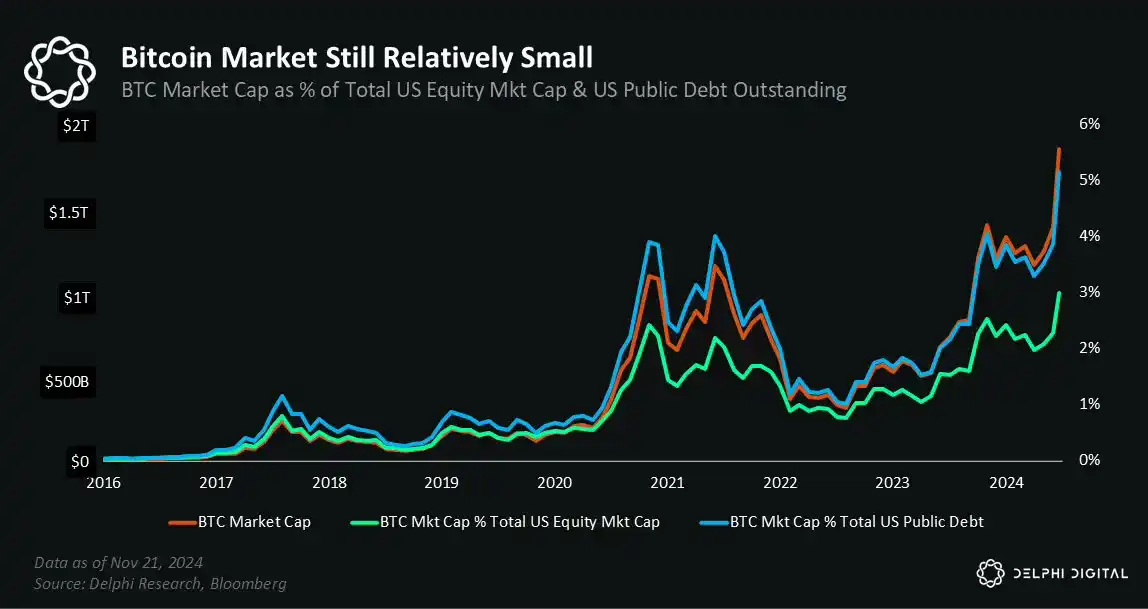
Despite Bitcoin attracting widespread attention, its growth potential remains immense:
- BTC's market value accounts for only 11% of MAG7's (Apple, Nvidia, Microsoft, Amazon, Google's parent company Alphabet, Meta, and Tesla) total market value.
- It represents less than 3% of the total market value of the US stock market and approximately 1.5% of the global stock market.
· Its market value is only 5% of the total US public debt, and less than 0.7% of the global (public + private) debt.
· The total funds in the US money market funds are three times the market value of Bitcoin.
· Bitcoin's market value is only about 15% of the total global foreign exchange reserves. Assuming global central banks allocate 5% of their gold reserves to Bitcoin, this would bring over $150 billion in purchasing power to Bitcoin—equivalent to three times the net inflows into IBIT this year.
· Global household net worth has reached a historical high, exceeding $160 trillion, $40 trillion higher than the peak before the pandemic. This growth is mainly driven by rising house prices and a booming stock market. As a comparison, this number is 80 times the current market value of Bitcoin.
In a world where the Federal Reserve and other central banks drive currency depreciation by 5-7% annually, investors need to seek a 10-15% annual return to offset the loss of future purchasing power.
You need to know:
· If a currency depreciates by 5% annually, its real value will halve in 14 years.
· If the depreciation rate is 7%, this process will shorten to 10 years.
This is why Bitcoin and other high-growth sectors are receiving attention.
The Alt Season Bubble
Despite Bitcoin achieving one all-time high after another this year, 2024 doesn't look friendly to most altcoins.
· $ETH failed to surpass its all-time high.
· Although $SOL hit a new high, the increase was only a few dollars higher than the previous peak. Compared to the growth in its market cap and network activity, this performance seems insignificant.
· $ARB had a strong start to the year, but as the year-end approaches, its performance has gradually declined.
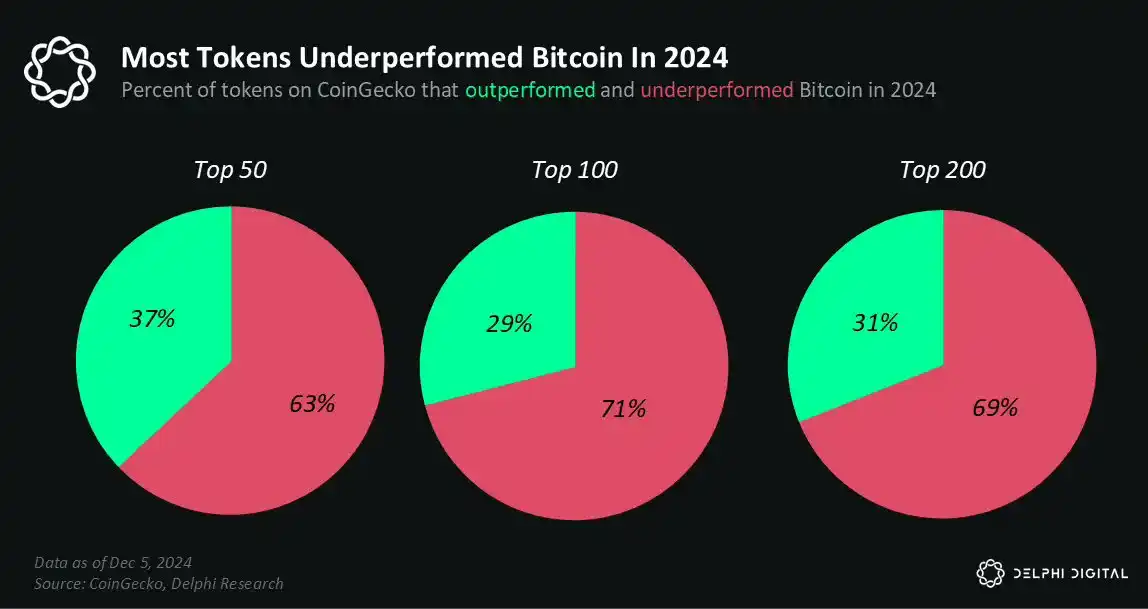
There are many similar examples. Just look at the performance data of 90% of altcoins in your investment portfolio.
Why is this happening?
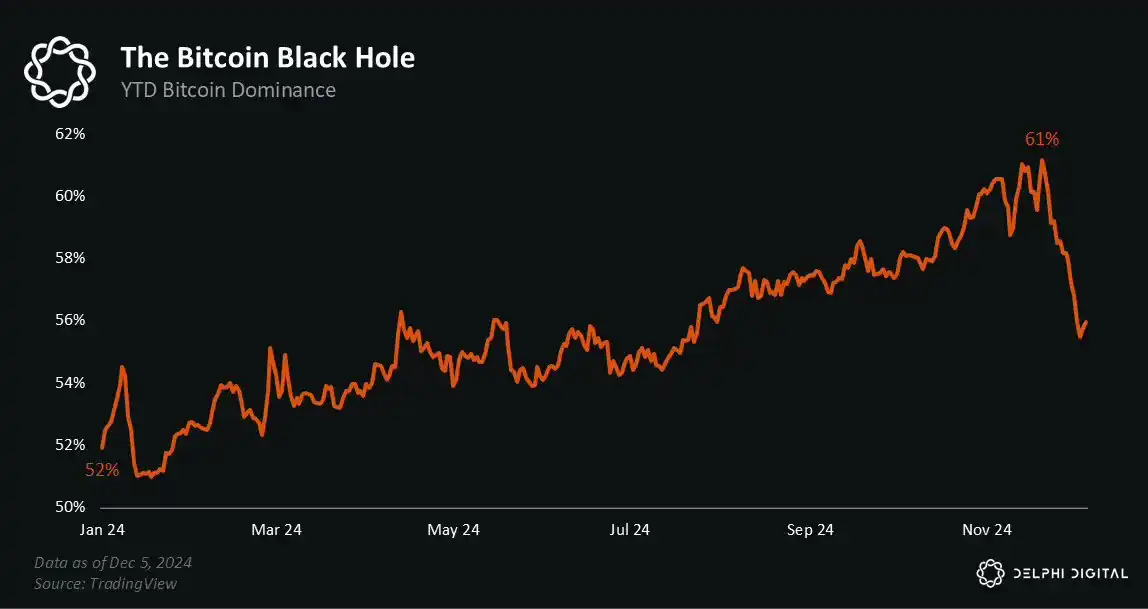
Firstly, Bitcoin's dominance is a key factor. BTC has performed exceptionally well this year, with its price rising over 130% year-to-date, driven by ETF inflows and Trump-related factors, reaching the highest level of dominance in three years.
Next is the phenomenon of market divergence.
This year, market divergence is a new feature of the crypto market. In previous cycles, asset prices usually moved in sync. When BTC rose by 1%, ETH would typically rise by 2%, and altcoins by 3%, forming a predictable pattern. However, this cycle is quite different.
Although a small number of assets have performed exceptionally well, more assets are in a state of loss. The rise of Bitcoin has not led to a comprehensive rise in other asset prices, and the anticipated "altcoin season" has not arrived as expected.
Finally, Meme coins and AI Agents also played significant roles in this.
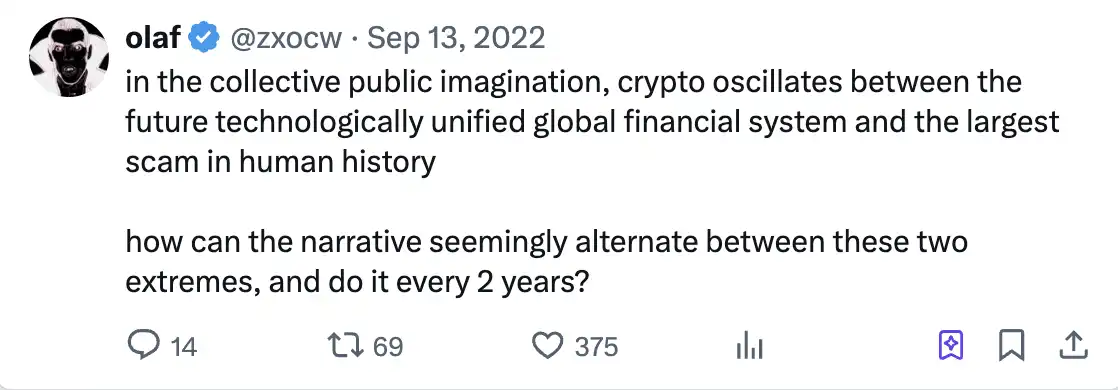
The crypto market has always fluctuated between "this is a Ponzi scheme" and "this technology will change the world." In 2024, the narrative of a "scheme" took the lead.
In the public's collective imagination, the crypto market is always swinging between a "unified global financial system of the future technology" and "the largest scam in human history," every two years.
Why does this narrative seem to alternate between these two extremes, occurring every two years?
The Super Cycle of Meme Coins and Market Sentiment
The super cycle of Meme coins further reinforced people's impression that the crypto market is a "Ponzi scheme." Many began to question whether the fundamentals of the crypto market really matter, even viewing it as a "casino on Mars." These concerns are not unfounded.
In this context, I would like to add a footnote.
When Meme coins are hailed as the best-performing asset of the year, people usually only focus on the "mainstream Memes" that have significant market value and have successfully built a community (such as DOGE, SHIB). However, 95% of Meme coins rapidly lose value after their launch, a fact that is often overlooked. Yet, even so, people still "want to believe."
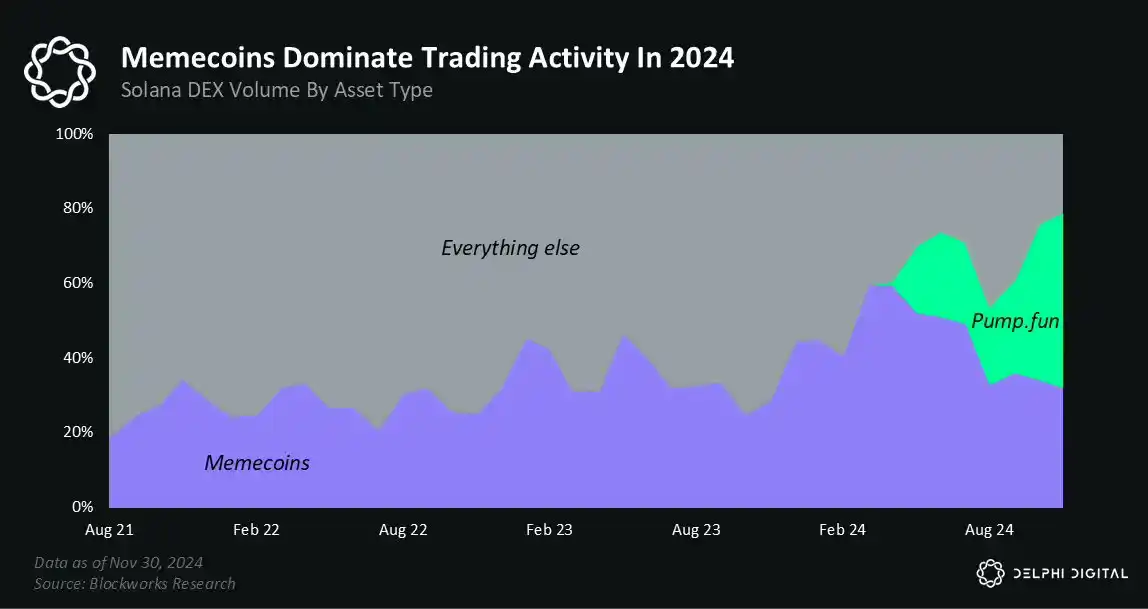
This belief has prompted many who previously invested in altcoins to shift their funds to Memecoins—some have profited, but most have not. As a result, capital inflows are primarily concentrated between Bitcoin (institutional funds) and Memecoins (high-risk investment), while most altcoins are being overlooked.
Delphi believes that 2025 will be the year of market transformation driven by technology, where these technologies will "change the world".
However, I am personally not as optimistic about this. In 2024, there was a surge of Key Opinion Leaders (KOLs) focused on Memecoins. When I tried to create a folder on Telegram containing channels with "truly valuable" content (you can find it here), I found that almost all channels were discussing "ape calls" (i.e., high-risk short-term investment advice). This is the nature of the attention economy, and these narratives profoundly influence market trends.
What are the next trends?
Growth of Stablecoins and Credit Expansion
One of the main challenges the current market faces is an oversupply of tokens. Driven by private investment and public token issuance, a large number of new assets have entered the market. For example, in just 2024, over 4 million tokens were launched on Solana's pump.fun platform. However, in contrast, the total market capitalization of the crypto market has only grown threefold from the previous cycle, compared to 18x and 10x growth in 2017 and 2020, respectively.
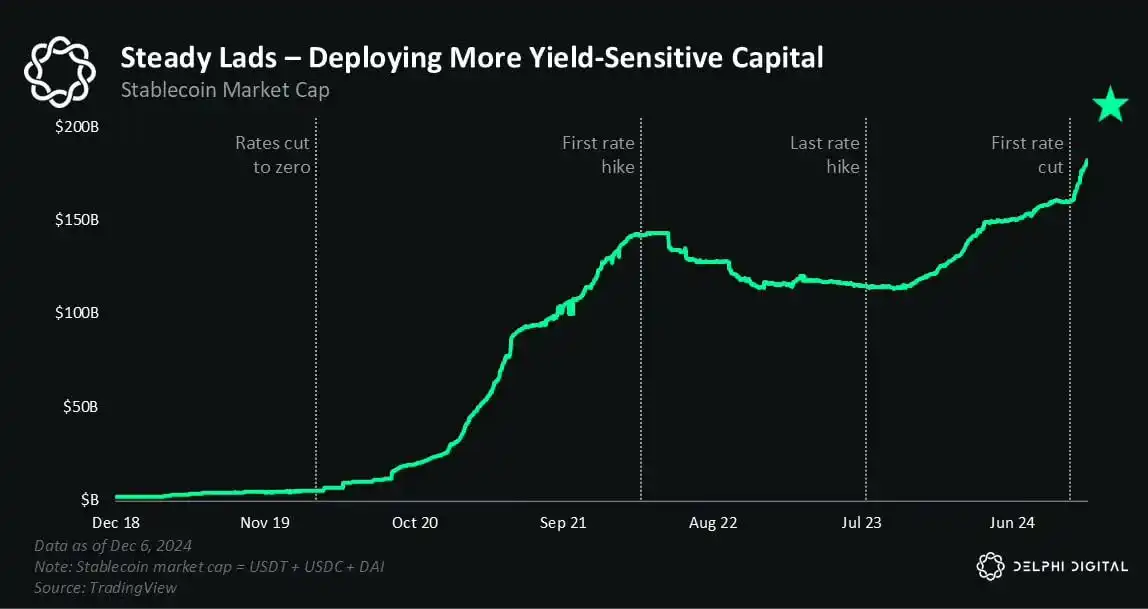
Two key missing factors in the market—growth of stablecoins and credit expansion—are reemerging. With falling interest rates and improved regulatory environment, speculative activity is expected to revive, thus mitigating the current market imbalance. The core role of stablecoins in trading and collateral will play a crucial role in the market's recovery.
Institutional Capital Inflows
Until last year, institutional investors remained cautious about crypto assets due to regulatory uncertainty. However, with the SEC reluctantly approving a spot Bitcoin ETF, this scenario is beginning to change, paving the way for future institutional capital inflows.
Institutional investors typically prefer to invest in familiar areas. While a few institutions may delve into Memecoins, they are more likely to focus on fundamentally supported assets such as ETH/SOL, DeFi, or infrastructure.
Delphi predicts that in the coming year, the market may see a "comprehensive rebound" similar to past cycles. Unlike before, this time the market will pay more attention to fundamentally-driven projects. For example, OG DeFi projects (original decentralized finance projects) with a proven track record may become the focus; infrastructure assets (such as L1 protocols) may also regain prominence. Additionally, Real-World Assets (RWAs) or emerging areas (such as artificial intelligence and DePIN) may also become hotspots.
Of course, not all tokens will be able to achieve triple-digit gains as they have in the past, but Meme's presence will become part of the market. This may signal a new starting point, a broad crypto rebound driven by an overall market uptrend.
Editor's Note: Most institutional traders typically rely on options hedging strategies. Therefore, if a "comprehensive rebound" occurs, the assets most likely to attract institutional interest will be those with options trading — currently primarily traded on Deribit and potentially the Aevo platform.
Argument for Solana
@Solana has demonstrated the strong resilience of the blockchain ecosystem. After experiencing a 96% market cap drop due to the FTX crash, Solana saw a remarkable recovery in 2024.

Here are some key performance highlights:
· Developer Momentum: Through hosting hackathons and distributing airdrops (such as the Jito airdrop), Solana successfully reignited developer and user interest. This increased engagement not only drove innovation but also formed a virtuous cycle of technical development and user adoption.
· Market Leadership: In the 2024 crypto market trend, Solana held a leading position in areas ranging from Meme to AI applications. Particularly noteworthy is its Real Economic Value (REV), which is over 200% of Ethereum's, demonstrating strong market vitality.
· Future Outlook: Solana is considered poised to challenge Ethereum's dominance in scalability and user experience. Compared to fragmented Layer-2 solutions, Solana offers a seamless user experience and highly concentrated ecosystem, giving it a significant competitive edge.
Stacy's Final Thoughts
The current market conditions may evoke memories of 2017-2018, when Bitcoin reached a historical high of $20,000 on New Year's Eve and then began to decline in early 2018. However, comparing the crypto market of 2018 to that of 2025 is not entirely appropriate in my opinion. The two exist in completely different market environments — what was once the chaotic and lawless "Wild West" is rapidly evolving into a more regulated alternative to the stock market.
We need to recognize that the scope of the crypto market goes far beyond Crypto Twitter (CT) and discussions on Platform X. For those who are not active on these platforms, their understanding and perception of the market may be entirely different.
Looking ahead to 2025, I believe the crypto market will bifurcate into two main directions:
· Web3 Native Users: This group will be deeply involved in the crypto market, familiar with its unique workings, and willing to take on high risks, participating in speculative trading such as Memes, AI avatars, and presale projects. These behaviors evoke memories of the "Wild West" era of the early crypto market.
· Mainstream Investors: Including institutional investors and retail investors, they typically adopt a more conservative risk management approach, leaning towards fundamental-based investment strategies. They view the crypto market as an alternative to the traditional stock market, focusing on long-term value rather than short-term speculation.
So, which areas might be marginalized? Early DeFi projects, RWA (Real-World Assets), and DePIN (Decentralized IoT) protocols that have failed to establish a leading position in their field or within the blockchain ecosystem may gradually lose market attention. This is just my perspective.
PS: This article summarizes the key points from @Delphi_Digital's 2025 Market Outlook. If you want to fully understand Delphi's detailed forecasts for 2025 and beyond, I highly recommend reading their original research report.
You may also like

Morning Report | OpenAI has submitted an S-1 registration statement draft to the U.S. SEC; Morpho completes $175 million financing

Morning Report | BitMine increased its holdings by 126,971 ETH last week; trader Eugene announced his exit from the crypto market

Wang Chuan: How can one not feel anxious after the neighbor Old Wang made thirty times profit by investing in storage stocks? (Seven) - A quarter-century cycle

Cryptocurrency CEXs are flocking to sell US stocks, and traditional brokerages are facing an "uninvited guest."

$75 billion in foreign capital has fled, and South Korean retail investors have absorbed it all using leverage

Japan’s Three Megabanks Plan Joint Stablecoin Issuance in Fiscal 2026
MUFG, SMBC, and Mizuho reportedly plan to jointly issue fiat-pegged stablecoins in fiscal 2026, signaling Japan’s growing push into bank-led digital payment infrastructure.

Humanity Discloses H Token Dual-Chain Attack Details, With Losses on Ethereum and BSC Exceeding $36 Million
Humanity said the H token attack across Ethereum and BSC caused more than $36 million in losses after leaked ProxyAdmin keys enabled malicious contract upgrades and token minting.
White House Discusses CLARITY Act With Law Enforcement Ahead of Senate Vote
The White House discussed the CLARITY Act with law enforcement ahead of a Senate vote, focusing on illicit finance risks and developer protections.

Bitcoin Trading Guide 2026: Strategies for Experienced Traders

What Is XAUT and PAXG? Why Tokenized Gold Is Booming in 2026

Will the SpaceX IPO Hurt Bitcoin? Here's What Traders Are Watching

Foreign selling in the South Korean stock market accelerates, with cumulative net sales reportedly reaching $75 billion this year
On June 9, The Kobeissi Letter, citing Goldman Sachs data, reported that global investors are selling South Korean stocks at an unusually rapid pace. In the latest trading session, foreign investors sold about $801 million worth of Kospi constituent stocks again; total foreign outflows last week reached about $10 billion, and the market has been in net foreign selling on nearly every trading day over the past month. According to the data cited in the report, foreign investors have sold about $75 billion worth of South Korean stocks so far this year. Meanwhile, South Korean retail and institutional investors together recorded roughly $69 billion in net buying over the same period, suggesting that the market’s main buying support has come from domestic capital rather than returning overseas funds. The information currently disclosed still mainly comes from The Kobeissi Letter’s retelling and Goldman Sachs data summaries, while public details on the statistical period and the specific definition of “selling” remain relatively limited.

Fortune Warns of Strategy’s Financing Structure Risks as Bitcoin Premium Narrows
Fortune warned that Strategy’s Bitcoin treasury model faces growing financing risks as MSTR’s net asset premium narrows and preferred stock dividend pressure increases.

Ferrari Challenge Le Mans: Carl Moon to Dominate in WEEX Livery

Sahara AI Responds to SAHARA’s Sharp Drop: No Contract or Product Security Issues Found, Internal Investigation Underway
Sahara AI responded to SAHARA’s 60% price drop, saying no token contract or product security issues have been found and an internal investigation is underway.

WEEX Deposit/Withdrawal Dynamic Island: Your Asset Status, Always in Sight
Scaling Crypto Derivatives: The Digital Asset Infrastructure Behind High-Volume Trading
In the fast-moving digital asset ecosystem, derivatives platforms face an extreme architectural test. High-leverage futures markets demand more than just standard security—they require absolute operational precision, zero-latency matching engines, and ironclad structural scalability, all while navigating intense market volatility.
As global platforms scale to meet these demands, the industry is shifting away from rigid, monolithic setups toward a more agile, "decoupled" infrastructure philosophy.
The Blueprint for High-Volume Copy TradingFor elite global exchanges like WEEX (founded in 2018), this architectural choice becomes critical when scaling high-volume retail features like social copy trading. When thousands of users automatically mirror the real-time strategies of elite traders simultaneously, it triggers sudden, monumental spikes in concurrent transactional volume.
To prevent execution latency or settlement bottlenecks during these peak volatility events, a platform's primary engine must remain entirely dedicated to risk management, copy-trade synchronization, and order matching.
The Architectural Rule: New-generation platforms must separate front-end user execution engines from heavy backend infrastructural overhead to eliminate operational friction.
By separating these layers, platforms can maintain complete sovereignty over their trading environments and user experiences while strategically aligning with institutional-grade infrastructure ecosystems. This strategic framework allows modern exchanges to leverage advanced Digital Asset Custody infrastructure such as Cobo’s behind the scenes, ensuring that backend wallet management scales elastically alongside trading spikes.
Capitalizing on Market Momentum and 400× LeverageIn a derivatives arena where platforms offer up to 400× leverage on perpetual contracts, capital efficiency and market agility are core business metrics. To capture market momentum, an exchange needs the ability to rapidly expand its asset offerings, supporting everything from legacy crypto assets to sudden, trending altcoins across a massive library of trading pairs.
Adopting a flexible, scalable Wallet-as-a-Service (WaaS) solution such as Cobo’s could completely rewrite the development timeline for high-growth exchanges. Instead of spending months of engineering capital building out custom backend wallet architectures for every new blockchain network, platforms can deploy localized infrastructure in days.
This agility allows platforms to instantly scale their listings to over a thousand trading pairs without compromising security or delaying time-to-market. It mirrors the exact operational advantages seen during high-velocity market events, similar to how advanced wallet infrastructure empowers platforms during sudden asset surges; allowing exchanges to pass that speed and liquidity directly to their global user base.
A Mature Foundation for GrowthThe synergy between trusted infrastructure ecosystems and global trading platforms represents the natural evolution of a maturing crypto market. As WEEX continues to scale its global spot and derivatives offerings for over 6 million users, adopting robust backend paradigms proves that platforms no longer have to compromise between cutting-edge trading velocity and uncompromised structural security.

Get Paid to Onboard? Try WEEX’s New Homepage with Rewards for Registration, Deposit & Trade
Morning Report | OpenAI has submitted an S-1 registration statement draft to the U.S. SEC; Morpho completes $175 million financing
Morning Report | BitMine increased its holdings by 126,971 ETH last week; trader Eugene announced his exit from the crypto market
Wang Chuan: How can one not feel anxious after the neighbor Old Wang made thirty times profit by investing in storage stocks? (Seven) - A quarter-century cycle
Cryptocurrency CEXs are flocking to sell US stocks, and traditional brokerages are facing an "uninvited guest."
$75 billion in foreign capital has fled, and South Korean retail investors have absorbed it all using leverage
Japan’s Three Megabanks Plan Joint Stablecoin Issuance in Fiscal 2026
MUFG, SMBC, and Mizuho reportedly plan to jointly issue fiat-pegged stablecoins in fiscal 2026, signaling Japan’s growing push into bank-led digital payment infrastructure.


