
December 24th Market Key Intelligence, How Much Did You Miss?



Top News
1. Solana On-Chain Meme Surges, PIPPIN Up 35%
2. Binance Launches USD1 Flexible Savings Product with Up to 20% APY
3. Polymarket Confirms Recent User Account Hacks Due to Third-Party Vulnerability
4. Binance Wallet to Airdrop Alpha Today at 21:00 UTC, 226 Points Threshold
5. Japan's 30-Year Government Bond Yield Rises 2 Basis Points to 3.445%, Hits Record High
Trending Topics
Source: Overheard on CT (tg: @overheardonct), Kaito
Below is the translation of the original content:
[STBL]
With a significant rebranding of its brand image and a shift towards "Stablecoin 2.0" infrastructure, STBL has seen a notable increase in market attention. This transformation focuses on institutional-grade reliability, Real-World Asset (RWA) integration, and compliance development. The core of community discussion revolves around the protocol snapshot vote scheduled for December 28 and the active social engagement activities driving its rise on the Kaito leaderboard. Users are particularly focused on the protocol's unique architecture, including the Ecosystem-Specific Stablecoin (ESS), Money-as-a-Service (MaaS) framework, and a three-token system (USST, YLD, $STBL) that separates principal and yield through Non-Fungible Tokens (NFTs). They also acknowledge its high-yield return through a multi-factor staking mechanism. (Reference: ref0 - ref6)
[ZAMA]
Today, the community discussion revolved around the blockbuster announcement of exclusive benefits for Zama's early Non-Fungible Token (OG NFT) holders. Holders will receive the exclusive right to purchase $ZAMA tokens at a fully diluted valuation (FDV) of $55 million, a value significantly lower than the rumored $1 billion project valuation, and with no lock-up period. This news sparked a strong reaction in the community, with members estimating a potential return of up to 18x. Additionally, Zama has joined the x402z All-to-All Payment Alliance (A2A Payment Alliance) and received a nomination for the "Best Privacy Project" award, further boosting market enthusiasm. (Reference: ref0 - ref4)
[LIGHTER]
The community's discussion of Lighter ($LIT) has been focused on the strong anticipation of its upcoming Token Generation Event (TGE) and airdrop, with the market generally expecting the events to kick off on December 29. The protocol gained significant attention after pre-trading on major exchanges like Binance and MEXC, with the current implied FDV ranging between $3 billion and $5 billion. While most community members are watching for its valuation comparison with Hyperliquid and zero-fee transaction model, some discussions have pointed out metadata confusion in the Binance pre-trading market, with users claiming incorrect display of information related to the old project Litentry. (Reference: ref0 - ref4)
[AAVE]
Aave is currently embroiled in a major governance conflict, referred to by the community as a "civil war" between Aave Labs and Aave DAO, with the controversy centering around protocol intellectual property, brand assets, and ownership of frontend revenue. The conflict was sparked by Aave Labs redirecting swap fees to its own wallet without DAO consent, leading to debates on whether the DAO (backed by independent service providers) that maintains the protocol's core "engine" should also own its "frontend" (interface and brand). Furthermore, the two sides have differences in strategic transition from V3 to V4, with this series of internal frictions causing a significant drop in the AAVE token price and raising high concerns in the market about the alignment of private equity interests with token holder interests. (Reference: ref0 - ref4)
[OPENMIND]
OpenMind (OPENMIND) garnered widespread attention due to the OM1 system upgrade announcement, which introduced privacy-centric features such as identity management and fall detection to home robots. Investors and tech enthusiasts are particularly focused on the project's strategic integration with the NEAR Protocol AI Cloud and the launch of "Smart Brain Modules" based on the NVIDIA Jetson Thor chip, further solidifying the platform's leading position in the "Physical AI" and decentralized robotics field. (Reference: ref0 - ref4)
Featured Articles
1.《Are Those Highly Funded Projects from 2021 Still Alive?》
According to Venture Capital analysis, cryptocurrency startups raised $25.2 billion in that year, a 713% surge from $3.1 billion in 2020. However, four years later, looking back at over 400 highly funded projects, only a very small number are still standing strong. Most projects have disappeared without a trace, either announcing the cessation of operations, pivoting to other projects, collapsing after being hacked, suffering a major negative impact following FTX's downfall, or becoming zombie projects lying flat.
2.《Aave Community Governance Dispute Escalates, What's Trending in the Overseas Crypto Circle Today?》
In the past 24 hours, the crypto market has simultaneously unfolded in multiple dimensions. Mainstream topics have focused on the re-discussion of macro policies and monetary systems, including the outlook of the Federal Reserve and the strengthening of safe-haven assets; in terms of ecosystem development, Solana continues to advance around developer tools and transaction efficiency, Ethereum strengthens its narrative of "public goods," and the Perp DEX track accelerates differentiation under projects like Hyperliquid and Lighter.
On-chain Data
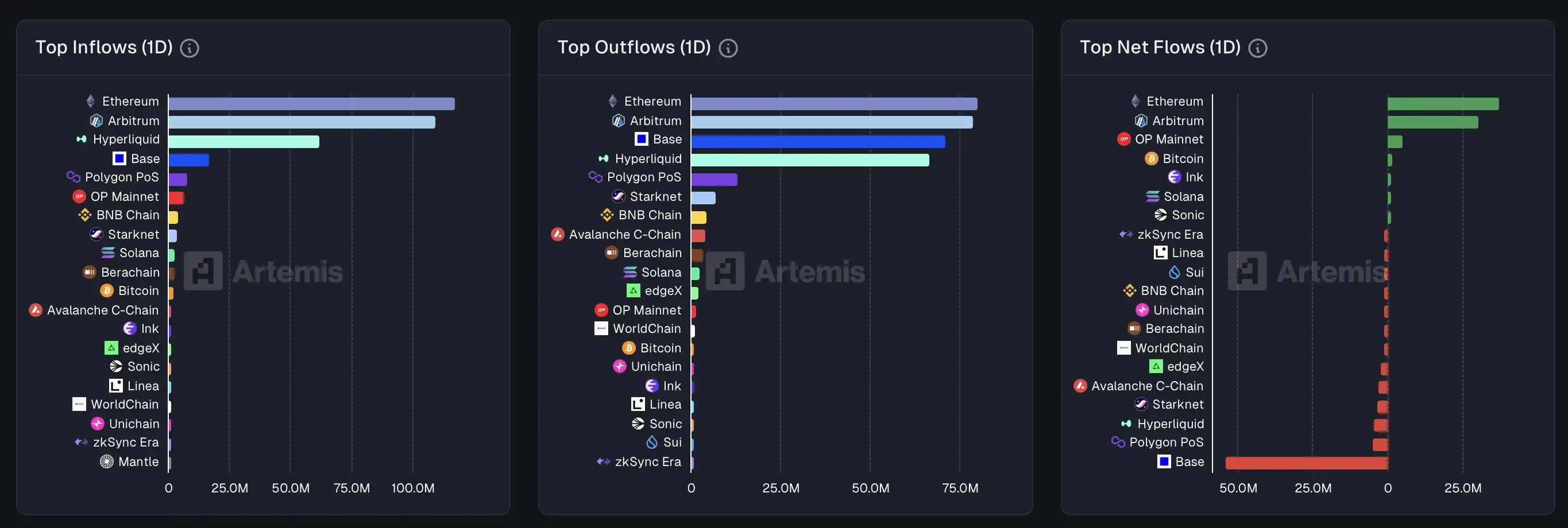
On-chain Fund Flow on December 24
You may also like

Can the CLARITY Act Become Law by July 4? Everything You Need to Know About the Final Battle

How to exit after asset tokenization?

The foundation of SpaceX's trillion-dollar valuation: Who is dividing Musk's annual capital expenditure of tens of billions?

France vs Senegal World Cup 2026: Mbappe’s New Era Begins Against a Historic Rival

SharpLink CEO: How to understand that Ethereum developers have just surpassed 1 million?

Morning Report | MiCA grace period expires on July 1; Kalshi's trading volume in the first week of the World Cup breaks $5.1 billion, setting a record

What is the connection between Huang Zheng of Pinduoduo and blockchain?

Morning Report | Prediction market platforms like Kalshi and Polymarket jointly sue Kentucky over 14.25% trading tax; Bridgewater founder discusses decision-making in the AI era: principled thinking should run parallel to AI, human insight remains irre...

If the AI bubble has already burst, who will truly remain?
Paul Graham: How to Make a Billion Dollars

After 18 years, blockchain has finally started to head towards the main channel
Claude enforces "facial recognition for household registration," starting in July, no ID card means no access?

On the day of SpaceX's IPO, the first real test of the three perpetual mechanisms

Value Distribution of Stablecoins
Galaxy Deep Dive: Is the Bitcoin Four-Year Cycle Still Valid?

SpaceX IPO, Nvidia, and Bitcoin: Why Traders Are Watching More Than Just Crypto in 2026

The other side of Musk's trillion-dollar fortune: 85% cannot be sold

The U.S. government prohibits foreigners from using Fable 5, Anthropic issues a rebuttal
Can the CLARITY Act Become Law by July 4? Everything You Need to Know About the Final Battle
How to exit after asset tokenization?
The foundation of SpaceX's trillion-dollar valuation: Who is dividing Musk's annual capital expenditure of tens of billions?
France vs Senegal World Cup 2026: Mbappe’s New Era Begins Against a Historic Rival
SharpLink CEO: How to understand that Ethereum developers have just surpassed 1 million?
Morning Report | MiCA grace period expires on July 1; Kalshi's trading volume in the first week of the World Cup breaks $5.1 billion, setting a record


