
Bloomberg has reported twice, Hyperliquid once again in Wall Street's radar

At 1:12 AM EST on February 28, during the exchange downtime, the trading volume of the prediction contract on Polymarket regarding the US striking Iran surged.
Source: @yenwod_
At 1:13 AM, the first open-source intelligence tweet about the airstrike appeared on Twitter.

One minute later, the price and trading volume of the crude oil perpetual contract on Hyperliquid's Trade.xyz followed an anomaly.
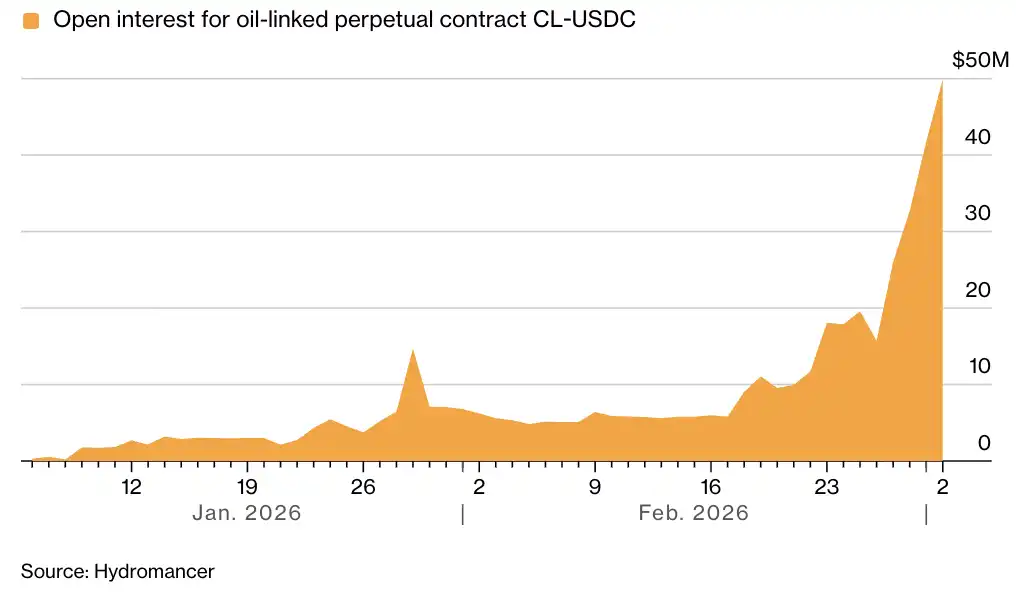
After the headline news broke, the crude oil perpetual contract on the Hyperliquid platform rose by 5%, with OI reaching $50 million. HYPE's price increased by 13%, leading the top 25 tokens by market cap.
24/7 Trading
Out of the past year's ten high-volatility macroeconomic events, eight occurred over the weekend. Hyperliquid's round-the-clock price discovery mechanism is drawing attention from the traditional financial markets.
In two recent articles about Hyperliquid, Bloomberg pointed out that as the intersection between the crypto market and traditional finance deepens, Wall Street is starting to closely watch platforms like Hyperliquid. During weekends when traditional markets are closed, on-chain derivatives offer continuous risk pricing capabilities. Bloomberg cited market participants stating that this round-the-clock pricing mechanism is a structural upgrade to enhance market efficiency. Weekend market movements validate a trend where round-the-clock on-chain trading of all asset classes is an inevitable direction for financial market development.
Decoupling
With the growth of HIP-3 supporting traditional market trading, HYPE's price performance has already begun to decouple from the default benchmark of the crypto market, Bitcoin. When news of the strike broke, the price of Bitcoin briefly fell and entered a period of volatility. In contrast, HYPE, which caters to trading demands for precious metals, stocks, and more, showed an independent trend.
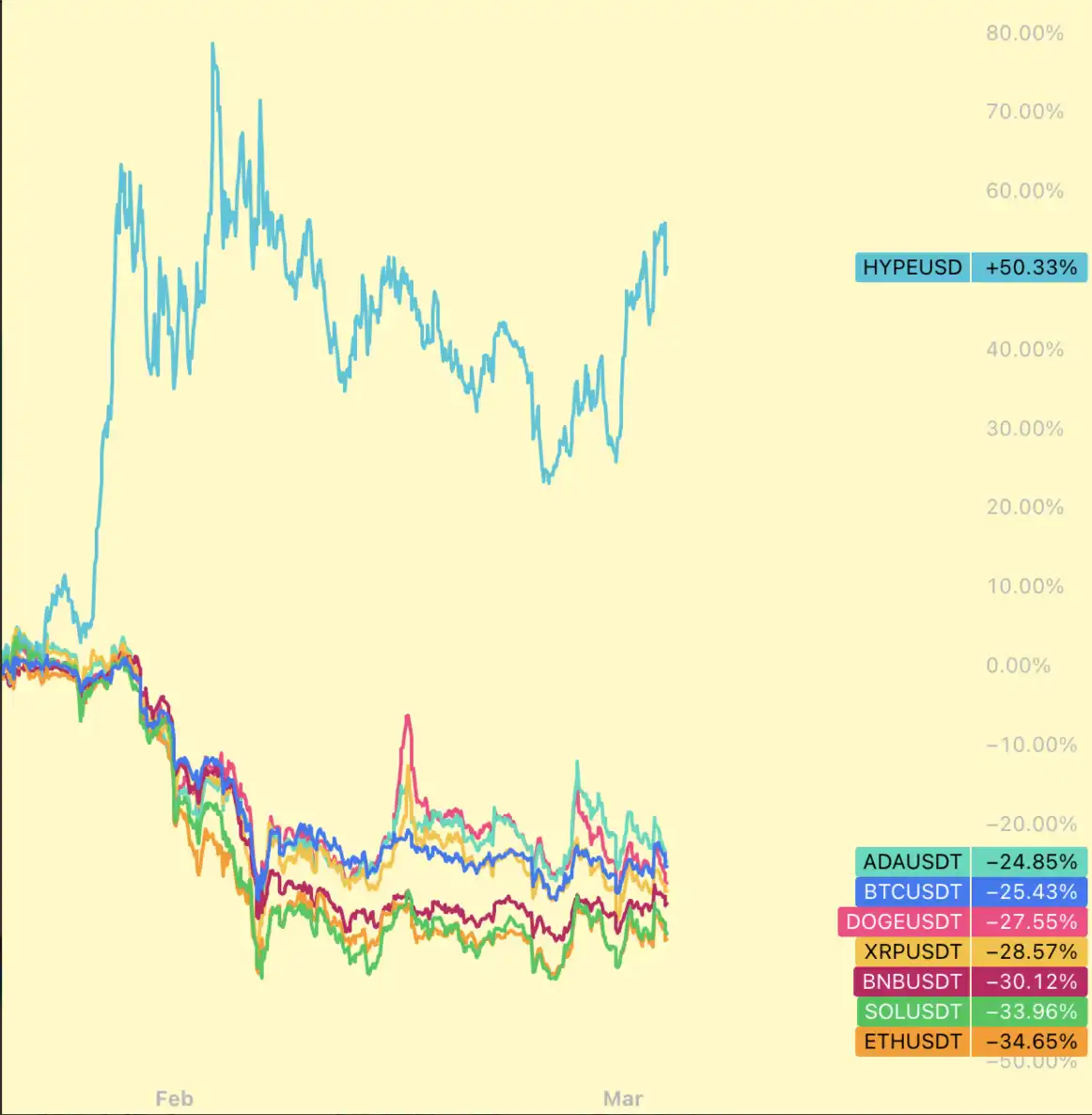
In late January, when silver broke $100 and gold broke $5500, the trading volume of silver-only contracts on the HIP-3 exchange tradexyz reached $1.2 billion, driving HYPE's 55% increase in three days, while Bitcoin only rose by 3% during that period.
Surge in Gold, Silver, and Copper Contract Trading Volume onTrade.xyz Since January
The Tokenomics explained the reason behind the HYPE surge. Hyperliquid's HIP-3 protocol dictates that 50% of all fee revenue generated by HIP-3 exchanges flows into the Hyperliquid Official Aid Fund for HYPE buybacks. Macro volatility drives up trading volume, increasing the buyback size, creating strong buying pressure for the HYPE token.
Fee Revenue Generated by HIP-3 Exchanges on
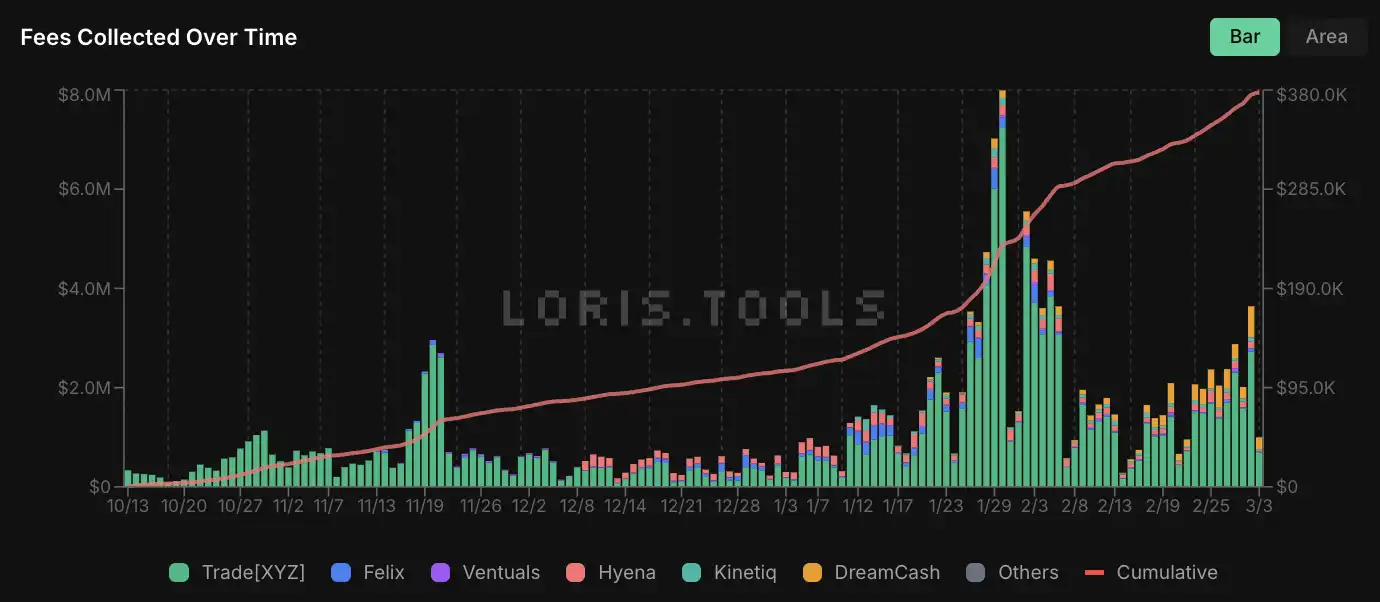
HYPE holders are not only betting on Hyperliquid's growth as an offshore Perp DEX but also on longing geopolitical uncertainty.
Hyperliquid is just the clearest expression of this narrative so far, and the market is finally starting to reflect that.
Discrepancy
Nevertheless, on-chain derivatives still have a ways to go to meet traditional institutional standards.
Hyperliquid's current edge lies in small to medium-sized retail orders. According to Blockworks Research, during normal trading hours, its Silver contract's spread is comparable to the COMEX micro contract. However, the depth discrepancy is significant. COMEX has a $13 million order book depth within ±5 bps, whereas Hyperliquid has only around $230k.
COMEX vs. Hyperliquid Order Book Depth Comparison
Source: Blockworks Research
In extreme market sell-offs, on-chain liquidity suffers from greater tail risks. 1% of Hyperliquid's Silver trades experience a slippage of over 50 bps, while COMEX still offers better execution costs in such scenarios.
COMEX vs. Hyperliquid Execution Slippage Comparison
Source: Blockworks Research
Currently, Hyperliquid's liquidity and funding rate model cannot yet meet the needs of large funds. To compete at an institutional level, on-chain platforms need to address KYC issues and may even need to establish technical and collaborative frameworks that match traditional clearing institutions. Many industry participants still believe that if the Chicago Mercantile Exchange (CME) were to launch 24/7 trading, it would have a natural hedging advantage and trust foundation.
However, the traditional financial market's reliance on a risk control model based on physical closure times has indeed shown its limitations. The ability to continuously price risk without waiting for Monday's opening is a core value proposition of offshore exchanges like Hyperliquid.
The transfer of market pricing power to the blockchain will be a long process. But we must dare to dream — just in case it comes true.
You may also like

Bank of Korea defends bank-first stablecoin plan amid bill deadlock
JPMorgan says bitcoin's main risk isn't Strategy, but blockchain adoption that doesn't benefit public chains and tokens
Fear & Greed Index Today: What Extreme Fear Means for Crypto, Stocks and Gold
Labour MPs Push to Make UK Crypto Donation Ban Permanent
Supreme Court ruling expanding Trump's authority over federal agencies raises questions for SEC, CFTC as crypto rulemaking advances
'Bottom building in progress': Analysts say bitcoin holder capitulation signals late-stage bear market
A Comprehensive Analysis: Starting from 1996, Who is Laying the Foundation for the Next Generation of Capital Markets
Luke Dashjr, the Biggest Anti-Spammer of Bitcoin, Inscribed Phrases on the Network in 2011
Whales bought 270,000 BTC while ETFs bled $7 billion. One side is wrong
The crypto IPO class of 2025-26 is down as much as 89%. Autopsy of a listing boom
Robinhood Chain Mining Guide: A Comprehensive Tutorial from Cross-Chain to Memecoin
BitGo CEO says single-digit percentages of bitcoin's supply are 'probably right' for large holders amid Strategy's sale
Beyond Private Keys: How to Safeguard the Security Boundaries of Web3 from Wallets, L2 to Supply Chains?
Vanguard Enters the Market, Opening a New Crypto Gateway for 50 Million Traditional Investors
Why the OUSD Alliance of 150 Companies Still Cannot Shake USDT and USDC?
Citigroup Analysis: Is There Still 47% Upside for Nvidia? Can Rubin and CPO Deliver?
WEEX API Fast Connect: Turn Every Sign-In Into a Live Trader in Under 10 Seconds
WEEX API Fast Connect is a one-click OAuth authorization system that lets your users link their WEEX account without ever touching an API key. Frictionless onboarding, faster conversions, higher retention — built for WEEX Broker partners.
Bitcoin's dwindling exchange reserves don't pack the same bullish punch anymore
Bank of Korea defends bank-first stablecoin plan amid bill deadlock
JPMorgan says bitcoin's main risk isn't Strategy, but blockchain adoption that doesn't benefit public chains and tokens
Fear & Greed Index Today: What Extreme Fear Means for Crypto, Stocks and Gold
Labour MPs Push to Make UK Crypto Donation Ban Permanent
Supreme Court ruling expanding Trump's authority over federal agencies raises questions for SEC, CFTC as crypto rulemaking advances
'Bottom building in progress': Analysts say bitcoin holder capitulation signals late-stage bear market