
- Buy Crypto
- Markets
 Futures
- Spot
- Copy Trade
- Earn
- More
Arizona Passes Unclaimed Crypto Law After Vetoing Reserve Last Week
By: decrypt|2025/05/08 12:30:02
0
Share
Arizona Passes Unclaimed Crypto Law After Vetoing Reserve Last Week Arizona becomes the first U.S. state to hold unclaimed crypto in its original form, following a veto on a separate crypto bill last week. In brief Arizona has passed HB 2749, allowing unclaimed crypto assets to be held in their native form rather than liquidated. The law introduces a three-year dormancy threshold before digital assets must be turned over to the state. A reserve fund will capture earnings from unclaimed assets, with distributions subject to legislative approval. Decrypt’s Art, Fashion, and Entertainment Hub. Arizona Governor Katie Hobbs (D-AZ) signed House Bill 2749 into law on Wednesday, introducing provisions to allow the state to retain unclaimed digital assets in their original form. The bill , led by House Commerce Committee Chairman Jeff Weninger (R-AZ), modernizes Arizona’s unclaimed property laws to account for crypto by identifying, collecting, and safeguarding unclaimed digital assets and allowing the state to maintain its value instead of liquidating it. Under the new law, digital assets will be presumed abandoned if the rightful owner fails to respond to communications or record any activity on an account over a three-year period, putting it in line with current legislation on other financial products such as stocks. After this, holders must give the digital assets to the Department of Revenue in their native form. The law also creates a reserve fund where earnings from unclaimed assets, such as staking rewards or airdrops, can be deposited and later allocated through legislative approval. “This law ensures Arizona doesn’t leave value sitting on the table and puts us in a position to lead the country in how we secure, manage, and ultimately benefit from abandoned digital currency,” said Wenniger in a statement . This measure is separate from a higher-profile crypto proposal that was recently vetoed . That bill, brought by State Senator Wendy Rogers (R-AZ), sought to create a Strategic Bitcoin Reserve funded by seized state assets. Governor Hobbs vetoed it on May 2, citing concerns about volatility and fiduciary risk. "Arizonans’ retirement funds are not the place for the state to try untested investments like virtual currency," she said in a letter on her decision. Rogers has pledged to reintroduce the bill in the next session. Across the U.S., state-level attempts to legislate crypto reserves and digital asset policy are heating up, though many are stumbling. Florida's effort to allocate up to 10% of select public funds to Bitcoin collapsed last week when both HB 487 and SB 550 were pulled just before the legislative session ended, having never made it to a floor vote. Similar bills have also failed in Oklahoma, South Dakota, Montana, North Dakota, Pennsylvania, and Wyoming. Many of these had previously advanced out of committee, only to falter in later stages. New Hampshire, however, has had some success in passing crypto legislation. Governor Kelly Ayotte signed HB 302 into law on Tuesday, authorizing the state treasurer to allocate up to 5% of public funds to either precious metals or digital assets with a minimum average market cap of $500 billion, effectively greenlighting Bitcoin for state investment. Edited by Sebastian Sinclair Daily Debrief Newsletter
You may also like

Particle Founder: The entrepreneurial insights I have gained the most from in the past year
Stop lean startup, stop lightning entrepreneurship, and think carefully about what your product aspirations are.

Huang Renxun's latest podcast transcript: The future of Nvidia, the development of embodied intelligence and agents, the explosion of inference demand, and the public relations crisis of artificial intelligence
The competition in the future is not just about whose model is larger or whose computing power is stronger, but also about who understands the industry better, who can embed AI more deeply into real processes, and who can organize these capabilities into a runnable and scalable system.

OKX Ventures Research Report: AI Agent Economic Infrastructure Research Report (Part 1)
The existing infrastructure is hostile to the Agent economy. Agents can think and act independently at the "capability level," but at the "economic level," they are still locked into infrastructure designed for humans.

The migration of settlement rights: B18 and the institutional starting point of on-chain banks
In the traditional system, banks decide the settlement; in the on-chain system, code begins to take over this responsibility.

From Tencent and Circle: Looking at the Simple and Difficult Questions of Investment
The AI narrative continues to ferment, but the recent performance of related stocks varies, with some in the midst of summer and others as if in winter.

The second half of stablecoins no longer belongs to the crypto circle
What Coinbase doesn't want, Mastercard is eager to buy.

Cursor "Shell" Kimi Controversy Reversed: From Copyright Infringement Allegations to Authorized Collaboration, China's Open Source Model Once Again Becomes a Global AI Foundation
Cursor was accused of being based on Kimi K2.5, which sparked controversy, and was later confirmed to be compliant through Fireworks AI due diligence.

The Real Reason Tokens Don't Sell: 90% of Crypto Projects Overlook Investor Relations
Provide an Investor Relations Best Practices Guide for Crypto Projects.

Is the income of pump.fun real, earning a million dollars a day despite the market downturn?
If it can really earn this much, what is the reason for the low price of $PUMP?

The real reason why tokens are not selling: 90% of crypto projects neglect investor relations
Investor Relations Practice Guide for Cryptocurrency Projects.

Who is the true winner of the "Tokenization" narrative?
Virtually everyone benefits, but the reason for the benefit, the timing, and the underlying logic are completely different.

Moss: The Era of AI-Traded by Anyone | Project Introduction
AI Trading Agent is rapidly growing its infrastructure.

Chip Smuggling Case Exposes Regulatory Loophole | Rewire News Evening Update
AI chips have become a strategic asset more sensitive than missiles

How a Structured AI Crypto Trading Bot Won at the WEEX Hackathon
Ritmex demonstrates how disciplined risk control and structured signals can make an AI crypto trading bot more stable and reliable on WEEX, highlighting the importance of combining execution discipline with scalable AI trading systems.

Old Indicator Fails, Three Major New Signals Emerge: BTC True Bottom May Still Be Below $60K
When the grocery shopping auntie on the subway, or Tony the hairdresser, start asking you about BTC, crypto, and cryptocurrency investments, selling immediately will be the only best option.

Meeting OpenClaw Founder at a Hackathon: What Else Can Lobsters Do?
Imperial College London MetaGame: AI Agent × Web3 Landing Three Major Directions.
Huang Renxun's Latest Podcast Transcript: NVIDIA's Future, Embodied Intelligence and Agent Development, Soaring Demand for Inferencing, and AI's PR Crisis
The future of competition is not only about whose model is bigger, whose computing power is stronger, but also about who understands the industry better, who can more deeply integrate AI into real processes, and who can organize these capabilities into a set of executable, scalable systems
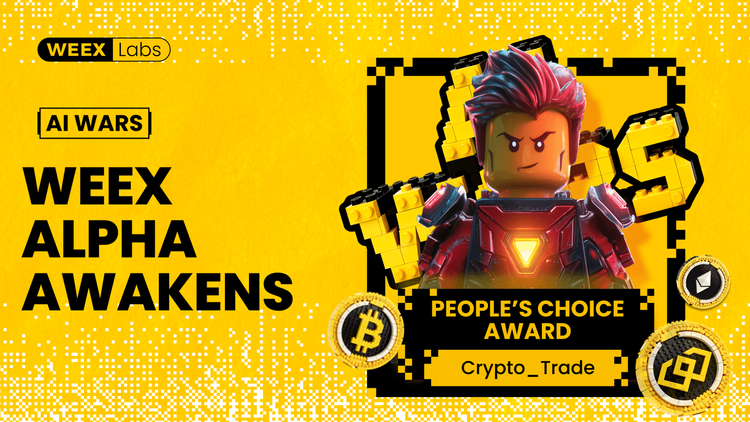
How a Structured AI Crypto Trading Bot Won at the WEEX Hackathon
Crypto_Trade shows how structured inputs and controlled adaptability can build a more stable and reliable AI crypto trading bot within the WEEX AI Trading Hackathon, highlighting a practical path toward scalable AI trading systems.
Particle Founder: The entrepreneurial insights I have gained the most from in the past year
Stop lean startup, stop lightning entrepreneurship, and think carefully about what your product aspirations are.
Huang Renxun's latest podcast transcript: The future of Nvidia, the development of embodied intelligence and agents, the explosion of inference demand, and the public relations crisis of artificial intelligence
The competition in the future is not just about whose model is larger or whose computing power is stronger, but also about who understands the industry better, who can embed AI more deeply into real processes, and who can organize these capabilities into a runnable and scalable system.
OKX Ventures Research Report: AI Agent Economic Infrastructure Research Report (Part 1)
The existing infrastructure is hostile to the Agent economy. Agents can think and act independently at the "capability level," but at the "economic level," they are still locked into infrastructure designed for humans.
The migration of settlement rights: B18 and the institutional starting point of on-chain banks
In the traditional system, banks decide the settlement; in the on-chain system, code begins to take over this responsibility.
From Tencent and Circle: Looking at the Simple and Difficult Questions of Investment
The AI narrative continues to ferment, but the recent performance of related stocks varies, with some in the midst of summer and others as if in winter.
The second half of stablecoins no longer belongs to the crypto circle
What Coinbase doesn't want, Mastercard is eager to buy.


 App
App