
2024 Public Blockchain Industry Annual Report: From Infrastructure Competition to Application Breakthrough


Original Article Title: "2024 Public Blockchain Industry Annual Report: From Infrastructure Competition to Application Breakthrough"
Original Author: Stella L, Footprint Blockchain Analytics
2024 marks a significant milestone for the public blockchain industry, as the industry focus shifts from technical competition to practical application implementation. In this year, the public chain market capitalization grew by 105.3% to reach $28 trillion. The price of Bitcoin surpassed $100,000 and achieved institutional adoption through ETFs, the Ethereum Layer 2 network expanded to over 200 chains, and Bitcoin Layer 2 TVL grew by 1,277.6%. These developments all demonstrate the industry's transition from technical experimentation to real-world practical application. The public blockchain industry is currently undergoing a shift from being primarily technology-driven to being increasingly demand-driven by applications.
Note: Unless otherwise specified, all data in this report is as of December 20, 2024.
Market Dynamics: Growth and Transformation
In 2024, the public blockchain industry experienced unprecedented growth, with several key indicators showing significant expansion.
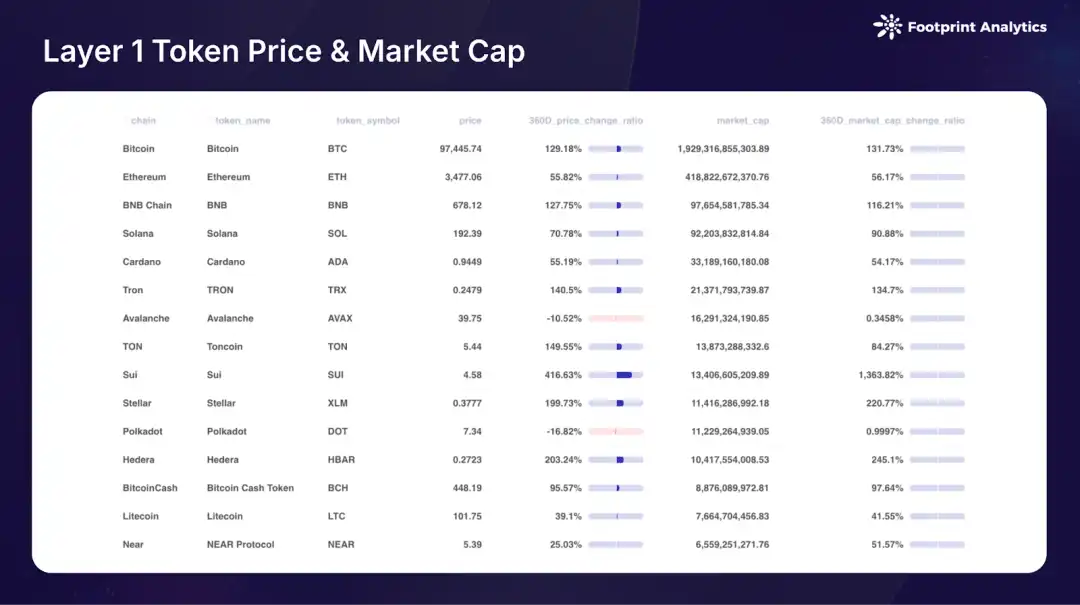
The total market capitalization of public chains grew by 105.3% to reach $28 trillion. Bitcoin's dominance rose to 69.8%, while Ethereum's share decreased from 20.4% to 15.2%. BNB Chain and Solana maintained their shares at 3.5% and 3.3%, respectively, with other platforms accounting for 8.1%.
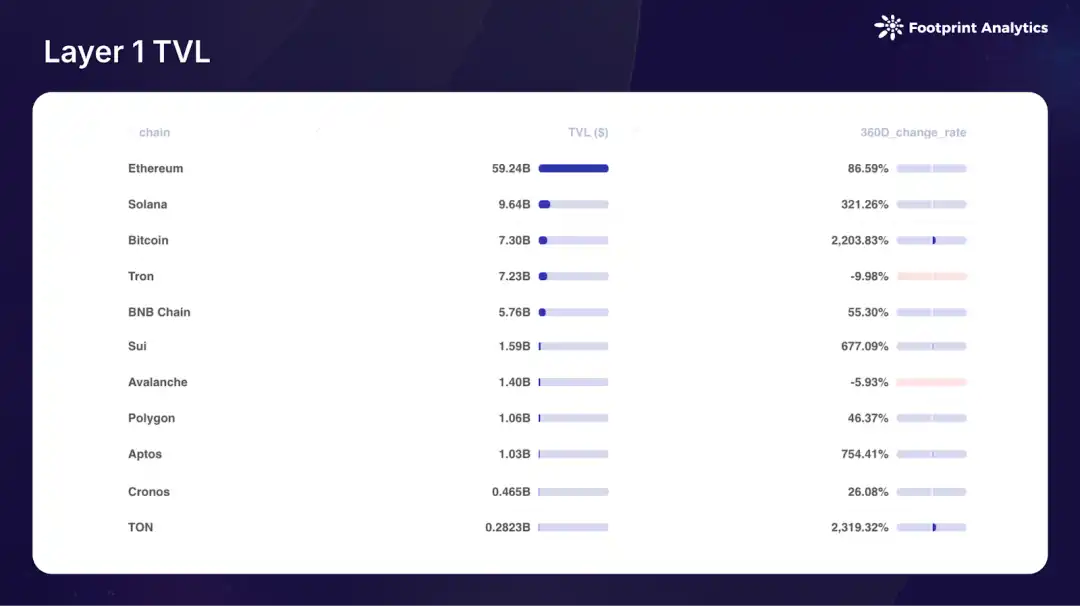
The DeFi sector also demonstrated strong growth momentum in 2024, with the total value locked (TVL) reaching $102.8 billion by the end of the year, an 88.6% year-on-year increase. Among the top 10 public chains by TVL, Bitcoin and TON showed the most significant growth, both exceeding 2,000%. Aptos, Sui, and Solana also performed well, with growth rates of 754.4%, 677.1%, and 321.3%, respectively. However, Tron and Avalanche saw decreases in their TVL.
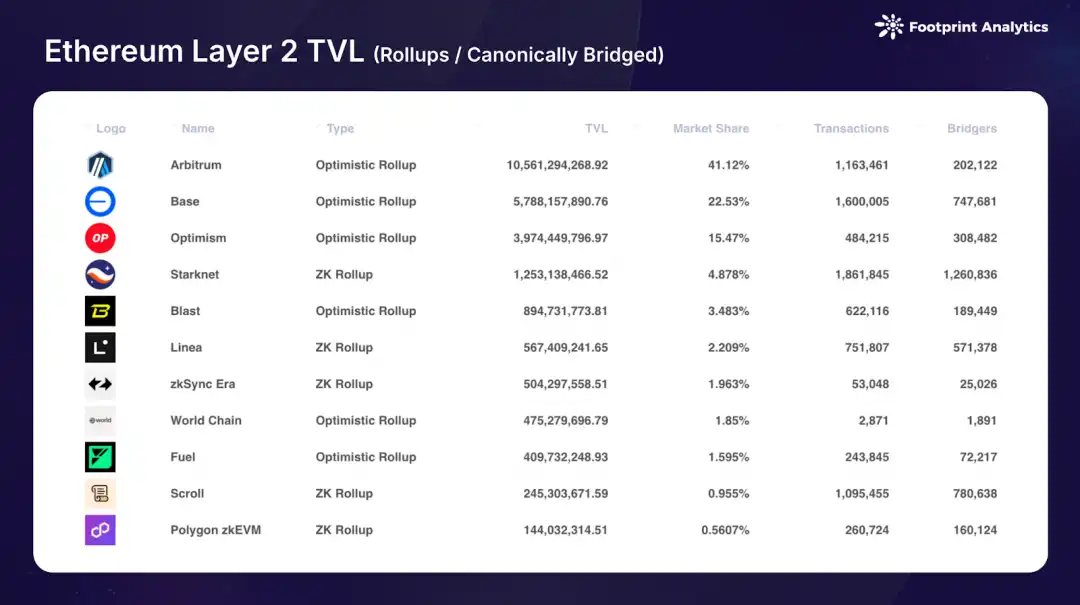
The Ethereum Layer 2 ecosystem experienced a noticeable trend of centralization in 2024. Arbitrum maintained its leading position with a TVL of $10.6 billion and a market share of 41.1%, a decrease from 50.8% in 2023. Base emerged as the dark horse of the year, ranking second with a $5.8 billion TVL (22.5% share), while Optimism ranked third with a $4 billion TVL (15.8%). These three platforms collectively held 79.1% of the Ethereum L2 DeFi TVL, with previous competitors such as Blast, zkSync, and Starknet experiencing a decline in market share.
Meanwhile, the ecosystem continues to expand, with currently 50 Rollups and 70 Validium & Optimium running on the mainnet, along with approximately 90 chains about to launch, bringing the total number of Ethereum L2 chains to over 200.
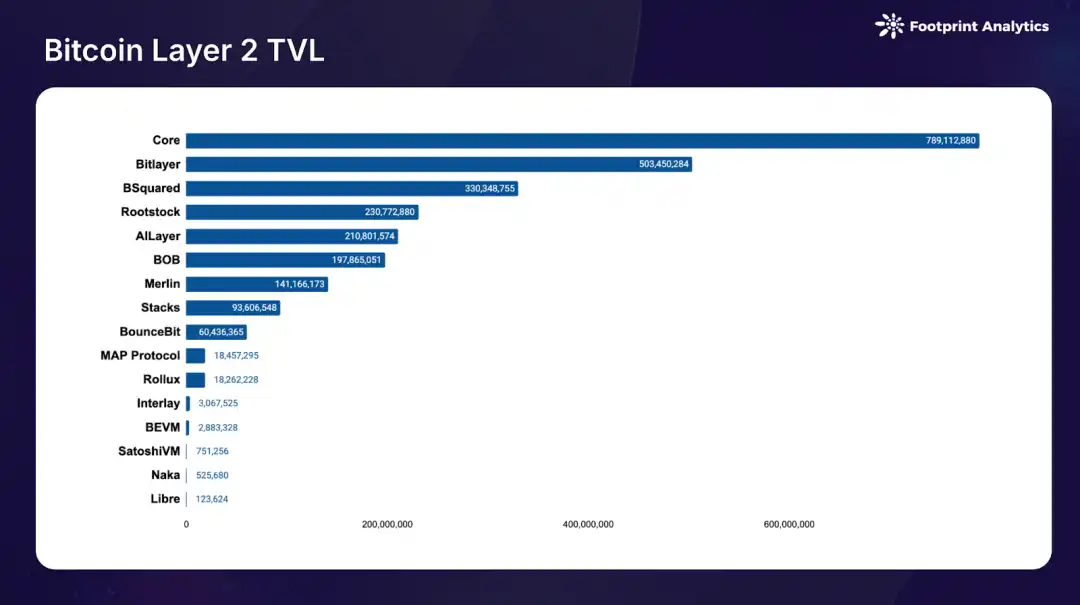
Bitcoin Layer 2 and sidechain ecosystems have experienced explosive growth, with a total locked value of $2.6 billion, representing a significant increase of 1,277.6% compared to 2023. Core leads with $0.79 billion TVL (30.3% market share), followed by Bitlayer ($0.50 billion, 19.4% share) and BSquared ($0.33 billion, 12.7% share). This growth is not only reflected in TVL but also in the number of active chains, which has more than doubled over the past year, reaching nearly 20 chains.
Competitive Landscape: Leaders and Challengers
In 2024, the competitive landscape of the public chain ecosystem underwent significant changes, characterized by Bitcoin's increased dominance, Solana's recovery, and the rise of emerging challengers.
Bitcoin: From Store of Value to Financial Infrastructure
In 2024, Bitcoin achieved remarkable growth, with a price increase of 129.2% and a market cap growth of 131.7%. This growth was primarily driven by institutional adoption of spot ETFs, the April halving event, and post-election positive sentiment in the United States. In addition to surpassing the $100,000 price milestone, the Bitcoin ecosystem saw two key developments:
Institutional Adoption Boost: The successful issuance of spot ETFs in January fundamentally changed the institutional access landscape, with BlackRock's product quickly reaching a $20 billion scale. Bitcoin surpassed silver and Saudi Aramco, becoming the seventh-largest global asset, marking a shift from a speculative asset to a recognized store of value.
BTCfi Emergence: The Bitcoin ecosystem expanded beyond price growth through innovative financial products. Babylon's Bitcoin staking project, Solv Protocol's cross-chain solution, and Core's Fusion upgrade all showcased a maturing ecosystem. Cross-chain functionality made progress through BOB Network's integration with Optimism and the BEVM's "Super Bitcoin" framework, although standardization still faces challenges.
Ethereum: Layer 2 Driving Ecosystem Evolution
2024 was a pivotal year for Ethereum's transformation into a Layer 2-centric ecosystem. Despite a 55.8% price increase to $3,744, Ethereum faced complex challenges of redefining its role and staying relevant amidst Layer 2 adoption growth. The successful launch of a spot ETF in July garnered some institutional acceptance, but Ethereum's price performance lagged significantly behind Bitcoin.
The Ethereum mainnet underwent the "Cancun Upgrade" to achieve significant changes, successfully reducing Layer 2 transaction costs and improving scalability. However, the shift in activity to Layer 2 led to a decrease in Ethereum's own transaction fee revenue, sparking discussions about Ethereum's long-term sustainability. The Ethereum Foundation responded through various measures, including implementing Proto-Danksharding (EIP-4844), developing cross-L2 communication standards, and strengthening security requirements for Layer 2 solutions.
The Layer 2 ecosystem demonstrated significant growth and integration throughout the year. Notable newcomers enriched the ecosystem, including World Chain, Uniswap's Unichain, and Sony's Soneium. This evolution highlighted Ethereum's transition from a pure execution layer to a diversified Layer 2 ecosystem of settlement and security providers. While questions around revenue models and competitive dynamics persist, Ethereum's ongoing development in developer activity and innovative scaling solutions showcased its adaptability.
Solana: The Third Giant
2024 witnessed Solana's strong comeback, with a 70.8% price increase and a 90.9% market cap growth. In November, the coin price broke $260, setting a new all-time high. This resurgence began with the January Jupiter airdrop, and Solana's ecosystem saw unprecedented activity. Solana established itself as a hub for retail trading, nurturing a vibrant meme and DeFi community. Beyond meme culture, Solana made advancements in various areas: re-staking protocols, modular Layer 2 solutions, and stablecoin innovation. The ecosystem's expansion through SVM chains like Eclipse, Soon, Atlas, and Sonic further extended its influence.
Rise of Emerging Powers: TON, Sui, and Base
TON: Social Integration-Driven Platform Growth
The Open Network (TON) showed significant growth in 2024, with the Toncoin price rising by 149.6% and market cap increasing by 84.3%. TON's success was primarily driven by its deep integration with Telegram, effectively bridging the gap between traditional social networks and blockchain technology. The platform simplified the crypto experience through Telegram wallet functionality and blockchain integration, providing easy access for millions of users to games, memes, and DeFi applications, establishing a model for mass adoption.
Sui: From Move Language Pioneer to Ecosystem Leader
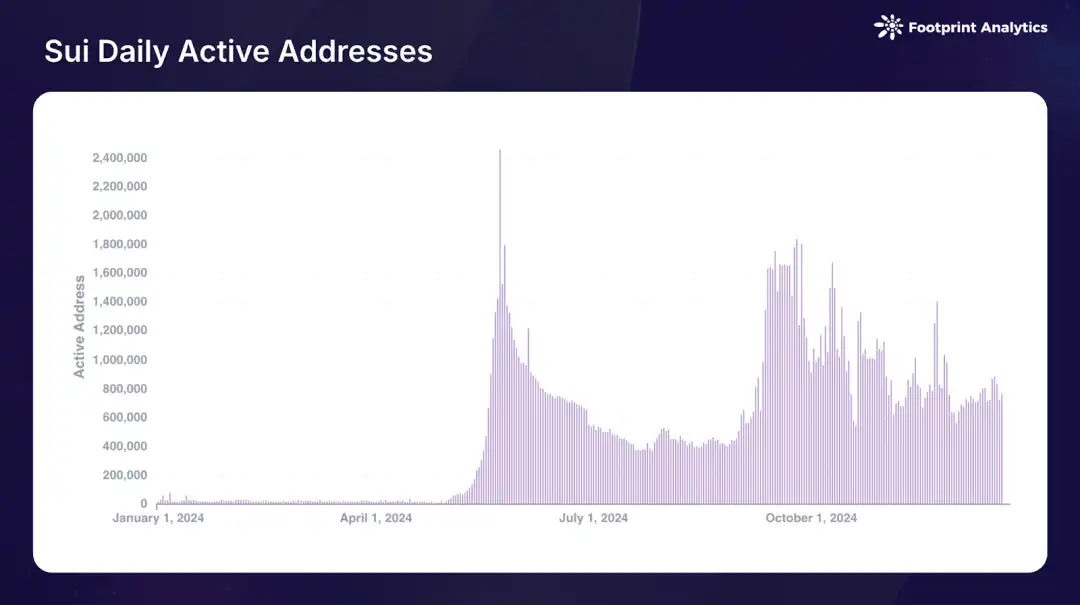
Sui demonstrated outstanding performance, with the token price skyrocketing by 461.6% and market cap increasing by 1,363.8%. This success reflects market confidence in Move language technology and ecosystem development. Sui focuses on the DeFi and gaming sectors, including Telegram game integration and innovative SuiPlay0X1 game console development, showcasing its comprehensive ecosystem growth strategy. The platform's emphasis on user experience and protocol development has created a positive network effect, attracting the participation of developers and users alike.
Base: Institutional Background Driving Rapid Growth
Base's significant growth was driven by several key factors. Coinbase notably lowered the entry barrier for mainstream users through its user-friendly smart wallet. The platform gained substantial momentum from successful social apps like friend.tech and Clanker, while the popularity of memecoins further boosted Base's on-chain activities. The implementation of the "Cancun Upgrade" significantly reduced transaction fees, enhancing Base's appeal to developers and users.
Key Trends in the 2024 Public Chain Industry
A Proliferation of New Chains
In 2024, many projects launched their own public chains. DeFi giant Uniswap announced Unichain; the gaming platform Treasure DAO developed a ZK-based Layer 2; the NFT sector saw the launch of Abstract by Pudgy Penguins; and the Web3 platform Galxe introduced Gravity. Furthermore, innovative new chains like Monad, Berachain, and HyperLiquid entering the scene reflect the public chain industry's shift towards specialized blockchain infrastructure.
Institutional Adoption: From Exploration to Strategic Integration
Institutional Engagement Transformation
2024 marks a decisive shift in institutional adoption from experimental blockchain initiatives to strategic implementation. Financial institutions are leading this transformation, with BlackRock's Bitcoin ETF quickly reaching a $20 billion scale, PayPal expanding PYUSD to Solana. Tech giants are demonstrating deeper engagement through innovative means: Sony launching the Soneum chain for entertainment applications, and Google Cloud expanding its Web3 gateway services. Infrastructure developments are particularly noteworthy, with Circle launching native USDC on Sui, and Visa integrating with Solana for settlements.
Institutional Investment Paradigm Shift
The public chain sector showed a strong recovery in 2024, with 174 funding events raising a total of $1.7 billion, a 137.1% increase from the previous year. It is worth noting that institutional investment strategies have shifted from pure infrastructure to application-driven innovation. Early-stage funding events accounted for 21.4% of total funding events, while Series A and Series B rounds accounted for 31.8%, reflecting a maturing ecosystem.
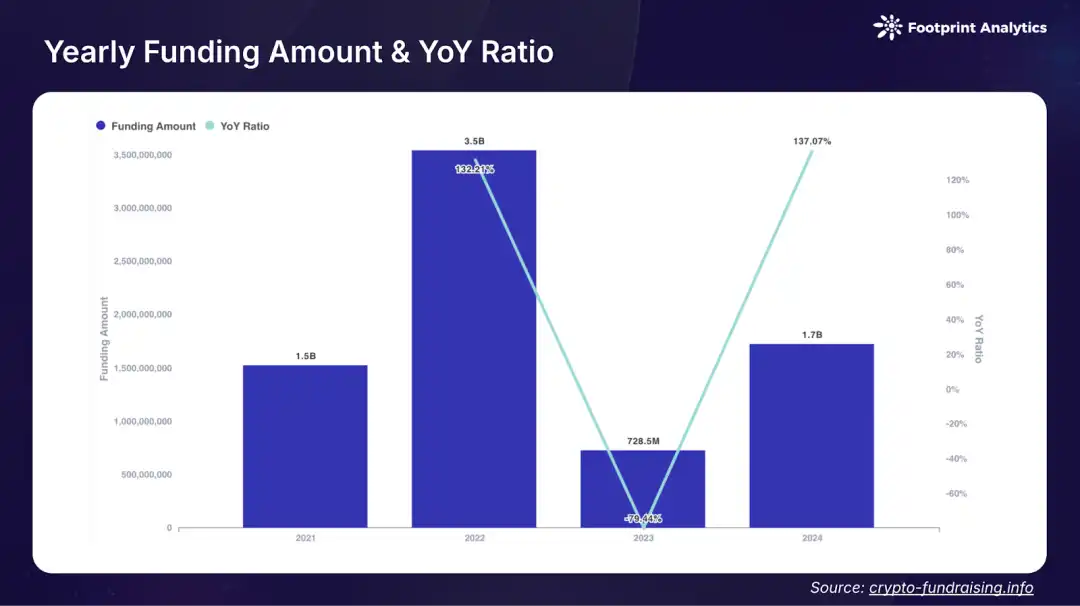
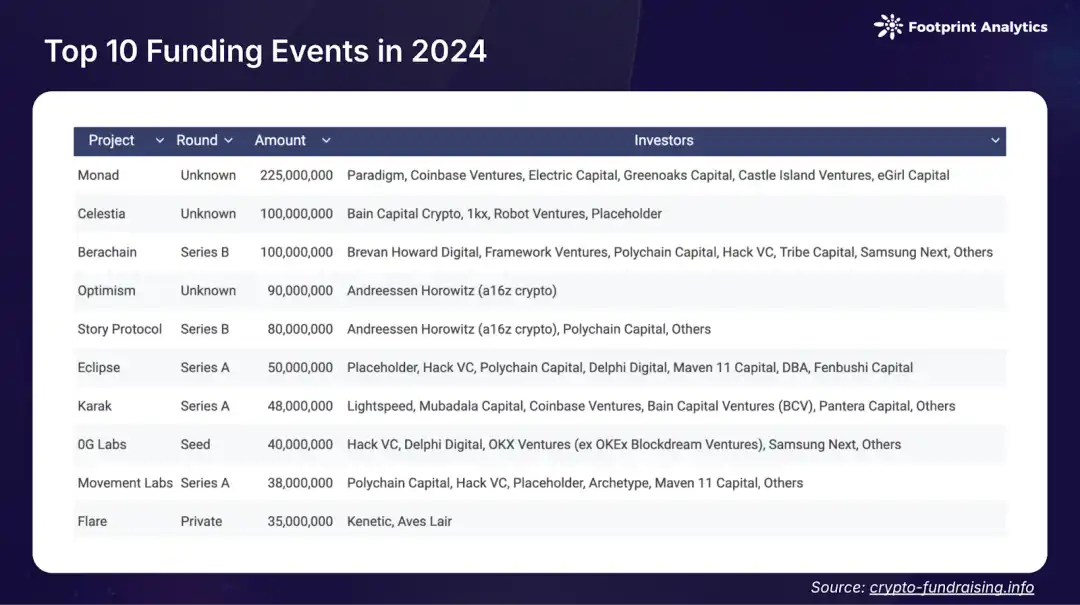
Venture capital investment philosophies have undergone a significant evolution, prioritizing user-facing applications over traditional infrastructure development. This is reflected in significant investments in consumer-facing projects: Monad raised $225 million to optimize user experience, while Celestia and Berachain each received $100 million for application-focused infrastructure.
From Technical Competition to Application Innovation
The public chain industry underwent a fundamental shift in 2024, moving from a technology-driven approach to an application-focused strategy. This transition challenged the previous industry mindset of "build it, and users will come" mentality. Despite significant advancements in technical capabilities, increased network capacity did not directly translate into corresponding user growth. For example, despite being "hardware-limited," Ethereum's base layer boasts a higher "user operations per second" (UOPS) than most Layer 2 solutions, highlighting the complex relationship between technical capabilities and actual adoption.
This reality has prompted the ecosystem to strategically pivot. Blockchain platforms are increasingly focused on identifying specific user needs and building targeted solutions rather than pursuing pure technological advancement. This "find users first, then build" approach is evident in several successful initiatives. Social finance integration has proven to be a particularly effective strategy, with TON's Telegram integration and Base's friend.tech showcasing how familiar social platforms can drive blockchain adoption. By simplifying user experience through account abstractions and familiar authentication methods, the barrier to entry for mainstream users has significantly decreased.
The evolution of meme culture in the blockchain space further exemplifies this shift towards application-oriented development. What initially started as purely speculative activity has evolved into an effective user acquisition channel, particularly on platforms like Solana and Base. These networks have successfully leveraged meme-driven initiatives to drive ecosystem growth while fostering sustainable community engagement. The success of these user-centric approaches indicates that sustainable growth in the blockchain space increasingly relies on understanding and serving user needs, rather than solely advancing technological capabilities.
Outlook for 2025
As the blockchain industry transitions from technical experimentation to practical implementation, 2025 is poised to be a pivotal year of transformation.
Regulatory Clarity
There is hope for a significant improvement in the regulatory landscape, especially in the United States. A more clear regulatory framework is expected to benefit the entire industry, particularly with advancements in stablecoin legislation. This regulatory clarity is expected to facilitate institutional blockchain adoption through the proliferation of regulated products and services, while fostering competition among jurisdictions in crypto regulation.
Public Chain Specialization
Public chain specialization has become a dominant trend, shifting from generalized Layer 1 competition to purpose-specific architectures. With the support of cross-chain infrastructure, application-specific chains and optimized execution environments will experience significant growth. The "Rollup as a Service" (RaaS) sector is poised to expand, offering enterprises and projects more convenient custom blockchain solutions.
Technological Innovation and AI Integration
In 2025, technological innovation will transition from mere breakthroughs to application-oriented infrastructure upgrades. The implementation of Proto-Danksharding will double Blob capacity, propelling Layer 2 scalability into a new phase; the development of chain abstraction technology will bring about a more intuitive user experience; standardized cross-chain communication will streamline interoperability.
At the infrastructure level, we anticipate seeing more development being driven by practical needs. A modular blockchain technology stack will mature, providing specialized solutions for data availability, settlement, and execution layers. Notably, the deep integration of AI technology with blockchain will reshape the infrastructure landscape: from enhancing user interfaces to realizing complex on-chain AI agents, from decentralized model training to supporting social finance integration, these innovations will underpin more sophisticated applications while maintaining security and decentralization, laying a solid foundation for the next wave of blockchain innovation.
Conclusion
The past year has demonstrated that sustainable growth relies not only on technological capabilities but also on meaningful user adoption and practical utility. With increasing regulatory clarity, advancements in technical infrastructure, and growing institutional involvement, the foundation for blockchain technology to achieve meaningful large-scale adoption is now in place. The focus has shifted from "what's technically possible" to "what's practically valuable," defining the next stage of industry growth in 2025.
You may also like

WEEX Labs Lands at Dutch Blockchain Week: A Disruptive Crypto × AI Conversation Sets Sail in Amsterdam

SK Hynix Reportedly Plans U.S. ADR Listing as Early as August, With SEC Approval Possible in Late June
SK Hynix may pursue a U.S. ADR listing as early as August, with SEC approval reportedly possible in late June amid strong AI chip supply chain demand.

SpaceX vs Tesla vs xAI: Which Elon Musk Trade Has the Biggest Upside in 2026?

OpenAI Reveals It Has Confidentially Submitted an S-1 to the SEC, Keeping the Door Open for a Future IPO
On June 9, according to an OpenAI announcement, the company recently confidentially submitted a draft S-1 registration statement to the U.S. Securities and Exchange Commission (SEC), beginning the preliminary compliance process for a potential initial public offering. OpenAI said it chose to disclose this proactively because it expected the news might leak; however, the company has not yet set a specific listing timeline, and related arrangements may still take some time.

Latest research from 13 top universities including Cornell University: The current state, challenges, and misconceptions of the fusion of Crypto and AI
Deconstructing Anthropic: The Best AI Company, Possibly Also a Type of Organizational Invention
Apollo and Blackstone Reportedly Back $35 Billion Anthropic Chip Financing as Deal Details Remain Unclear
On June 9, according to currently available news alerts, Apollo and Blackstone Group participated in a $35 billion financing for an Anthropic “chip project.” Based on the original wording of the report, the funding has already been raised, but public information remains limited. The financing structure, use of proceeds, project entity, and whether Apollo and Blackstone participated through equity, debt, or project financing have not yet been disclosed.

Humanity Protocol Security Incident Escalates: More Than $31 Million Stolen From Related Addresses as Attacker Continues Selling H for ETH
On June 9, according to monitoring by Onchain Lens, more than $31 million has been stolen from addresses linked to Humanity Protocol, and the attack is still ongoing, with the hacker continuously swapping H tokens for ETH. Project founder Terence Kwok later confirmed the security incident on X, saying the issue involved a private key leak.

Bloomberg: As Bitcoin Weakens, Stablecoins and RWA Continue to Drive Expansion in Crypto Businesses
In June, Bloomberg reported that despite Bitcoin falling below $60,000 last week, wiping out about $235 billion in market value within seven days, and dropping close to 50% from last year’s peak, some core businesses in the crypto industry are still expanding, mainly in stablecoins, real-world asset tokenization (RWA), payments, and infrastructure. The report also noted that overall altcoin activity has contracted significantly: altcoin market capitalization has fallen from a peak of about $431 billion in November 2021 to around $170 billion, and among the tens of millions of tokens issued in recent years, fewer than 1,700 still maintain meaningful trading activity.

Galaxy Deep Research Report: How Hyperliquid's HIP-4 Upgrade Changes the Landscape of Prediction Markets?
Binance Research: RWA Market Expected to Expand Nearly 6x from Early 2025, with Public Equities and Onchain Payments Heating Up Together
In June, Binance Research said in its monthly market report that the real-world asset (RWA) market is expected to grow by about 589% from the beginning of 2025. Bond- and money market fund-related RWA expanded by about $6.5 billion, up 83% year over year, while publicly traded equity RWAs grew by about 422%. The report also noted that monthly crypto debit card transaction volume exceeded $747 million in May, up 48.6% year to date.

Japan to Assess a Framework for Yen Stablecoins and Crypto ETFs as Asia’s Compliant Payments Narrative Heats Up
Recently, according to the original report, Japan is considering the launch of yen stablecoins and cryptocurrency ETFs. Public information remains limited at this stage, and there is still no complete policy text, regulatory draft, or clear implementation timeline, so this is better characterized as a “policy discussion” rather than formal implementation. The original wording also noted that advancing stablecoin regulation in Asia is driving XRP usage and supporting growth in the XRPL ecosystem. However, based on currently available public information, there is not enough evidence to directly establish a clear causal relationship between this round of discussion in Japan and XRP or XRPL.

ZachXBT: Humanity private key leak and abnormal surge in H token should be viewed separately
On June 9, according to related disclosures, on-chain investigator ZachXBT posted an update on Humanity’s roughly $31 million security incident, saying that after further analyzing fund flows, he currently tends to believe the project team was not involved in an “inside job” or a self-staged attack. According to him, the official explanation about the private key leak was broadly accurate, but before the token unlock, the price of H had been artificially pushed higher, and the hacker later took advantage of that market environment; therefore, the private key leak and the earlier abnormal price pumping should be regarded as two separate and independent events. This reframing has shifted the market’s understanding of the nature of the incident. Earlier discussion around Humanity had focused on whether the team directly participated in the attack or used the security incident to cover up internal operations. ZachXBT’s latest remarks shift the focus from “whether it was self-theft” to “whether there were pre-unlock market structure issues.” He also questioned whether the team may have.

Morning Report | OpenAI has submitted an S-1 registration statement draft to the U.S. SEC; Morpho completes $175 million financing

Morning Report | BitMine increased its holdings by 126,971 ETH last week; trader Eugene announced his exit from the crypto market

Wang Chuan: How can one not feel anxious after the neighbor Old Wang made thirty times profit by investing in storage stocks? (Seven) - A quarter-century cycle
Cryptocurrency CEXs are flocking to sell US stocks, and traditional brokerages are facing an "uninvited guest."
$75 billion in foreign capital has fled, and South Korean retail investors have absorbed it all using leverage
WEEX Labs Lands at Dutch Blockchain Week: A Disruptive Crypto × AI Conversation Sets Sail in Amsterdam
SK Hynix Reportedly Plans U.S. ADR Listing as Early as August, With SEC Approval Possible in Late June
SK Hynix may pursue a U.S. ADR listing as early as August, with SEC approval reportedly possible in late June amid strong AI chip supply chain demand.
SpaceX vs Tesla vs xAI: Which Elon Musk Trade Has the Biggest Upside in 2026?
OpenAI Reveals It Has Confidentially Submitted an S-1 to the SEC, Keeping the Door Open for a Future IPO
On June 9, according to an OpenAI announcement, the company recently confidentially submitted a draft S-1 registration statement to the U.S. Securities and Exchange Commission (SEC), beginning the preliminary compliance process for a potential initial public offering. OpenAI said it chose to disclose this proactively because it expected the news might leak; however, the company has not yet set a specific listing timeline, and related arrangements may still take some time.
Latest research from 13 top universities including Cornell University: The current state, challenges, and misconceptions of the fusion of Crypto and AI
Deconstructing Anthropic: The Best AI Company, Possibly Also a Type of Organizational Invention


