
How to Go Long in Futures: WEEX Guide 2026


Going long is the first thing most traders learn.
Buy low. Sell high. That is the dream.
But in futures trading, going long works differently than spot. Leverage changes everything. Funding costs appear. Liquidation becomes real.
This guide shows exactly how to go long on WEEX futures, what to check before clicking buy, and how to avoid the mistakes that wipe out new traders.
What Does "Go Long" Mean in Futures Trading?
Going long means opening a futures position that profits when the asset price rises.
Simple example:
A trader goes long on BTC at 80,000.Pricerisesto80,000.Pricerisesto85,000. The trader profits $5,000 per BTC (minus fees and funding).
Same trader goes long at 80,000.Pricedropsto80,000.Pricedropsto75,000. The trader loses $5,000.
td {white-space:nowrap;border:0.5pt solid #dee0e3;font-size:10pt;font-style:normal;font-weight:normal;vertical-align:middle;word-break:normal;word-wrap:normal;}
Position | Price Goes Up | Price Goes Down |
Long (buy) | Profit | Loss |
Short (sell) | Loss | Profit |
Futures trading allows leverage. A trader does not need to put up full value. But leverage amplifies both gains and losses.
Why Go Long Instead of Just Buying Spot?
Reason 1 – Leverage multiplies returns
Spot trading: 1,000buys1,000buys1,000 of BTC. Price rises 10%. Trader makes $100.
Futures with 10x leverage: 1,000margincontrols1,000margincontrols10,000 of BTC. Same 10% rise makes $1,000. That is 100% return on margin.
Same leverage works against the trader if price drops.
Reason 2 – No need to hold the asset
A spot buyer must hold actual Bitcoin. A futures long position only requires margin. No wallet setup. No custody concerns.
Reason 3 – Access to more markets
WEEX futures offer longs on BTC, ETH, SOL, and dozens of other pairs. Spot trading may have fewer options or lower liquidity.
How to Go Long on WEEX: Step-by-Step Guide
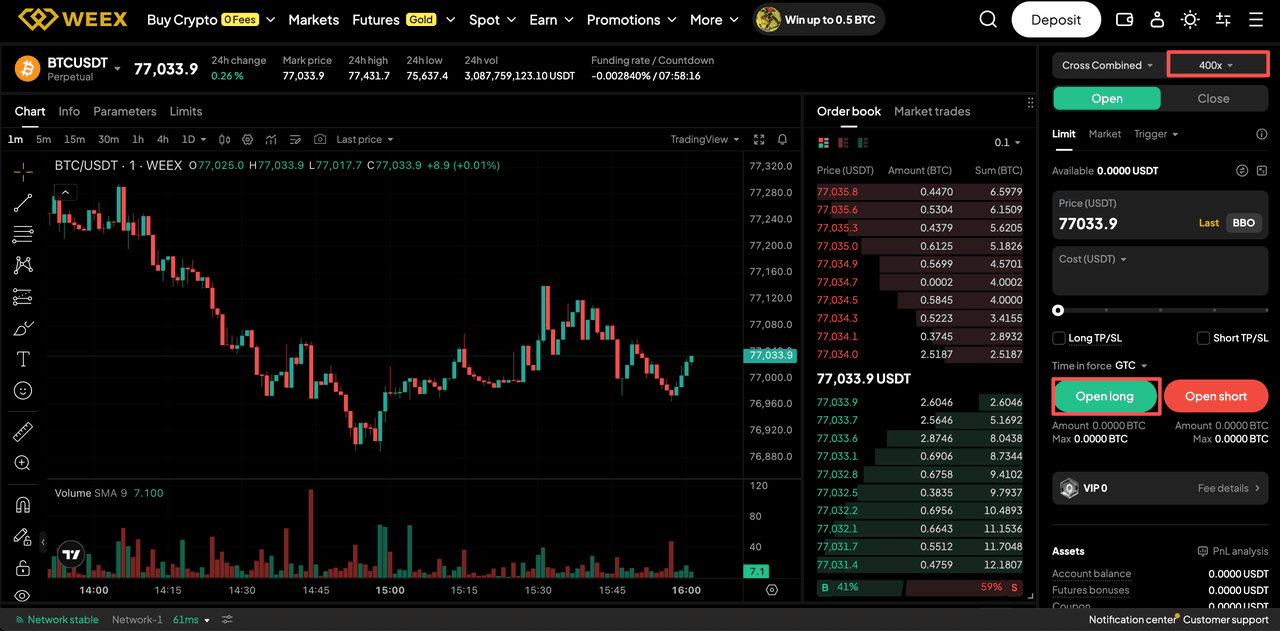
WEEX offers futures trading with up to 400x leverage on select markets. The following steps work for both web and mobile.
1. Navigate to Weex futures trading page
2. Select the trading pair (BTC, ETH, SOL, etc.)
3. Set leverage using the leverage selector
4. Choose order type: Limit or Market
5. Enter position size or margin amount
6. Set take-profit or stop-loss in the order panel
7. Click Open Long to open the position
8. Confirm order details and submit
What to Check Before Confirming a Long Position
Before clicking Buy / Long, a trader should review five things.
- Leverage setting and liquidation price
Higher leverage means lower liquidation distance. At 100x leverage, a 1% move against the position wipes it out.
- Stop-loss level
The stop-loss defines maximum acceptable loss. Without one, a trader relies on hope. Hope does not work in futures trading.
- Current funding rate
If funding rate is positive, long positions pay shorts every 8 hours. Holding through multiple funding intervals adds cost.
- Available margin and margin mode
Cross margin uses all available balance. Isolated margin limits risk to the specific position. Beginners should use isolated margin.
- Position size relative to account size
A single position should not risk more than 1-2% of total account value. That is a common rule among professional traders.
Common Mistakes When Going Long on Futures
No stop-loss
The most expensive mistake in futures trading. A trader who does not set a stop-loss will eventually lose everything.
Over-leveraging
400x leverage sounds exciting. It also means a 0.25% move against the position causes liquidation. Most traders should use 2x to 10x, not 400x.
Ignoring funding rates
Positive funding means long positions pay. Holding for days without checking funding costs can turn a winning trade into a loser.
No take-profit
Greed kills trades. A take-profit locks in gains. Without one, a trader watches price rise, then fall, then rise again, then lose everything.
Long vs Short: Which Strategy Fits?
Factor | Going Long | Going Short |
Market direction | Bullish | Bearish |
Natural feeling | Comfortable | Uncomfortable for most |
Max loss | Limited to margin | Theoretically unlimited |
Funding impact | Pays if positive | Pays if negative |
Best for | Uptrends, breakouts | Downtrends, overbought conditions |
Most beginners start with long positions. That makes sense. Going long feels natural. But a trader who only knows longs misses half the market.
How WEEX Futures Compare to Other Platforms
Feature | WEEX | Typical Competitors |
Maximum leverage | Up to 400x | Often 50x-100x |
Fees | Competitive | Varies widely |
Markets | 100+ futures pairs | Usually fewer |
Execution | Instant | Varies |
The main difference for most traders is leverage range. WEEX offers higher maximum leverage. That does not mean a trader should use it. But the option exists.
Conclusion
Going long on futures is simple in concept: profit when price rises. But the details matter. Leverage kills unprepared traders. Funding costs add up. Liquidation happens fast.
A trader who uses stop-losses, starts with low leverage, and checks funding rates has a real advantage over most retail traders.
Ready to trade? WEEX gives you up to 400x leverage, zero fees, instant execution, and the security you need. Sign up now and start trading!
FAQ
What does going long mean in crypto futures?
Going long means opening a futures position that profits when the price of an asset rises.
How does a trader go long on WEEX?
Select the market, set leverage, choose order type, enter position size, set TP/SL, and click Buy/Long.
What leverage can be used on WEEX futures?
WEEX offers up to 400x leverage on select markets. Lower leverage is recommended for beginners.
How do I manage risk when trading long or short?
Use stop-loss orders, size your trades conservatively, and follow a defined risk-to-reward ratio. Monitoring volatility and avoiding overtrading are also key to staying in control.
How does a trader avoid liquidation when going long?
Set a stop-loss below entry. Avoid over-leveraging. Use isolated margin mode.
You may also like

How to Buy Cryptocurrency on WEEX Exchange 2026: Full Guide
Prediction Market Apps 2026: How Prediction Markets Work? Are They Safe and Legal?
Is Polymarket Legal in India in 2026? Key Legal Updates on Prediction Markets
14 Best Prediction Market Apps in 2026: The Ultimate Guide to Crypto-Native and Regulated Platforms
Can Politicians Rig Election Prediction Markets? The Dark Side of Election Prediction Markets
2026 US Election Odds: Who Leads Right Now on Polymarket and Kalshi?
What Is a Crypto Prediction Market? Key Opportunities in the Prediction Market Sector
Plot twist in the AI race—the next big flex is actually physical infra?
How to Profit on Prediction Market: A Beginner's Guide to Prediction Market
Decentralized Prediction Market: A Beginner's Guide for WEEX Users
Kalshi Prediction Market Explained: How It Works and Who Can Use It
What Is WXT Used For? A Beginner's Guide to WEEX Token Utility
Top Prediction Market Websites in 2026: Which Platform Is Best for You?
How to Start Spot Trading on WEEX: No Leverage, No Liquidation Risk
What Is a Prediction Market Platform? How It Works and Key Risks
Can You Make Money on Prediction Markets? Risks and Strategies
Is a Prediction Market Just Gambling? How It Works and Key Risks
What Are the Most Popular Prediction Market Platforms in 2026?
How to Buy Cryptocurrency on WEEX Exchange 2026: Full Guide
Prediction Market Apps 2026: How Prediction Markets Work? Are They Safe and Legal?
Is Polymarket Legal in India in 2026? Key Legal Updates on Prediction Markets
14 Best Prediction Market Apps in 2026: The Ultimate Guide to Crypto-Native and Regulated Platforms
Can Politicians Rig Election Prediction Markets? The Dark Side of Election Prediction Markets
2026 US Election Odds: Who Leads Right Now on Polymarket and Kalshi?
Contents
Popular coins


